
 fufufafa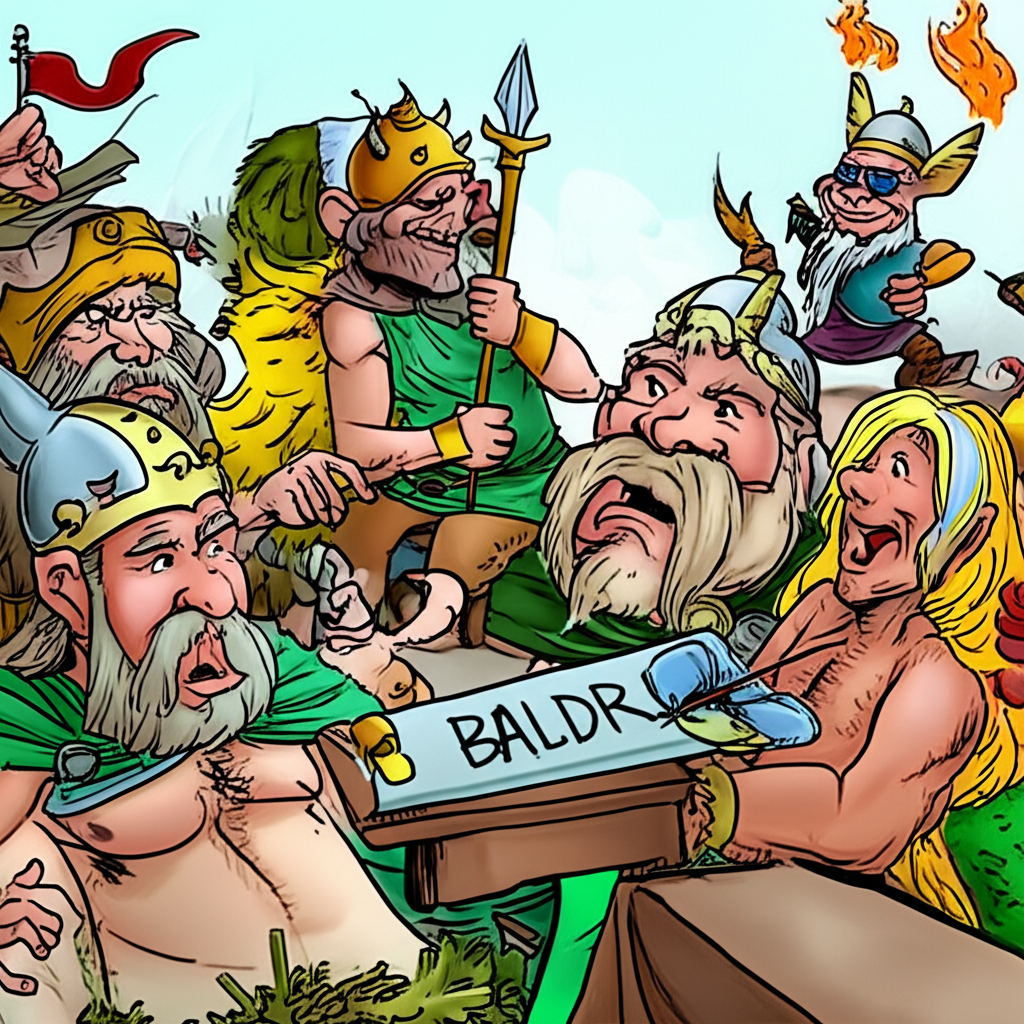
The vibrant tapestry of ancient Norse mythology, woven from the threads of oral tradition and later immortalized in the Icelandic Eddas, offers a profound glimpse into the worldview of the Germanic peoples of pre-Christian Scandinavia. Among its most poignant and pivotal narratives is the tragic tale of the Death of Baldr, a story that echoes with themes of fragility, betrayal, and the inexorable march of fate. This traditional legend, recounted by ancient seers and poets, serves not as a guide for belief or worship, but as a rich cultural artifact, illuminating the fears, hopes, and philosophical understandings of a people intimately connected to the cycles of nature and the mysteries of existence.
Origins and Cultural Background: Echoes from the Viking Age
The myth of Baldr’s demise emerged from a cultural landscape shaped by the harsh realities and robust spirit of the Viking Age (roughly 8th to 11th centuries CE). In this era, societies across Scandinavia were characterized by seafaring exploration, skilled craftsmanship, complex social structures, and a rich oral tradition. Their world, as reflected in their myths, was a dynamic interplay between order and chaos, light and darkness, creation and destruction. They envisioned a cosmos comprised of nine interconnected realms, bridged by the shimmering arc of Bifrost, the rainbow bridge that connected Midgard (the human world) to Asgard (the realm of the Aesir gods).
For these ancient peoples, the world was alive with unseen forces—gods, giants, elves, and dwarves—each playing a role in the grand cosmic drama. Life was often perilous, and the concept of wyrd (fate) was deeply ingrained, suggesting that even the gods themselves were subject to a preordained destiny, culminating in the cataclysmic event of Ragnarök, the twilight of the gods. Amidst this backdrop, stories like Baldr’s death served to explain the inexplicable, to imbue the natural world with meaning, and to explore universal human experiences such as loss, grief, and the consequences of malevolence. They viewed the world as a place of cyclical renewal, but also of inevitable decay, where even the purest light could be extinguished, signaling a profound shift in the cosmic balance.
Characters and Cosmic Roles: Figures of Light and Shadow
At the heart of this somber narrative stand several key figures, each embodying distinct symbolic attributes within the Norse pantheon.
Baldr, son of Odin and Frigg, was perhaps the most beloved of all the Aesir. He was the radiant god of light, purity, beauty, joy, and innocence. His presence brought warmth and serenity to Asgard, and his very being was synonymous with the goodness and splendor of creation. Baldr’s symbolic attributes are clear: he represents the golden age, the ideal state of harmony and unsullied virtue. His death is not merely the loss of a god, but the fading of an age, a darkening of the world.
Loki, the trickster god, provides the starkest contrast to Baldr. A complex and often contradictory figure, Loki is a being of cunning intellect, shapeshifting ability, and a penchant for mischief that often escalates into outright malice. He is the catalyst for disorder, the embodiment of chaos and destructive envy. Loki’s actions in this myth highlight the pervasive presence of disorder and the fragility of even the most robust order when confronted with deliberate subversion.
Frigg, the wise and loving mother goddess, wife of Odin, is a figure of immense maternal power and sorrow. She knows many fates but is ultimately powerless to avert the most painful of them. Her actions are driven by profound love for her son, a love that attempts to defy fate itself, even if only temporarily.
Hoder, Baldr’s blind brother, serves as a tragic instrument of fate. He is an innocent, unwitting participant in the cosmic tragedy, his blindness symbolizing a lack of foresight or understanding, making him vulnerable to manipulation.
Finally, Mistilteinn, the humble mistletoe, plays a crucial, ironic role. Seemingly innocuous and insignificant, it becomes the singular vulnerability in Baldr’s otherwise impenetrable shield. It symbolizes how even the smallest, most overlooked element can contain the power to unravel the greatest strengths.
The Main Story: The Shadow of Grief Over Bifrost
The tale begins with a creeping dread. Baldr, the shining god, began to be tormented by terrible dreams—visions of his own death, a darkness consuming his radiant form. Deeply troubled, he confided in his mother, Frigg, and his father, Odin. Odin, ever seeking knowledge, rode his eight-legged steed, Sleipnir, down to the misty realm of Hel to consult a Völva, a prophetess, whose grim prophecies confirmed Baldr’s impending doom.
Determined to protect her beloved son, Frigg embarked on an extraordinary quest. She traveled throughout the nine realms, extracting solemn oaths from every living thing and every inanimate object—from fire and water, iron and all metals, stones, earth, trees, diseases, beasts, birds, venom, and even the smallest blades of grass—all swore never to harm Baldr. Such was the love and respect for Baldr that none refused. Frigg returned to Asgard believing her son was now invulnerable.
Rejoicing in Baldr’s apparent safety, the gods invented a new sport. Gathering in the great halls, they would hurl axes, stones, and spears at Baldr, watching with delight as the weapons harmlessly bounced off him. Baldr stood radiant and unharmed, a testament to his mother’s tireless efforts.
Yet, this spectacle stirred a dark envy in Loki’s heart. Disguising himself as an old woman, Loki approached Frigg and cunningly inquired about Baldr’s invulnerability. Frigg, in her pride and relief, revealed a small detail: "There is just one thing, a small shrub, called mistletoe, that grows to the west of Valhalla. I did not ask an oath from it, for I thought it too young and insignificant to cause any harm."
A sinister plan ignited in Loki’s mind. He immediately sought out the mistletoe, plucked it, and fashioned it into a small, sharp dart. Returning to the gods’ gathering, he found Hoder, Baldr’s blind brother, standing apart, unable to participate in the sport. Loki approached him, his voice dripping with false sympathy. "Why do you not join in, Hoder?" he asked. Hoder replied that he could not see where to aim and had no weapon. "Fear not," Loki purred, "I shall guide your hand and give you something to throw."
Loki placed the mistletoe dart into Hoder’s hand, guided his arm, and directed him to throw it towards Baldr. The moment the seemingly harmless mistletoe struck Baldr, the laughter died. Baldr staggered, a sudden pallor replacing his usual radiance, and fell to the ground, lifeless. A profound silence descended upon Asgard, broken only by the gods’ collective gasp of horror and then their inconsolable wails of grief. The light of Asgard dimmed, and a terrible shadow fell over the realms.
Odin, heartbroken, dispatched his son Hermod to Hel, the underworld, to plead for Baldr’s return. Hel, the formidable ruler of the dead, agreed to release Baldr on one condition: every single thing in the nine realms, living and dead, must weep for him. Messengers were sent throughout the cosmos, and indeed, all wept for Baldr—humans, gods, giants, animals, stones, and trees. The world wept tears that flowed like rain.
But as the messengers returned, they found one lone giantess, named Thokk, dwelling in a cave. When asked to weep for Baldr, she sneered, "Thokk will weep dry tears for Baldr. Let Hel keep what she has!" It was Loki, once again in disguise, who refused to weep, thereby sealing Baldr’s fate. Baldr remained in Hel, and the darkness that had fallen upon Asgard grew deeper, a clear sign that the world was now closer to the twilight of the gods.
Symbolism and Meaning: A Mirror to Ancient Concerns
The myth of Baldr’s death is laden with profound symbolism that would have resonated deeply with the ancient Norse. Baldr himself, as the god of light and purity, represents the inherent goodness and order of the cosmos. His death symbolizes the tragic loss of innocence, the vulnerability of even the most perfect creation to the forces of malevolence and betrayal. It signifies a profound shift in the cosmic balance, marking the beginning of the end of the current world order, a prelude to Ragnarök.
Loki, as the orchestrator of this tragedy, embodies the disruptive force of chaos, envy, and cunning. He represents the destructive potential that lies within any system, the flaw that can unravel even the most carefully constructed peace. His actions highlight the ancient understanding that internal strife and betrayal can be far more devastating than external threats.
The mistletoe, the seemingly insignificant detail that Frigg overlooked, is a powerful symbol of the overlooked vulnerability, the small flaw in an otherwise perfect defense. It teaches a lesson about the unpredictability of fate and how even the most minor elements can hold immense power to disrupt. Hoder, the blind god, represents the tragic consequences of unwitting participation, the idea that even without malicious intent, one can be a tool of destruction.
Frigg’s desperate quest for oaths speaks to the universal theme of parental love and the human desire to defy fate, even when it is predetermined. Her ultimate failure underscores the Norse belief in the inexorable nature of wyrd, a destiny that even the most powerful gods could not escape. The collective weeping of the world for Baldr, and the single refusal of Thokk (Loki), further emphasize the concept of universal grief and the devastating impact of a single act of malice in an otherwise sympathetic world. The "Songs of Bifrost" in this context can be seen as the unfolding narrative carried across the realms, the mournful echoes of a cosmos forever changed by this singular, tragic event.
Modern Perspective: Enduring Echoes in Contemporary Culture
Centuries after its initial telling, the myth of Baldr’s death continues to resonate, albeit in new forms and contexts. In modern literature, particularly in fantasy novels like Neil Gaiman’s American Gods, Norse mythology and its characters are reinterpreted, exploring themes of faith, identity, and the clash between ancient beliefs and the contemporary world. Baldr, Loki, and the shadow of Ragnarök frequently appear in these narratives, offering rich allegorical possibilities.
In cinema and television, the Marvel Cinematic Universe’s depiction of the Asgardian gods, while highly adapted, draws heavily from Norse lore, popularizing figures like Thor and Loki and introducing audiences to the concept of the realms and their impending doom. While Baldr’s story isn’t a central focus in the MCU, the themes of fratricide, betrayal, and the unraveling of a golden age are prominent.
Video games, especially titles like God of War (2018) and Assassin’s Creed Valhalla, have extensively explored Norse mythology, often placing players directly into narratives that feature Baldr, his invulnerability, and his eventual demise. These games provide immersive, interactive experiences that bring the ancient stories to life, allowing players to witness or even participate in the dramatic events of the myths, reinterpreting them for a new generation.
Academically, Baldr’s myth is a subject of intense study in cultural history, comparative mythology, and religious studies. Scholars analyze its structural similarities to other dying-god myths, its psychological archetypes, and its role in understanding pre-Christian Germanic worldviews. The story serves as a valuable lens through which to examine ancient peoples’ understanding of good versus evil, fate versus free will, and the cyclical nature of existence. It is consistently presented as a narrative of cultural heritage, not as a system of belief to be adopted.
Conclusion: A Legacy of Storytelling
The Death of Baldr, woven into the "Songs of Bifrost," stands as a powerful testament to the enduring human capacity for storytelling. It is a profound narrative from Norse mythology, born of the imagination and cultural experiences of ancient peoples, offering insights into their worldview, values, and fears. It is crucial to reiterate that this is a traditional story, a piece of cultural and historical heritage, and not a belief system to be practiced or worshipped.
As Muslims, we recognize that only Allah is the true Creator and Sustainer, and all power and divinity belong solely to Him. The stories of ancient mythologies, while rich in human creativity and cultural significance, are understood as products of human imagination and interpretation of the world around them, distinct from divine revelation. Yet, they serve a vital purpose in enriching our understanding of human history, diverse cultural expressions, and the universal themes that resonate across time and civilizations. The legacy of Baldr’s death, as recounted through the ages, continues to inspire reflection on the fragility of goodness, the consequences of malice, and the timeless power of narrative to explore the profound mysteries of existence.


