
 fufufafa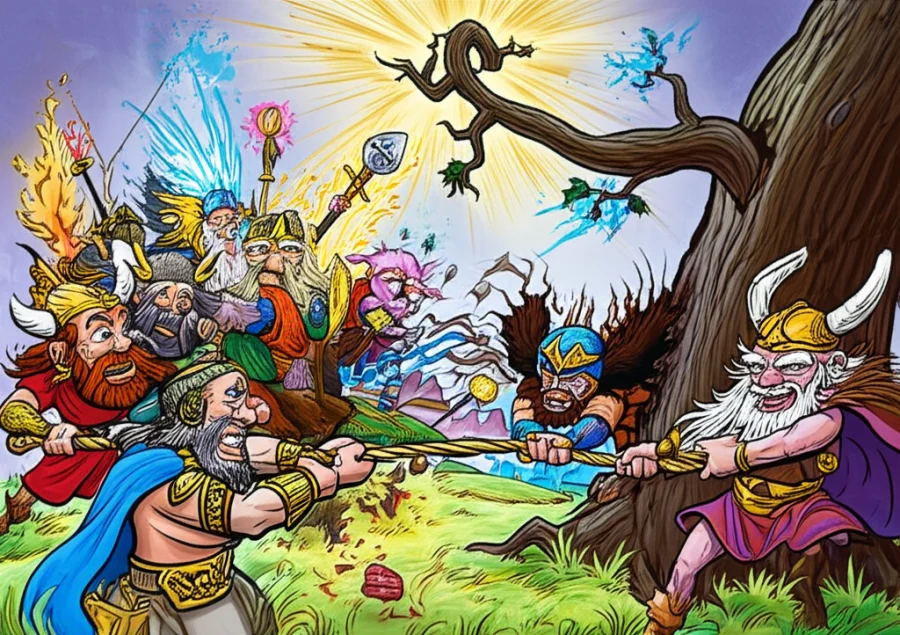
The crisp, windswept landscapes of Scandinavia, dotted with ancient forests and the formidable fjords, are the cradle of a rich tapestry of myths and legends. Among these, the stories of the Norse gods and their epic sagas hold a prominent place. These tales, passed down through generations via oral tradition and later inscribed in ancient texts like the Poetic Edda and the Prose Edda, offer a window into the worldview of the early Germanic peoples. They were stories told around flickering fires, shaping their understanding of the world, the forces of nature, and the very fabric of existence. Today, we explore one such powerful narrative: the Aesir–Vanir War, and its enigmatic connection to the World Tree, Yggdrasil.
This is a traditional story, a product of ancient imagination, not a historical account or a doctrine to be followed. It is a testament to the human need to explain the inexplicable, to weave narratives that imbue the world with meaning and drama.
Roots in a World of Cycles and Spirits
The myths of the Aesir and Vanir emerged from a society deeply intertwined with the natural world. The harsh, unpredictable environment of Scandinavia fostered a profound respect, and often a healthy fear, of the elements. Life was a constant cycle of birth, growth, death, and rebirth, mirrored in the changing seasons. The people of this era likely viewed the world as animated by various spirits and forces, both benevolent and malevolent. They saw divine power in the raging storm, the fertile earth, the life-giving sun, and the mysterious depths of the forests.
Their cosmology was not a singular, monotheistic vision, but rather a pantheon of powerful beings, each with their own domains and often conflicting desires. These deities were not distant, ethereal beings, but rather figures who, despite their immense power, exhibited very human traits like pride, anger, love, and jealousy. This relatable humanity within the divine made their stories resonate deeply, offering lessons and entertainment in equal measure.
The Divine Dwellers: Aesir and Vanir
The central figures in this myth are two distinct groups of deities: the Aesir and the Vanir.
The Aesir, primarily associated with Asgard, the celestial realm, are often depicted as the warrior gods. Their prominent members include Odin, the All-Father, master of wisdom, magic, poetry, and war, often symbolized by his ravens, Huginn (Thought) and Muninn (Memory), and his spear, Gungnir. Odin’s pursuit of knowledge was relentless, often at a great personal cost, reflecting a cultural value placed on wisdom and foresight. Thor, the mighty god of thunder, lightning, and strength, wielding his hammer Mjolnir, represented protective power and the forces of nature that could both nurture and destroy. Tyr, the god of law and heroic glory, was known for his courage and sacrifice, often symbolized by his severed hand, a testament to his bravery. The Aesir, in their symbolic attributes, embody order, strength, justice, and the pursuit of power and knowledge.
The Vanir, hailing from Vanaheim, are often associated with fertility, prosperity, magic, and the sea. Prominent among them are Freya, the goddess of love, beauty, sexuality, war, and death, often depicted with her chariot pulled by cats, and possessing a necklace of immense power, Brisingamen. She embodies both allure and fierce independence. Freyr, her brother, is the god of peace, fertility, and good harvest, often associated with the golden boar Gullinbursti and his ship Skidbladnir, which could carry all the gods but also be folded up and put in a pocket. The Vanir, through their symbolic attributes, represent abundance, natural cycles, and the more subtle, yet potent, forces of life and prosperity.
The Clash of Powers: A Narrative of Conflict and Reconciliation
The Aesir–Vanir War, as recounted in the ancient lore, was a cataclysmic conflict that shook the very foundations of the cosmos. The exact catalyst for the war remains somewhat shrouded in the mists of time, but a commonly accepted origin points to the Aesir’s perceived arrogance and their hoarding of magical prowess. Some tales suggest the Vanir were seen as wielding a more potent form of magic, and the Aesir, fearing this power, initiated hostilities.
The war was brutal and protracted, marked by devastating battles and immense losses on both sides. The earth trembled with the clash of divine weapons, and the skies wept with the sorrow of slain gods. Spears flew, shields shattered, and the very essence of the realms seemed to bleed. The Aesir, with their martial prowess, and the Vanir, with their potent magic and control over natural forces, engaged in a fierce struggle for dominance.
It was during this devastating conflict that the World Tree, Yggdrasil, became inextricably linked to the fate of both divine factions. Yggdrasil, a colossal ash tree, stood at the center of the Norse cosmos, its branches reaching into the heavens and its roots extending into the underworld and other realms. It was the axis mundi, the cosmic pillar connecting all nine worlds. The very health and stability of the universe were understood to be intrinsically tied to Yggdrasil.
The war, in its ferocity, began to scar Yggdrasil. The battles waged by the Aesir and Vanir sent ripples of destruction through the cosmic tree, threatening its very existence. The wounds inflicted upon Yggdrasil were not merely physical; they represented a fundamental imbalance in the cosmic order. The myth suggests that the war brought the realms to the brink of chaos, a state of utter dissolution where all existence would cease to be.
Realizing the catastrophic consequences of their unending conflict, a profound realization dawned upon both the Aesir and the Vanir. The continued war threatened not just their own existence, but the existence of everything. The prophecy, or perhaps the emergent understanding, was that Yggdrasil’s destruction would signify the end of all things, the ultimate Ragnarok. This shared existential threat served as a powerful catalyst for a truce.
Instead of annihilation, the two divine tribes chose a path of reconciliation and exchange. To solidify the peace, they exchanged hostages. Odin, the chief of the Aesir, sent his brother Hoenir and the wise Mimir to Vanaheim. In return, the Vanir sent Njord, the god of the sea and wealth, and his children, the radiant twins Freyr and Freya, to Asgard. This exchange was not merely symbolic; it represented a merging of their powers and perspectives. Njord brought his knowledge of the seas and commerce to Asgard, while Freyr and Freya enriched the Aesir with their gifts of fertility, magic, and love. The Aesir, in turn, shared their martial strength and wisdom with the Vanir. This exchange led to a period of greater harmony and mutual understanding, and the Aesir–Vanir War is often seen as the event that ultimately unified the divine realms, paving the way for the pantheon that would eventually face Ragnarok.
Symbolism and Meaning: The Cosmic Dance of Opposition and Unity
The Aesir–Vanir War, and its resolution through the exchange of hostages and the preservation of Yggdrasil, held profound symbolic meaning for the ancient Norse people.
- Nature’s Duality: The distinction between Aesir and Vanir likely represented a duality observed in nature and human life. The Aesir, with their association with war and order, could symbolize the stern, unyielding aspects of the cosmos – the storms, the harsh winters, the need for defense and structure. The Vanir, with their connection to fertility and abundance, embodied the life-giving, nurturing forces – the spring thaw, the bountiful harvest, the cycles of growth and renewal. The war and subsequent peace represented the ongoing interplay and eventual balance between these opposing yet complementary forces.
- The Fragility of Order: The near-destruction of Yggdrasil served as a potent reminder of the delicate balance required to maintain cosmic order. It underscored the idea that unchecked conflict and the pursuit of dominance could lead to utter ruin.
- The Power of Exchange and Wisdom: The resolution through hostage exchange and the merging of divine tribes highlighted the importance of diplomacy, compromise, and the recognition of diverse strengths. It suggested that true strength lay not just in might, but in the integration of different forms of wisdom and power.
- The Enduring Cycle: Even in conflict, the underlying narrative of Yggdrasil’s resilience suggests an enduring cycle of creation and destruction, death and rebirth. The tree, though wounded, survived, mirroring the natural world’s ability to recover from hardship.
Modern Echoes: From Ancient Lore to Contemporary Culture
The captivating narratives of the Aesir and Vanir continue to resonate in modern times. These myths have found fertile ground in various forms of media:
- Literature: Authors have drawn heavily on Norse mythology, weaving these tales into epic fantasy novels, historical fiction, and children’s stories. The complex characters and dramatic conflicts provide rich material for imaginative storytelling.
- Film and Television: The visual spectacle of gods and their battles has translated effectively to the screen. Movies and TV series often explore the power struggles, the relationships, and the prophecies associated with these deities.
- Video Games: The adventurous and often violent nature of Norse myths makes them a perfect fit for video games. Players can embody god-like figures, explore mythical realms, and engage in epic quests inspired by these ancient stories.
- Cultural Studies and Academic Research: Scholars continue to analyze Norse mythology, exploring its historical context, linguistic roots, and its influence on subsequent cultures and belief systems. These studies offer valuable insights into the minds and societies of the past.
A Legacy of Storytelling
In reflecting on the Aesir–Vanir War and its connection to Yggdrasil, it is crucial to reiterate that this is a narrative born from the rich cultural heritage of the ancient Norse people. It is a testament to their storytelling traditions, their attempts to understand the world around them, and their capacity for imagination.
As Muslims, we recognize that only Allah (God) is the true Creator and Sustainer of the universe. The stories of these ancient myths, while fascinating and culturally significant, are understood within the framework of divine truth as revealed in Islam. They serve as a reminder of the diverse ways in which humanity has sought to comprehend existence throughout history.
The enduring power of these myths lies not in their literal truth, but in their ability to spark imagination, provoke thought, and connect us to the vast tapestry of human cultural expression. They are echoes of ancient voices, whispers of a time when the world was alive with divine drama, and the mighty Yggdrasil stood as the silent witness to the eternal dance of creation and conflict.







