fufufafa
1. Introduction
From the vast, ocean-spanning cultures of Polynesia come tales that speak of the land, the sea, and the powerful forces that shape them. Among these ancient narratives, we find stories of awe-inspiring beings and elemental deities, passed down through generations. This article explores a narrative tapestry woven from the threads of Māori mythology—featuring the formidable Taniwha and the encompassing deity Tangaroa—and the fiery majesty of the Hawaiian volcanoes. It is important to understand that this is a traditional story, a product of the imaginative and spiritual worldview of ancient peoples, and is presented solely for cultural, historical, and educational understanding, not as a reflection of reality or belief.
2. Origins and Cultural Background
The myths we explore emanate from a vibrant cultural era spanning millennia, primarily within the Māori traditions of Aotearoa (New Zealand) and the broader Polynesian narrative framework that links the islands of the Pacific. For these ancient voyagers and settlers, the world was a living entity, imbued with spiritual essence and powerful forces. Their society was deeply intertwined with nature; the ocean was their highway, their larder, and their spiritual domain. The land provided sustenance and shelter, but also presented challenges in the form of earthquakes, volcanic eruptions, and unpredictable weather.
In this worldview, natural phenomena were not random occurrences but manifestations of divine will or the actions of powerful beings. Mountains were ancestors, rivers were arteries of the land, and the sea was the realm of mighty gods. Every storm, every fertile harvest, every tremor of the earth held meaning. This animistic perspective fostered a profound respect for the environment, guiding their customs, rituals, and their very understanding of existence. It was within this rich tapestry of reverence and interconnectedness that stories like those of Tangaroa and the Taniwha were born, serving to explain the inexplicable, to teach moral lessons, and to preserve cultural memory.
3. Character / Creature Description
At the heart of this narrative exploration are two central mythological entities: Tangaroa and the Taniwha.
Tangaroa is a primary deity across many Polynesian cultures, revered as the god of the sea, lakes, rivers, and the creatures within them. In Māori mythology, Tangaroa is one of the great atua (gods) and a child of Ranginui (Sky Father) and Papatūānuku (Earth Mother). He embodies the vastness, power, and mystery of the ocean itself. Tangaroa is not merely a ruler but the very essence of the marine world – the currents, the tides, the life-giving abundance, and the destructive fury of the waves. He is often depicted as a powerful, ancient being, whose moods dictate the fate of voyagers and fishermen. Symbolically, Tangaroa represents the life-sustaining yet unpredictable nature of the ocean, the source of all nourishment and the ultimate unknown.
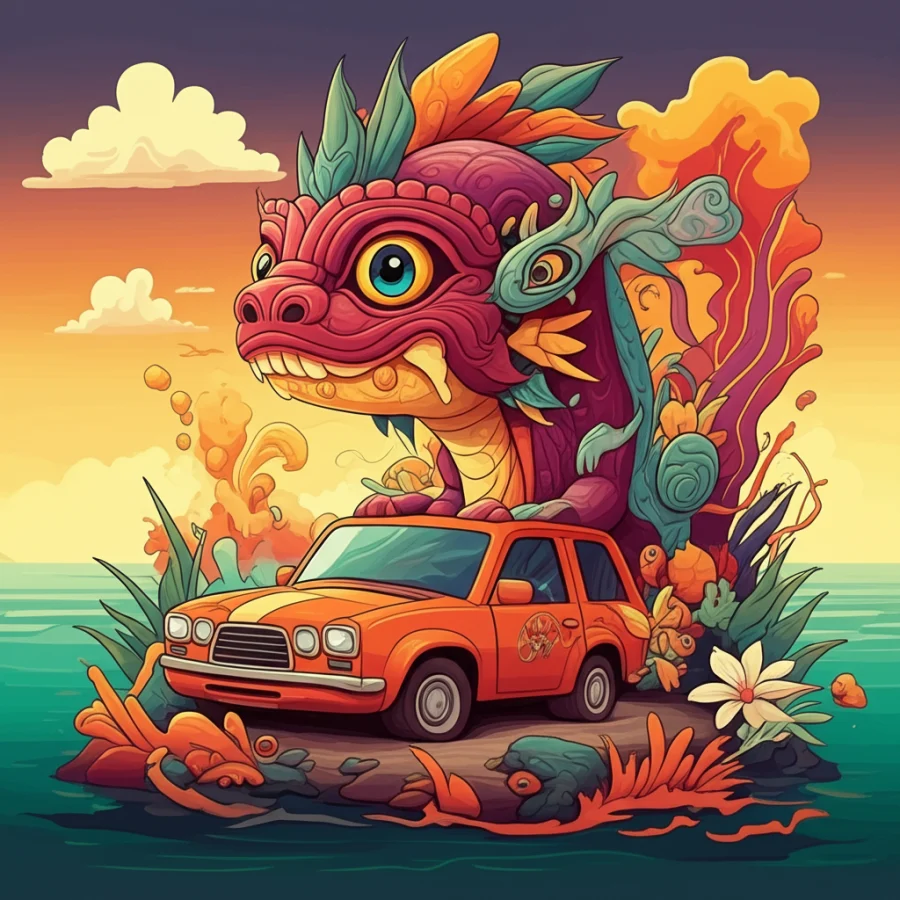
The Taniwha are supernatural beings unique to Māori folklore, often described as colossal reptilian creatures resembling giant lizards, sharks, or even dragons. They dwell in deep pools, caves, rivers, and the open sea. Taniwha are complex figures, possessing a duality: they can be fearsome monsters, capable of capsizing canoes and devouring people, or benevolent guardians of specific places, tribes, or individuals. They often serve as spiritual protectors (kaitiaki) of a particular waterway or community, demanding respect and offerings. Physically, Taniwha are often depicted with powerful bodies, sharp teeth, and sometimes wings or fins, reflecting their mastery of both land and water. Symbolically, Taniwha represent the raw, untamed power of nature, the dangers lurking beneath the surface, but also the deep, spiritual connection between people and their environment, emphasizing the need for balance and respect.
4. Main Story / Narrative Retelling
In the shimmering expanse of Te Moana-nui-a-Kiwa, the Great Ocean of Kiwa, where the sky met the water in an endless embrace, lived Kaihoro, a Taniwha of immense power and ancient lineage. Kaihoro was a guardian of a deep, twisting fjord in Aotearoa, his scales the colour of polished obsidian, his eyes like ancient, glowing embers. For generations, he had watched over his people, ensuring the bounty of the waters and protecting them from those who would desecrate his sacred domain.
But a restlessness began to stir in the ocean’s depths, a subtle tremor that rippled through the very essence of Tangaroa, the Great Ocean Father. It was not a storm, nor a great tsunami, but a low, guttural hum, a deep resonance from the heart of Papatūānuku, the Earth Mother, far to the north. Tangaroa, whose senses encompassed every drop of water, every current, felt this distant, fiery pulse and knew it was a force unlike any that had troubled the western seas.
Through the deep, silent currents, Tangaroa sent forth a summons, a silent urging that resonated within the most ancient of his children. Kaihoro felt it, a profound call to journey beyond the familiar shores. With a final, sorrowful gaze upon his fjord, the great Taniwha slipped from his sanctuary, his massive form gliding into the open ocean, propelled by an unseen force.
For countless sunrises and sunsets, Kaihoro journeyed north, guided by the insistent hum that grew stronger with each passing league. He passed through emerald archipelagos, beneath skies painted with stars unknown to his home waters. The ocean changed around him; the waters grew warmer, the marine life more vibrant, yet the deep tremor persisted, now accompanied by an acrid scent carried on the wind.
Finally, a faint glow appeared on the horizon, not the soft luminescence of the moon, but a pulsing, orange heart. As Kaihoro drew closer, the glow intensified, revealing colossal mountains that breathed fire into the heavens. These were the sacred fire mountains of Hawai’i, where the earth’s molten core met the open sky.
Kaihoro, a creature of water and deep earth, had never witnessed such a spectacle. Rivers of liquid fire cascaded down the mountain flanks, hissing into the ocean, sending plumes of steam high above. The air vibrated with the roar and rumble of the earth, a sound far grander and more terrifying than any storm Tangaroa had ever unleashed. The Taniwha felt the immense power, the creative and destructive force of these Hawaiian volcanoes, a primal energy that mirrored the deep, churning power of Tangaroa, yet manifested as burning heat and solidifying stone.
He swam closer, drawn by an irresistible curiosity, circling the fiery islands. The ocean around the volcanoes boiled and steamed, but Kaihoro, shielded by his ancient magic and the will of Tangaroa, felt only the immense pressure of the forces at play. He witnessed the birth of new land from fire, a slow, inexorable expansion that spoke of the earth’s endless cycle of creation and destruction. He saw the stark beauty of the cooling lava, forming black, jagged shores that seemed to defy the ocean’s relentless assault.
The encounter was not a battle, but a revelation. Kaihoro understood, through the deep wisdom of his Taniwha spirit, that the immense, fiery heart of the earth was a sibling force to the vast, life-giving ocean. Both were expressions of Papatūānuku and Ranginui’s eternal dance, each holding power to shape worlds and inspire awe. The hum that Tangaroa had felt was the very breath of these fire mountains, a testament to the interconnectedness of all elemental forces across the great Pacific.
With this profound understanding, Kaihoro turned, his mission fulfilled. He carried the echo of the fire mountains within him, a memory of searing heat and molten birth, back to his distant home. He returned to Aotearoa, forever changed, a silent testament to the vast, interwoven powers that ruled the world, a bridge between the deep waters of Tangaroa and the fiery heart of the Hawaiian lands.
5. Symbolism and Meaning
To the ancient peoples who shared such tales, this narrative would have been rich with symbolism. Tangaroa, as the god of the sea, represents the all-encompassing power and mystery of the ocean, which was both a source of life and a formidable challenge for island-dwelling societies. The Taniwha, like Kaihoro, embodied the raw, untamed forces of nature – the dangers lurking in the unknown, but also the protective spirits tied to specific places. Their duality reflected humanity’s complex relationship with their environment: nature could be nurturing or destructive, depending on how it was respected and understood.
The journey of Kaihoro to the Hawaiian volcanoes symbolizes the interconnectedness of the Pacific islands and the elemental forces that shaped them. The volcanoes themselves represent the raw, creative, and destructive power of the earth, a force of profound awe and fear. For ancient Polynesians, who understood the land and sea intimately, this story could have been a way to conceptualize the vast geological processes at play, linking the tremors of the earth in their own lands to the visible fiery births of new land elsewhere. It speaks to a deep respect for all natural phenomena, reminding people that while their immediate world was vital, larger, more profound forces were at work across the entire ocean. The story could also symbolize exploration, the courage to face the unknown, and the wisdom gained from encountering different manifestations of primal power.
6. Modern Perspective
Today, tales like that of Kaihoro, Tangaroa, and the metaphorical journey to the fire mountains continue to resonate, albeit with different interpretations. In modern literature, film, and games, Polynesian mythology, including the concept of Taniwha and powerful deities like Tangaroa, has found new life. Contemporary artists and storytellers often draw inspiration from these myths to create narratives that explore themes of environmentalism, cultural identity, and the timeless human connection to nature.
For example, the widespread popularity of animated films like Disney’s Moana showcases a broad appreciation for Polynesian culture and mythology, albeit a simplified version. Taniwha-like creatures and powerful elemental spirits appear in various fantasy genres, representing guardians, challenges, or manifestations of magical energy. In academic and cultural studies, these myths are invaluable for understanding ancient worldviews, linguistic connections across the Pacific, and the enduring power of oral traditions. They serve as a crucial link to ancestral knowledge, helping to preserve and revitalize indigenous languages and cultural practices for future generations.
7. Conclusion
The narrative of Kaihoro’s journey, spurred by Tangaroa to witness the fire mountains, stands as a testament to the profound imagination and intricate worldview of ancient Polynesian peoples. It is a story born from the deep observation of nature, the awe inspired by the ocean and the land, and the human desire to understand the forces that shape existence.
It is imperative to reiterate that this narrative, like all mythology, is a cultural story, a product of human creativity and interpretation, and not a belief to be held as truth. As Muslims, we recognize that only Allah (God) is the true Creator and Sustainer of the heavens and the earth, the One who formed mountains and oceans, and whose power transcends all human imagination and mythical constructs. This reflection on cultural heritage reminds us of the universal human impulse for storytelling, for seeking meaning, and for passing down wisdom through narrative. These echoes of Tangaroa and the Taniwha, reaching towards the Hawaiian volcanoes, are a beautiful and imaginative legacy, enriching our understanding of human culture and the diverse ways in which people have sought to comprehend their world.