fufufafa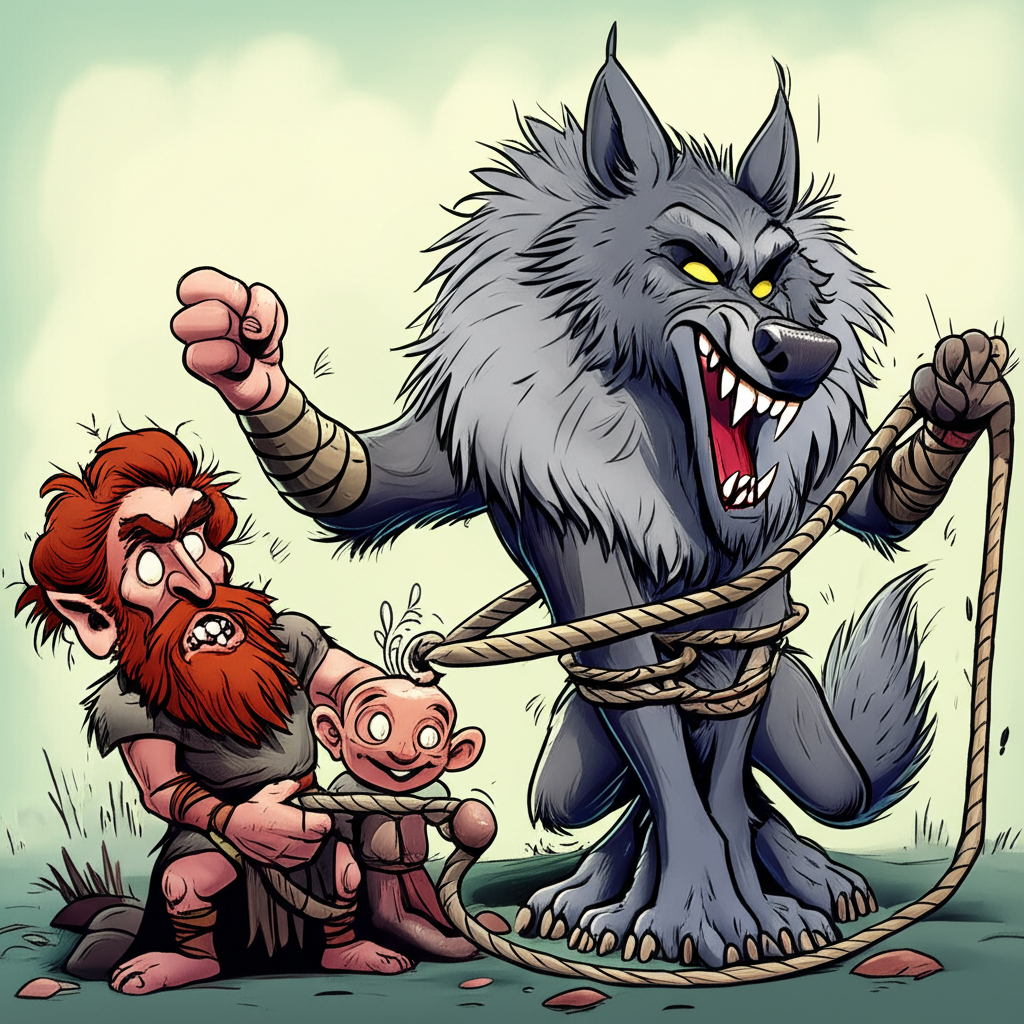
The winds that swept across the ancient lands of Scandinavia carried with them tales of gods, giants, and creatures of immense power. Among these narratives, woven into the fabric of Norse mythology, is the chilling story of Fenrir, a wolf of monstrous proportion, and the prophecy that foretold his ultimate binding. This is not a chronicle of divine decree or a sacred text, but rather a traditional story, a legacy of imagination and belief from the people who once inhabited these northern realms.
Whispers from a Harsh Land: Origins and Cultural Background
The myths of Norse lore, including the tale of Fenrir, emerged from a world vastly different from our own. The era was one of a stark and often unforgiving environment, where survival depended on resilience, community, and a profound respect for the forces of nature. The people, often living in scattered settlements amidst vast forests, fjords, and mountains, viewed the world as a dynamic and often perilous place. Their lives were intertwined with the cycles of seasons, the ferocity of storms, and the raw power of the untamed wilderness.
In this context, their worldview was populated by a pantheon of gods who, while powerful, were not distant and all-knowing deities in the Abrahamic sense. Instead, they were figures with human-like flaws and struggles, often engaged in battles and facing their own destinies. The natural world itself was imbued with a sense of sentience and spirit. The thunder was the roar of Thor’s hammer, the harsh winter a manifestation of ancient frost giants, and the ever-present threat of chaos a tangible force that needed constant vigilance. Myths served as a way to understand these forces, to grapple with the mysteries of existence, and to provide a framework for societal values like courage, honor, and the acceptance of fate.
Fenrir: A Shadow of Unbound Fury
The heart of this particular legend lies with Fenrir, a creature born of primordial chaos. He is described not merely as a wolf, but as a wolf of unparalleled size and ferocity. His jaws, it is said, could gape wide enough to swallow the sky, and his eyes burned with an infernal light. He was the offspring of the trickster god Loki and a giantess named Angrboda, a lineage that imbued him with a nature inherently antagonistic to the established order.
Fenrir’s symbolic attributes are stark and potent. He represents the primal, untamed force of destruction, the embodiment of unchecked aggression and the potential for chaos to overwhelm even the divine. He is the embodiment of fear itself, a creature whose very existence is a threat to the cosmic balance. His immense power is not a tool for creation or governance, but a harbinger of ruin.
The Fateful Progeny: A Narrative of Growing Dread
The story of Fenrir’s binding unfolds as a chilling testament to foresight and a desperate, ultimately flawed, attempt to control destiny. The gods, observing Fenrir’s rapid growth and the fear he inspired, realized the immense danger he posed. They foresaw a future where his insatiable hunger would lead him to consume Odin, the All-Father himself, and then devour the very sun and moon. This was a prophecy of ultimate Ragnarok, the twilight of the gods, a cataclysmic event that would reshape the cosmos.
The gods, gathered in their celestial hall of Valhalla, debated how to contain this burgeoning threat. Direct confrontation proved impossible; Fenrir’s strength was already beyond their immediate capabilities. So, they devised a cunning plan, a ruse born of desperation. They approached Fenrir, appealing to his pride and his desire for recognition. They claimed that he was so powerful, so formidable, that they wished to test his strength by binding him.
Fenrir, confident in his own might, agreed. The first fetter they presented was Gleipnir, a silken ribbon forged by the dwarves in the deepest caverns of the earth. This ribbon, seemingly delicate, was imbued with a potent magic, woven from the sound of a cat’s footsteps, the breath of fish, and the roots of a mountain. When the gods brought Fenrir this seemingly flimsy chain, he scoffed. He demanded that one of them place a hand in his mouth as a pledge of good faith, a guarantee that the binding was not a trap. Tyr, the god of law and justice, a figure of immense courage, stepped forward.
With a heavy heart, Tyr placed his right hand into Fenrir’s gaping maw. The gods then tightened Gleipnir, and to Fenrir’s astonishment, the seemingly weak ribbon held fast. The magic of Gleipnir was absolute; it would not break. Fenrir struggled, his mighty muscles straining, but the fetter only grew tighter. In his rage and despair, he bit off Tyr’s hand at the wrist. The gods then secured the chain to a great rock, the ancient stone of Gjöll, and anchored it with a heavy chain, thus binding the monstrous wolf.
The prophecy, however, was not entirely averted. Fenrir was bound, but his release was foretold to coincide with Ragnarok, the final battle where he would break free, unleash his fury, and fulfill his destiny of devouring Odin. The binding of Fenrir, therefore, became a symbol of a temporary reprieve, a delaying tactic against an inevitable doom.
Symbolism of the Shadowed Wolf
To the ancient Norse people, the story of Fenrir held layers of meaning. Primarily, it served as a stark reminder of the ever-present forces of chaos and destruction that threatened their ordered world. Fenrir represented the untamed wild, the destructive potential within nature and perhaps even within society itself, that needed to be contained for civilization to thrive.
The binding of Fenrir also spoke to the complex nature of power and the limitations of even the gods. It demonstrated that some threats are too great for brute force alone and require cunning, sacrifice, and a willingness to face dire consequences. Tyr’s sacrifice of his hand became a potent symbol of courage and the willingness to pay a heavy price for the greater good, a virtue highly esteemed in their warrior culture.
Furthermore, the prophecy of Fenrir’s eventual release at Ragnarok likely reflected a fatalistic acceptance of cyclical destruction and renewal. It acknowledged that even the most powerful bindings are temporary and that the universe operates on grand, often destructive, cycles. It was a worldview that embraced the inevitability of change, even when that change was catastrophic.
Echoes in the Modern Imagination
In contemporary times, the myth of Fenrir continues to resonate, finding new life in literature, film, and popular culture. He is often depicted as a formidable antagonist, a creature of immense power and primal rage, whose presence signals impending doom. In fantasy novels and video games, Fenrir frequently appears as a boss monster or a significant threat, embodying the destructive forces that heroes must overcome. His imagery – the monstrous wolf, the unbreakable chain, the prophecy of doom – lends itself powerfully to dramatic narratives. Scholars and enthusiasts of mythology also study these tales, delving into their cultural significance, their archetypal themes, and their influence on human storytelling.
A Legacy of Storytelling
The tale of Fenrir’s binding is a profound example of the rich tapestry of human storytelling. It is a narrative born from a specific cultural context, reflecting the fears, values, and worldview of ancient Norse peoples. As Muslims, we recognize that only Allah (God) is the true Creator and Sustainer of all existence, and that all power and dominion belong to Him alone. The stories of ancient cultures, while holding historical and educational value, are understood as human creations, expressions of imagination and attempts to understand the world.
The enduring appeal of such myths lies not in their literal truth, but in their ability to explore universal themes of courage, sacrifice, the struggle against chaos, and the inexorable march of time. The binding of Fenrir, a chilling prophecy whispered from the shadows of Vanaheim, serves as a powerful reminder of our shared human heritage of storytelling and the enduring power of imagination to shape our understanding of the world, past and present.