fufufafa
The turquoise waters surrounding the Samoan archipelago, kissed by a perpetual sun and fringed with verdant rainforests, have long been a canvas for tales spun by ancient storytellers. Among these captivating narratives are the legends of the Taniwha, formidable beings said to inhabit the depths of the ocean and freshwater sources. These are not accounts of historical fact, but rather the rich tapestry of folklore woven by the ancestors of Samoa, offering a glimpse into their worldview, their respect for the powerful forces of nature, and their understanding of the world around them.
The stories of the Taniwha emerged from a time when life was inextricably linked to the rhythms of the natural world. In ancient Samoa, before the advent of modern technology, the sea was both a provider and a potential adversary. Freshwater streams carved through volcanic landscapes were essential for survival. The environment itself, with its dramatic cliffs, hidden caves, and the vast, mysterious ocean, undoubtedly fueled the imagination. People of that era perceived the world as a place imbued with spiritual presence, where unseen forces governed the ebb and flow of life. They sought to understand and appease these forces, and the Taniwha became a powerful embodiment of these elements – the untamed power of the ocean, the hidden dangers of the deep, and the respect due to the natural world.
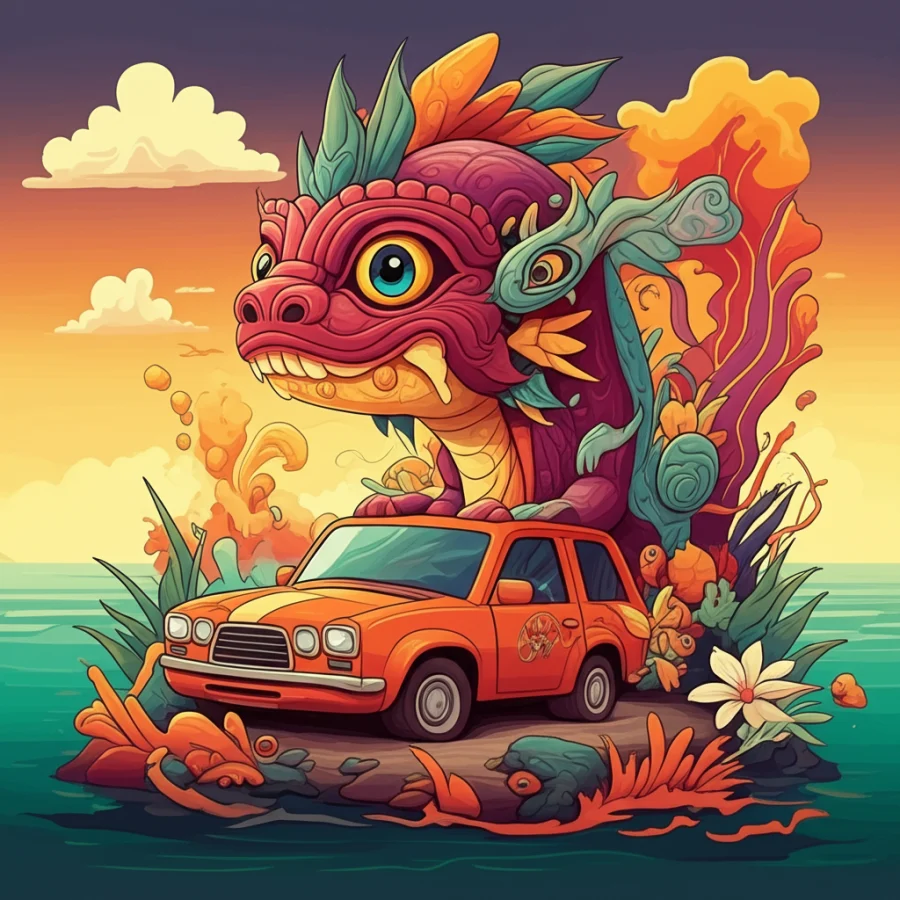
The Taniwha, as depicted in Samoan folklore, are not monolithic figures. They manifest in various forms, often as colossal reptilian creatures, reminiscent of serpents or dragons, with scales that shimmer like polished obsidian or the iridescent hues of deep-sea fish. Some tales describe them with powerful limbs, capable of stirring immense waves, while others speak of their ability to transform, appearing as logs, rocks, or even mist. Their eyes are often portrayed as glowing embers, reflecting the profound darkness of their underwater abodes. Symbolically, the Taniwha represent the immense, often unpredictable power of nature. Their serpentine forms can evoke the winding currents of rivers and the vast, undulating expanse of the ocean. Their association with deep water signifies the unknown, the mysterious, and the potent forces that lie beyond human comprehension. They are guardians, sometimes benevolent, sometimes wrathful, of their domains.
One particular narrative, passed down through generations, recounts an imagined encounter with a Taniwha. Imagine a young Samoan fisherman named Tala, his outrigger canoe a mere speck against the vast blue horizon. The sun beat down, warming his skin as he cast his net, the rhythmic pull and release a familiar dance. The ocean, usually his generous provider, seemed unusually still that day, an unnerving calm that hinted at something more. As he paddled further offshore, a peculiar disturbance rippled the surface. It wasn’t the playful dance of dolphins or the surge of a distant wave. It was a slow, deliberate movement, as if the very seabed was shifting.
Suddenly, from the deep, a colossal head emerged, its scales catching the sunlight like a thousand emeralds. It was a Taniwha, its form immense, its eyes – like molten gold – fixed upon Tala’s small vessel. A low rumble, like distant thunder, emanated from its throat. Tala, though his heart pounded a frantic rhythm against his ribs, remembered the ancient teachings. He did not shout in terror or try to flee with reckless abandon. Instead, he remained still, his hands gripping the sides of his canoe, his gaze steady. He spoke, his voice clear and respectful, offering an apology for disturbing the Taniwha’s domain, acknowledging its power and the respect owed to it. He spoke of his need to feed his family, not as a demand, but as a humble request.
The Taniwha observed him for what felt like an eternity. The water around them remained undisturbed, save for the gentle rise and fall of the creature’s immense form. Then, with a slow, deliberate movement, it submerged, leaving behind only ripples that gradually faded. Tala, breathing a sigh of relief, understood. The Taniwha, in this telling, was not merely a monster to be feared, but a powerful entity that demanded respect and acknowledged genuine humility. He returned to shore, his net not full, but his spirit enriched by the profound understanding of the unseen forces that governed his world.
The symbolic weight of such stories is multifaceted. For the ancient Samoans, the Taniwha served as potent metaphors for the raw power of nature. They represented the ocean’s immense capacity for both sustenance and destruction, the unseen currents that could capsize a canoe, and the hidden dangers that lurked beneath the surface. They also embodied a moral compass, reminding people of the importance of respecting their environment and acknowledging the interconnectedness of all living things. Tales of appeasement and respectful interaction with these beings could also reflect societal expectations of humility, deference, and the wisdom of not challenging forces beyond one’s control. In some interpretations, the Taniwha could also represent ancestral spirits or guardians of specific places, their presence a reminder of the history and spiritual significance of the land and sea.
In the modern era, these ancient narratives continue to resonate. The Taniwha are no longer believed in as literal beings, but they persist as potent cultural symbols. They appear in contemporary Samoan literature, often used to explore themes of identity, heritage, and the enduring connection to the natural world. In films and art, they can be depicted as powerful, sometimes mystical, guardians or antagonists, reflecting the ongoing fascination with these mythical creatures. In academic studies of folklore and mythology, the Taniwha offer invaluable insights into the worldview, beliefs, and values of ancient Polynesian societies.
It is crucial to reiterate that these are traditional stories, passed down through oral tradition and imaginative storytelling. They are a testament to the rich cultural heritage of Samoa and the enduring power of human imagination. As Muslims, we recognize that only Allah (God) is the true Creator and Sustainer of all that exists. Our understanding of the world is guided by divine revelation, which teaches us that while nature is a creation of Allah, it is not to be worshipped or attributed with divine powers. These myths, therefore, are viewed as cultural artifacts, expressions of human attempts to understand the world through narrative and metaphor, rather than as divine truths. The legacy of the Taniwha lies not in their literal existence, but in their enduring ability to spark curiosity, to remind us of the power of storytelling, and to connect us to the ancestral voices that shaped the cultural landscape of the beautiful Samoan Isles.