fufufafa
The vast Pacific Ocean, a shimmering tapestry of blue, has long been a cradle of human migration and a canvas for the most enduring of stories. From its myriad islands, including the mythical homeland of Hawaiki, emerged the rich tapestry of Polynesian oral traditions. These tales, passed down through generations around crackling fires and under star-dusted skies, offer a glimpse into the worldview of ancient peoples, their understanding of the natural world, and the forces they believed shaped their lives. Among these narratives, the legend of the Taniwha holds a prominent place, a creature deeply woven into the fabric of Māori culture in Aotearoa (New Zealand). This is one such story, a traditional narrative shared to illuminate a cultural understanding of the past, not as a matter of present belief.
In the era when these stories took root, the world was perceived as a vibrant, interconnected realm where the spiritual and the physical were inextricably linked. The natural world – the soaring mountains, the crashing waves, the dense forests – was not merely a backdrop but a living entity, imbued with mana (spiritual power) and inhabited by beings both seen and unseen. For the ancient voyagers who navigated the vast oceans in their waka hourua (double-hulled canoes), the ocean itself was a formidable entity, capable of both sustenance and destruction. It was within this context of profound respect for nature and the presence of ancestral spirits that the concept of the Taniwha arose. These were not simple monsters but powerful guardians, shapeshifters, and sometimes formidable adversaries, embodying the raw, untamed power of the natural world.
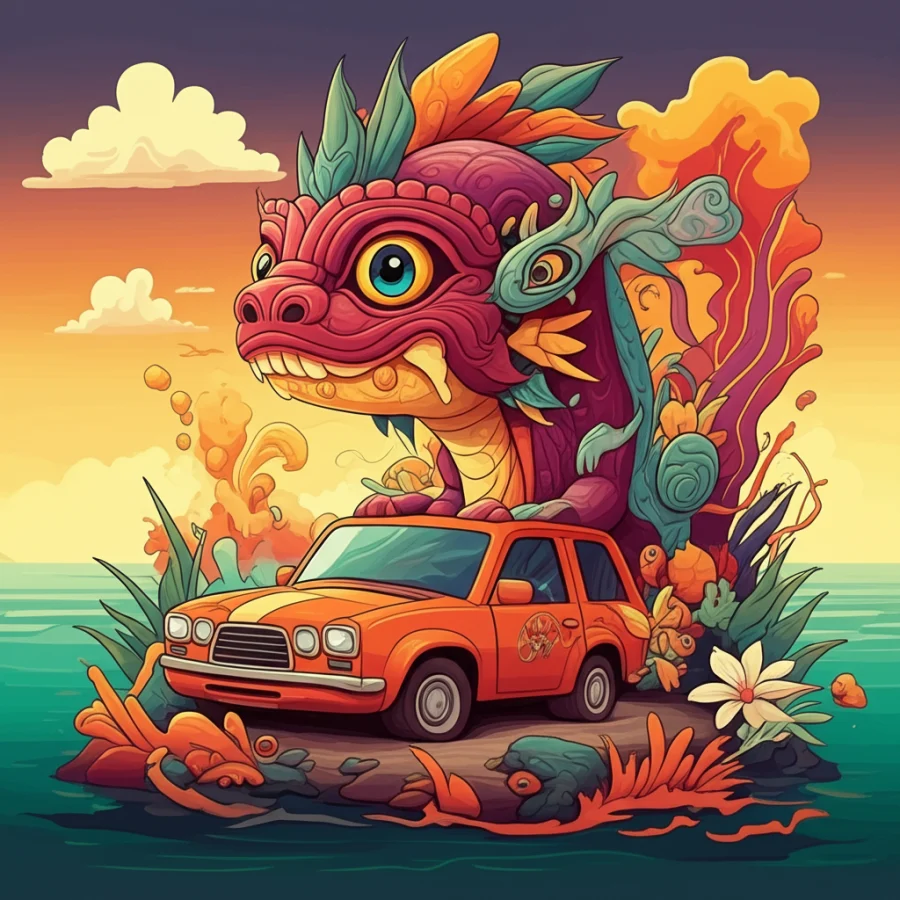
The Taniwha, as depicted in these traditional accounts, is a being of immense power and varied form. It is not a single, defined creature but a class of supernatural beings, often associated with water – rivers, lakes, and the sea. Their descriptions vary wildly, reflecting the diverse environments they were said to inhabit. Some tales speak of them as serpentine dragons, their scales glinting like obsidian, their bodies vast enough to churn the waters into a tempest. Others portray them as colossal lizards, their eyes burning with ancient wisdom, their claws capable of tearing through the very earth. The symbolic attributes of the Taniwha are numerous and often contradictory. They can represent the protective forces of a place, guarding sacred sites and ensuring the balance of the ecosystem. Conversely, they can embody the dangers of the unknown, the treacherous currents, and the lurking perils that faced those who ventured into unfamiliar territories. Their presence served as a constant reminder of the awesome power of nature and the need for respect and caution.
Imagine, then, a time long ago, when the great waka of the ancestors first touched the shores of Hawaiki, a spiritual homeland often spoken of as the origin point for many Polynesian peoples. The air was thick with the scent of salt spray and the calls of unknown birds. Among the navigators and their families was a young warrior named Kai. Kai was known for his courage and his keen observational skills, but also for a certain restless curiosity that sometimes bordered on recklessness.
The elders had warned them of the waters surrounding this new land. "Be wary," they had cautioned, their voices raspy with age and experience. "The deep holds ancient powers. The Taniwha watch." Kai, however, was eager to prove his mettle and explore the bounty of this new world. One day, venturing further than the others in a smaller canoe, he found himself drawn to a deep, shadowed inlet. The water here was unnaturally still, the silence broken only by the gentle lapping against his hull. A strange, almost hypnotic calm settled over him.
Suddenly, the water began to stir. Not with the gentle movement of the tide, but with a deliberate, powerful upheaval. From the depths emerged a colossal form. It was a Taniwha, its body a shimmering, scaled darkness, its head crowned with what looked like a forest of kelp. Its eyes, the size of dinner plates, glowed with an eerie, phosphorescent light. Kai, though his heart hammered against his ribs, did not panic. He remembered the teachings: that the Taniwha were not always malevolent, but often responded to respect and the understanding of their domain.
Instead of brandishing his spear, Kai held his canoe steady. He spoke, his voice clear and steady, not in defiance, but in acknowledgment. "Great guardian of this place," he called out, his words carried on the still air. "I am Kai, a son of the voyagers. We come not to harm, but to seek sustenance and a new home. We respect your waters and your dominion."
The Taniwha regarded him, its massive head slowly turning. The water around it swirled, not in aggression, but as if the creature was testing the young warrior. Then, with a sound like the groan of ancient trees, it submerged, leaving behind only ripples that slowly faded. Kai, his breath catching in his throat, felt a profound sense of awe. He understood then that his encounter was not a battle, but a test. He had shown respect for a power far greater than himself, and in return, he had been granted passage. He paddled back to his people, his story a testament to the need for humility and understanding when confronting the unknown forces of nature.
The story of Kai and the Taniwha, like many such narratives, is rich with symbolism. The Taniwha itself can be seen as a representation of the primal forces of nature – the untamed power of the ocean, the hidden dangers of the wilderness, and the sheer, overwhelming might of the natural world. Its varied forms suggest the adaptability of these forces, capable of appearing in ways that inspire both fear and wonder. The encounter, particularly Kai’s respectful approach, speaks to the importance of acknowledging and respecting the environment. It highlights a worldview where humans are not masters of nature, but rather a part of it, dependent on its goodwill and subject to its power. The Taniwha can also symbolize ancestral spirits, guardians of the land and sea, whose presence demands reverence. For the ancient people, such stories served as cautionary tales, moral lessons, and explanations for the inexplicable, guiding their interactions with the world around them.
In the modern era, these ancient myths continue to resonate. The Taniwha, once a figure of awe and respect in traditional Māori society, has transitioned into a potent symbol in literature, film, and popular culture. Authors and artists draw upon the rich imagery of these legends to explore themes of identity, heritage, and the enduring connection between humanity and the natural world. In contemporary Māori art, the Taniwha often appears as a powerful motif, representing ancestral strength and the spirit of the land. Its presence in video games and fantasy novels allows for imaginative explorations of its formidable nature, often reinterpreting its role as guardian or adversary in new contexts. These modern interpretations, while entertaining, are a testament to the enduring power of storytelling and the way ancient narratives can be reimagined for new audiences.
It is important to reiterate that stories like the encounter with the Taniwha of Hawaiki are deeply embedded within the cultural heritage of the Māori people and other Polynesian cultures. They are traditional narratives, passed down through oral tradition, offering insights into the beliefs and worldview of ancient societies. As Muslims, we understand that the true Creator and Sustainer of all existence is Allah (SWT), and we acknowledge that only He possesses ultimate divine power. These stories, therefore, are viewed through the lens of cultural understanding and appreciation for human imagination and the enduring tradition of storytelling, which allows us to connect with the past and explore the rich tapestry of human experience. The tales of the Taniwha, in their vibrant imagery and profound symbolism, serve as a powerful reminder of the enduring human impulse to understand our place in the world, to explain the mysteries around us, and to weave narratives that have the power to shape cultures for generations.