
 fufufafa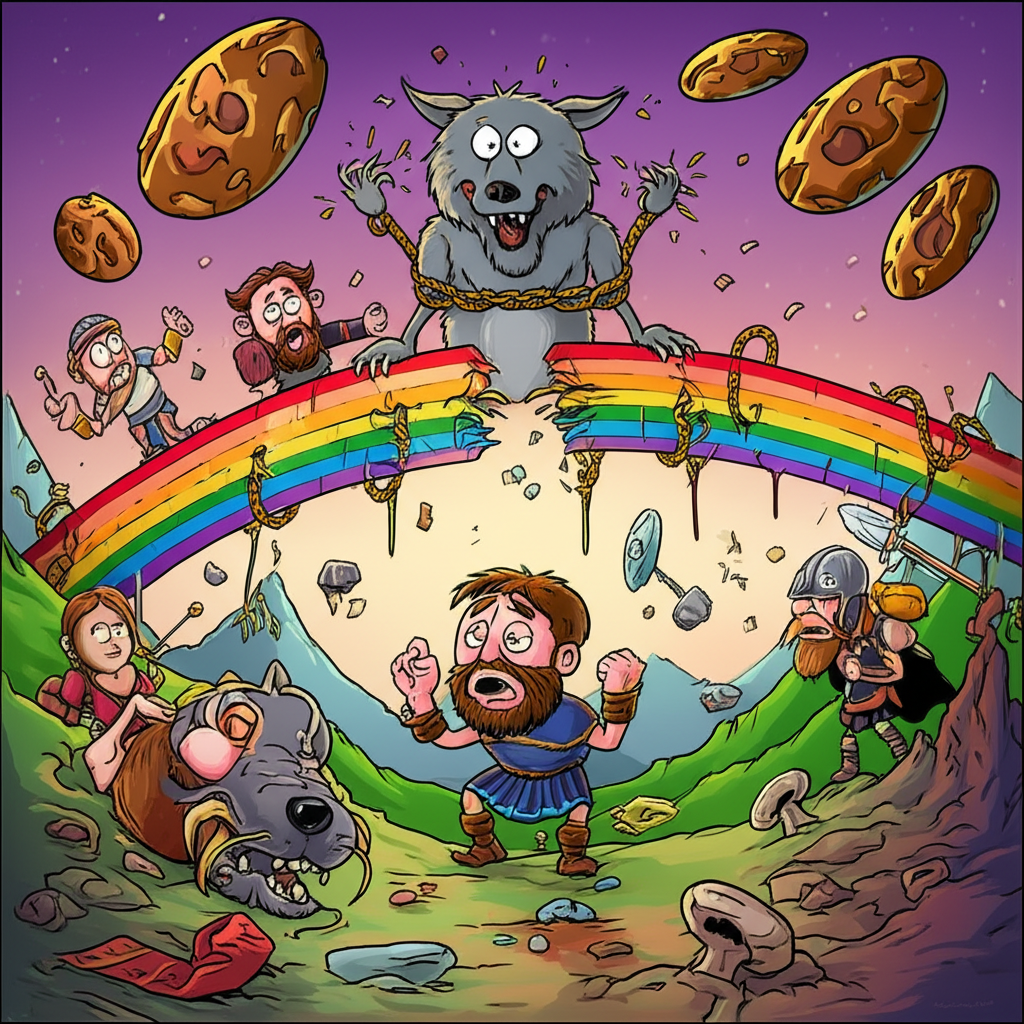
Important Note: This article explores a story from pre-Christian Norse mythology. It is a traditional folk narrative passed down through generations and is presented here for cultural, historical, and educational understanding. This story is not real and is not meant to be believed, worshipped, or practiced.
Introduction
From the windswept coasts of Scandinavia, in an age of longships and iron, comes a vast collection of myths that speak of gods, giants, and the inevitable end of the world. These tales, primarily preserved in medieval Icelandic texts like the Prose Edda and the Poetic Edda, were the cultural bedrock of the Norse people, often known as the Vikings. They were not just entertainment but a way for ancient people to explain the world around them—its creation, its harshness, and its ultimate fate. Among the most powerful of these narratives is the story of the binding of Fenrir, a monstrous wolf whose destiny was intertwined with that of the gods themselves. It is a story of fear, deception, and the heavy price of maintaining order.
Origins and Cultural Background
This myth emerged from the Viking Age (roughly 8th to 11th centuries), a period defined by exploration, trade, and conflict. The world of the Norse people was often unforgiving. They faced brutal winters, unpredictable seas, and the constant threat of raids. Their worldview was shaped by this environment, leading to a belief system steeped in fatalism. They believed in a concept called Wyrd, or fate, an unchangeable force to which even their most powerful gods were subject. Their stories reflect this reality: they are not tales of absolute good triumphing over evil, but of a constant, desperate struggle to hold back the forces of chaos for as long as possible. The gods of Asgard were not seen as perfect or all-powerful; they were flawed, courageous, and ultimately doomed, fighting a battle they knew they would one day lose.
Character Description: Fenrir, the Wolf of Prophecy
In this mythological framework, Fenrir is one of the most formidable and symbolic figures. He is a monstrous wolf, one of three fearsome offspring of the trickster god Loki and the giantess Angrboða. His siblings were Jörmungandr, the world-encircling serpent, and Hel, the ruler of the underworld. From birth, Fenrir was unlike any other creature. He grew at an astonishing rate, his strength and size terrifying even the gods of Asgard.
Symbolically, Fenrir was not just a large animal; he represented the untamed, destructive forces of nature and chaos. He was the embodiment of the wild that could not be civilized, the entropy that threatened to unravel the ordered world the gods had built. His prophesied role in the final battle of Ragnarök—where he is fated to devour Odin, the Allfather and chief of the gods—made him a living symbol of their inevitable doom. Fenrir is the ultimate fear: a threat that grows stronger the longer it is ignored, a destiny that cannot be outrun.
Main Story: The Binding of Fenrir
The tale begins in Asgard, the celestial stronghold of the Aesir gods, connected to the mortal realm by the shimmering rainbow bridge, Bifrost. A prophecy had reached Odin’s ears, a dark foretelling from a seer who spoke of Loki’s children and the ruin they would bring. Fearing this future, the gods decided to act. They cast Jörmungandr into the sea and banished Hel to the misty depths of the underworld, but Fenrir they kept in Asgard, hoping to control him.
This proved to be a grave miscalculation. The wolf cub grew into a beast of immense size, his howls echoing through the golden halls. His eyes burned with a primal fire, and his strength became so great that only Tyr, the god of law and heroic glory, was brave enough to approach and feed him. The gods watched with growing dread, realizing the prophecy was unfolding before their eyes. They knew they could not kill Fenrir, as it would stain their sacred sanctuary with blood, so they resolved to bind him instead.
Their first attempt was a great chain called Læðingr. They brought it before Fenrir, framing it as a game to test his legendary strength. The wolf, proud and confident, allowed them to chain him. With a single, mighty flex of his shoulders, he shattered Læðingr into pieces. The gods hid their fear behind forced smiles and praised his power.
Undeterred, they forged a second chain, Drómi, which was twice as strong. Again, they presented it as a challenge. Fenrir eyed the heavy iron links with suspicion but agreed once more. He struggled mightily this time, the earth trembling as he strained against his bonds. With a tremendous roar, he broke Drómi as well, the links flying apart like shrapnel.
Panic set in among the Aesir. Their finest craftsmanship had failed. In desperation, Odin sent a messenger to Svartalfheim, the realm of the dwarves, renowned as the greatest smiths in the Nine Worlds. He begged them to forge a fetter that no force could break. The dwarves, using their deep magic, created Gleipnir. It was not a chain of iron but a ribbon, as thin and soft as silk. It was crafted from six impossible ingredients: the sound of a cat’s footfall, the beard of a woman, the roots of a mountain, the sinews of a bear, the breath of a fish, and the spittle of a bird. Because it was made of things that do not exist, it could not be broken.
The gods took Fenrir to the remote island of Lyngvi and showed him the silken ribbon. They challenged him one last time, but the wolf was no fool. He sensed trickery. "This slender band looks as though I could gain no fame from breaking it," he growled. "But if it was made with cunning and magic, then I want no part of it."
The gods taunted him, questioning his courage. Fenrir, wary but unwilling to be called a coward, proposed a deal. "If you truly mean no deceit," he said, "then one of you must place your hand in my mouth as a pledge of good faith. If the ribbon is as harmless as you say, your comrade will be safe."
A heavy silence fell upon the gods. None would risk such a sacrifice, for they all knew Gleipnir’s true nature. As they exchanged fearful glances, Tyr stepped forward. Without a word, he placed his right hand between Fenrir’s massive jaws. The other gods quickly bound the wolf with Gleipnir.
Fenrir began to struggle, but the magical ribbon held fast. The more he fought, the tighter it became. A terrible realization dawned on him—he had been betrayed. In a final, agonizing roar of fury and pain, he snapped his jaws shut, severing Tyr’s hand at the wrist. The gods, save for the maimed Tyr, laughed to see their greatest fear contained. They took the end of the fetter, passed it through a great stone slab, and anchored it deep within the earth. To silence his ceaseless howls, they thrust a sword into his mouth, its hilt on his lower jaw and its point against his upper. From his gaping maw, a river of foam called Ván now flows. And there, on that lonely island, Fenrir waits, dreaming of his revenge at Ragnarök.
Symbolism and Meaning
To the ancient Norse people, this story was rich with meaning. It was a stark lesson on the nature of order and chaos. The gods, representing cosmic order, must resort to deception and sacrifice (Tyr’s hand) to contain the wild, destructive force of Fenrir. It suggests that maintaining civilization is a costly, sometimes dishonorable, and ultimately temporary endeavor. The story also powerfully illustrates the theme of inescapable fate. By trying to prevent the prophecy, the gods ensure it. Their act of binding Fenrir fills him with a hatred that will fuel his rampage at Ragnarök, where he will finally fulfill his destiny and kill Odin. Tyr’s sacrifice is particularly poignant; the god of law and justice must break an oath and suffer for the greater good, showing the complex moral compromises required for leadership.
Modern Perspective
The myth of Fenrir continues to capture the modern imagination. In popular culture, he appears in various forms. Marvel Comics and the associated cinematic universe feature "Fenris Wolf" as a giant lupine creature, often in service to the goddess Hela. Video games like God of War: Ragnarök and Valheim incorporate Fenrir and his story into their worlds, sometimes reimagining him as a tragic figure rather than a purely monstrous one. In literature, authors like Neil Gaiman have retold the myth for new audiences in works such as Norse Mythology, preserving its stark power and psychological depth. For cultural scholars, the story serves as a fascinating window into the Viking Age psyche, revealing a culture that grappled with ideas of destiny, sacrifice, and the ever-present threat of chaos.
Conclusion
The Binding of Fenrir is more than just an ancient tale of a monstrous wolf; it is a profound cultural artifact. It reflects the worldview of a people who saw life as a noble but losing battle against the harsh forces of the world. It is a story that has been passed down through centuries, a testament to the enduring power of human imagination and the tradition of storytelling.
While these tales offer a window into the past and the rich tapestry of human culture, it is important to remember their context as folklore. As Muslims, we hold the firm belief that only Allah is the true Creator and Sustainer of all things, the one and only God worthy of worship. These myths, while culturally and historically significant, belong to the realm of human storytelling. By studying them, we gain a deeper appreciation for the diverse ways in which people throughout history have sought to understand their world, leaving behind a legacy of imaginative narratives that continue to resonate today.


