
 fufufafa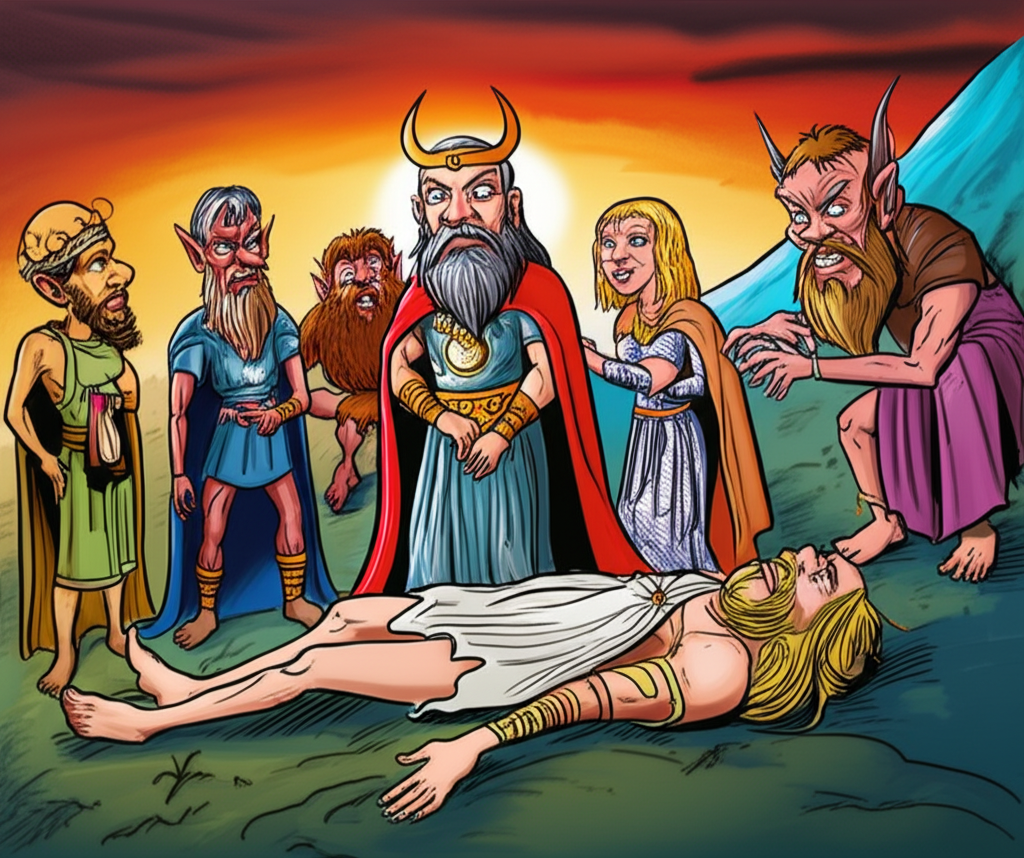
This article explores a foundational narrative from Norse mythology, a rich tapestry of stories woven by the ancient Germanic peoples of Northern Europe, particularly in the regions now known as Scandinavia. These tales were traditional accounts, passed down orally through generations before being recorded in texts like the Poetic Edda and the Prose Edda, offering a fascinating glimpse into the worldview of a bygone era. It is crucial to understand that this is a cultural story, a product of human imagination and early attempts to comprehend the world, and not a reflection of reality or an object of belief.
Origins and Cultural Background
The myths of the Norse pantheon emerged from a society deeply connected to its environment, flourishing during what is often referred to as the Viking Age, roughly from the late 8th to the mid-11th century. This was a time of exploration, trade, and occasional conflict, where communities lived in often harsh climates, dependent on the land and sea for survival. The people of this era perceived a world brimming with unseen forces, where powerful gods and formidable giants waged an eternal struggle, influencing harvests, weather, and the fortunes of warriors.
Their cosmology was intricate, centered around Yggdrasil, the World Tree, which connected nine distinct realms, including Asgard (home of the Aesir gods), Midgard (the realm of humans), and Muspelheim (the primordial land of fire). Fate, or Wyrd, was a powerful, immutable force that even the gods could not escape, a concept that imbued their stories with a sense of tragic inevitability. Life was viewed as a cycle of creation and destruction, with the ultimate cataclysm of Ragnarök – the twilight of the gods – looming as an inescapable destiny, a grand finale that would cleanse the old world with fire and flood, making way for a new beginning. It was within this dramatic, often fatalistic framework that the tale of Baldr’s death, a pivotal event foreshadowing the end times, took root and flourished.
Figures of Light and Shadow
At the heart of this poignant narrative stands Baldr, the radiant god of light, purity, beauty, and joy. Son of the chief god Odin and the goddess Frigg, Baldr was depicted as the most beloved of all the Aesir, embodying all that was good and virtuous. His presence brought warmth and cheer, and his very being seemed to ward off the encroaching shadows. Symbolically, Baldr represented innocence, hope, and the fleeting nature of pure goodness in a world destined for chaos. His vulnerability, despite his divine status, speaks to the fragility of even the most cherished ideals.
Opposite Baldr, and indeed the orchestrator of his downfall, was Loki, the trickster god. A complex and often contradictory figure, Loki was of giant lineage but was counted among the Aesir due to his blood-brotherhood with Odin. Known for his sharp wit, cunning, and penchant for mischief, Loki often brought both humor and calamity to the gods. In this story, he embodies envy, deception, and the disruptive forces of chaos that seek to unravel order. His actions highlight the danger of unchecked malice and the destructive power of a single malicious intent.
Crucially, the story intertwines with the realm of Muspelheim, the primordial land of fire, located at the southernmost root of Yggdrasil. This fiery realm was the birthplace of creation, yet it was also destined to be its ultimate undoing. Ruled by the formidable fire giant Surtr, Muspelheim was not merely a place but a force of nature, representing primordial destruction and the inevitable conflagration that would engulf the world at Ragnarök. Surtr himself, a being of immense power wielding a flaming sword, symbolized the unstoppable, consuming fire that would ultimately reshape existence. The prophecy linking Baldr’s death to the rise of Muspelheim’s flames is not a direct decree from the fire realm itself, but rather an understanding among the gods that such a tragic loss would herald the weakening of their world, paving the way for the ultimate destructive forces, personified by Surtr and his fiery legions.
Other significant figures include Frigg, Baldr’s devoted mother and Odin’s wife, who personifies maternal love and protective instinct, and Hoder, Baldr’s blind brother, who tragically becomes an unwitting instrument of fate and Loki’s malice, symbolizing the innocent yet destructive consequences of manipulation.
The Unfolding Tragedy: A Narrative Retelling
In the shimmering halls of Asgard, a shadow began to fall over the joyous god Baldr. He was plagued by terrible dreams – visions of his own demise, dark and chilling premonitions that even the radiant light of Asgard could not dispel. Disturbed by these omens, Baldr’s loving mother, Frigg, resolved to protect her beloved son. She traveled across all nine realms, extracting solemn oaths from every living thing and every inanimate object: fire and water, iron and all metals, stones, earths, trees, diseases, beasts, birds, and creeping things – all swore they would never harm Baldr.
The oaths were so comprehensive that Baldr became invulnerable. The gods, delighted by his newfound immunity, made a sport of it. In their great assembly, they would hurl weapons, stones, and axes at Baldr, watching them bounce harmlessly off him, a testament to Frigg’s unwavering love and the magic of her protective charms. Laughter and cheer filled the air, as Baldr stood unharmed amidst the playful assault.
But Loki, ever the disruptor, watched from the periphery with a sneer of envy and malice twisting his lips. He saw not a celebration, but an opportunity for chaos. Disguising himself as an old woman, Loki approached Frigg and, with feigned concern, inquired about the game. Frigg, beaming with pride, recounted her monumental effort, confident that Baldr was now beyond harm. Yet, in a moment of maternal candor, she confessed a single oversight: "There is one small thing," she admitted, "a tiny shoot of mistletoe growing west of Valhalla. It seemed too young, too insignificant to demand an oath from."
Loki’s eyes gleamed with wicked understanding. He immediately sought out the overlooked plant, plucked it, and fashioned it into a slender dart. Returning to the assembly, he found Hoder, Baldr’s blind brother, standing mournfully apart from the revelry, unable to participate. "Why do you not throw at Baldr?" Loki asked, feigning sympathy.
"I am blind," Hoder replied, "and have no weapon."
"Let me guide your hand," Loki purred, placing the mistletoe dart into Hoder’s grasp. "Throw this small twig at your brother, so you too can join the game."
Unknowing and trusting, Hoder took aim, guided by Loki’s treacherous hand, and hurled the mistletoe dart. The slender projectile, the one thing that had not sworn an oath, pierced Baldr. The vibrant god of light gasped, then crumpled to the ground, lifeless.
A stunned silence fell over the gods. The laughter died, replaced by an agonizing grief. Their beloved Baldr, the embodiment of their world’s purity, was gone. Frigg’s cries tore through the air, and Odin himself wept openly. This profound loss was not merely the death of a god; it was a profound wound to the very fabric of their existence, a clear sign that the cosmic order was beginning to unravel. They knew, with a chilling certainty, that this sorrowful event was a grim precursor to the ultimate cataclysm – the Twilight of the Gods, Ragnarök – where the destructive fires of Muspelheim, led by Surtr, would eventually consume all.
In their desperation, the gods sought to retrieve Baldr from the realm of Hel, the goddess of the underworld. Hermod, Baldr’s brother, rode Sleipnir, Odin’s eight-legged steed, on a perilous journey to the shadowy realm. Hel, cold and unyielding, agreed to release Baldr, but only on one condition: if every single living thing in all nine worlds wept for him. Messengers were dispatched, and indeed, all creatures, all plants, all stones, wept tears for the beloved Baldr, their grief a testament to his goodness. But then, a giantess named Thökk, sitting in a cave, refused. "Let Hel keep what she has," she cackled, "I shed no tears for Baldr." The gods suspected, rightly, that Thökk was Loki in disguise, sealing Baldr’s fate and plunging Asgard deeper into despair. Baldr remained in Hel, awaiting the final reckoning of Ragnarök, his death a somber prelude to the ultimate fiery destruction prophesied from Muspelheim.
Symbolism and Meaning
The death of Baldr resonates with profound symbolic weight. To the ancient Norse people, it represented the loss of innocence and the inevitable triumph of malevolence over purity. Baldr’s demise was a stark reminder of the fragility of goodness and the ever-present threat of chaos, embodied by Loki’s deceit. The single oversight – the mistletoe – speaks to the idea that even the most comprehensive protections can have a fatal flaw, highlighting human fallibility and the unforeseen consequences of seemingly minor details.
More broadly, Baldr’s death serves as a critical turning point in the Norse cosmic narrative, a powerful harbinger of Ragnarök. It symbolized the weakening of the gods’ reign, the beginning of the end for the current world order. The ultimate triumph of the destructive forces associated with Muspelheim, led by Surtr, was now seen as inevitable, a natural conclusion to the cycle of creation and destruction. The story thus explores themes of fate versus free will, the destructive power of envy, and the cyclical nature of existence, where even divine beings are subject to an inescapable destiny.
Modern Perspectives
Today, the story of Baldr’s death and the prophecy of Muspelheim continues to captivate and inspire, finding new life in various forms of modern media and academic discourse. In literature, it often appears in fantasy novels that draw upon Norse mythology, sometimes reimagined to explore contemporary themes. Movies and television series, notably Marvel’s Thor franchise, frequently adapt elements of Ragnarök and the Norse pantheon, though often with significant creative liberties, focusing on the spectacle and heroism while touching upon the underlying themes of fate and destruction.
Video games, such as the God of War series and Assassin’s Creed Valhalla, immerse players in richly detailed worlds inspired by Norse myths, allowing them to interact with the gods and experience the unfolding of these ancient narratives firsthand. Academically, the myth remains a fertile ground for cultural studies, offering insights into the pre-Christian worldview, societal values, and storytelling traditions of ancient Scandinavia. Scholars analyze its psychological dimensions, its place in comparative mythology, and its enduring relevance as a tale of cosmic struggle and profound loss. While these modern interpretations may vary widely, they collectively underscore the lasting power of this ancient story to provoke thought and inspire creativity.
Conclusion
The story of Baldr’s death and its ominous connection to the prophecy of Muspelheim is a powerful testament to the imaginative prowess of ancient cultures. It is a cultural narrative, a product of human creativity and an attempt to make sense of a complex world, rather than a factual account or a basis for religious belief. As Muslims, we recognize that only Allah (God) is the true Creator and Sustainer of the universe, and that all power and truth reside solely with Him.
Nevertheless, these myths offer invaluable insights into the cultural heritage and intellectual endeavors of past civilizations. They remind us of humanity’s innate desire to tell stories, to understand the mysteries of existence, and to pass down wisdom, fears, and hopes through narrative. The enduring appeal of tales like Baldr’s death speaks to the universal themes they touch upon – love, loss, betrayal, and the cyclical nature of life and destruction – which continue to resonate across time and cultures, enriching our understanding of the vast tapestry of human imagination and storytelling tradition.


