
 fufufafa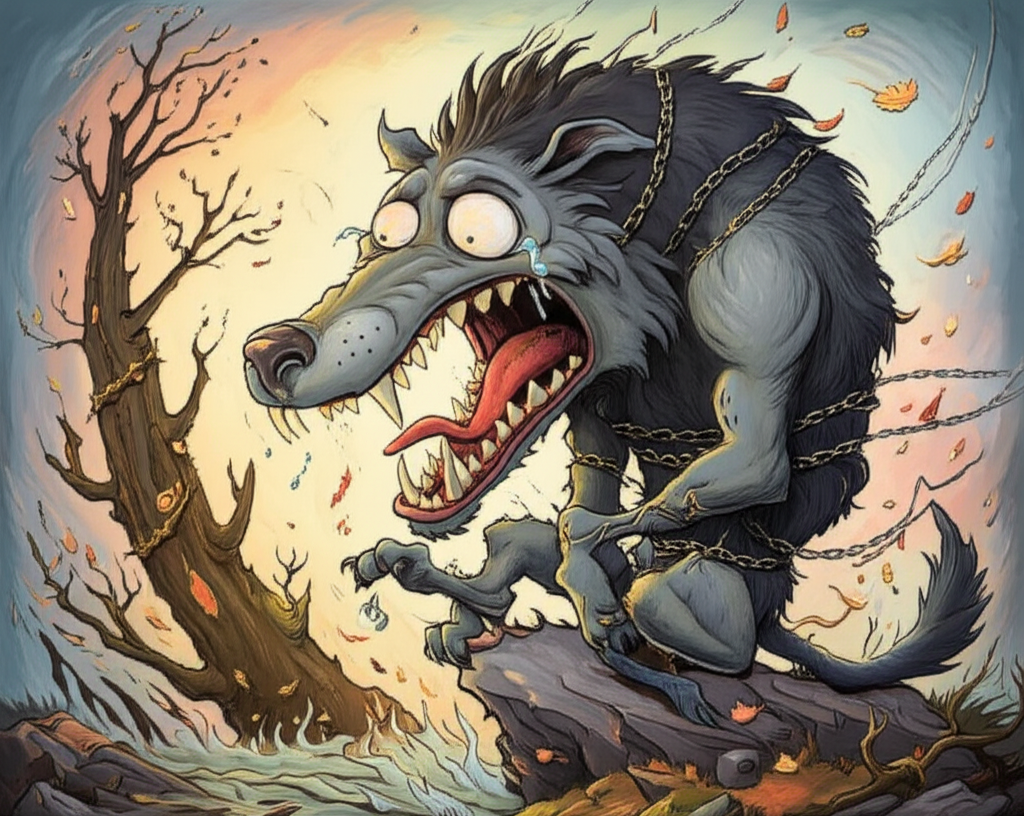
In the frosty reaches of ancient Scandinavia, where longships carved through icy fjords and sagas were spun by firelight, a rich tapestry of myths and legends took root. Among these tales, passed down through generations of Norsemen, none loomed larger or carried more weight than the intricate narratives surrounding Yggdrasil, the mighty World Tree, and the beings whose fates were intertwined with its vast branches and deep roots. This article delves into one such pivotal legend: the binding of Fenrir, a monstrous wolf whose destiny was inextricably linked to the cosmic order and the ultimate fate of the gods themselves. It is crucial to understand that this is a traditional story, a product of human imagination and cultural expression by ancient peoples, and not a factual account or a system of belief to be adopted.
Echoes from a Northern World: Origins and Cultural Background
The myths of Fenrir, Yggdrasil, and the pantheon of Norse gods emerged from a society deeply connected to the natural world – a world often harsh, unpredictable, and majestic. The cultural era in which these myths flourished, particularly during the Viking Age (roughly 8th to 11th centuries CE), was characterized by a blend of agricultural life, seafaring exploration, and martial prowess. For these ancient Germanic peoples, life was a continuous struggle against formidable forces, both seen and unseen. Their worldview was inherently polytheistic, populated by a diverse array of gods (the Æsir and Vanir), giants (Jötnar), dwarves, elves, and other beings, each playing a role in the grand cosmic drama.
At the heart of their cosmos stood Yggdrasil, the ash tree of immense size that connected the nine worlds, from Asgard, the realm of the gods, to Niflheim, the realm of ice and mist. Yggdrasil represented order, connection, and the very structure of existence. Its health reflected the health of the cosmos. Yet, even this mighty tree was not immune to the forces of decay and destruction, foreshadowing the cyclical nature of their beliefs – a world destined for a glorious, yet catastrophic, end known as Ragnarök. Fate, or wyrd, was a powerful concept; even the gods were subject to it, and their actions often stemmed from a desperate attempt to delay or prepare for the inevitable. The tales of the Æsir, therefore, are often imbued with a sense of tragic grandeur, of heroes battling against a destiny they cannot fully escape.
The Beast of Prophecy: Describing Fenrir
Central to this particular narrative is Fenrir, a creature whose very existence embodied the terrifying power of chaos and untamed destruction. According to the ancient Norse myths, Fenrir was no ordinary wolf. He was one of the three monstrous children of the trickster god Loki and the giantess Angrboða, his siblings being Jörmungandr, the Midgard Serpent, and Hel, ruler of the underworld. From the moment of his birth, Fenrir was destined for greatness – and for dread. The prophecies foretold that he would grow to an unimaginable size and power, eventually breaking free to devour Odin, the Allfather, and unleash untold destruction upon the world during Ragnarök.
Symbolically, Fenrir represents the primal, uncontrollable forces of nature and the inevitability of destruction. He is not merely an animal but a force of cosmic entropy, a manifestation of the gods’ deepest fears and the world’s eventual unraveling. His immense strength, his rapid growth, and his insatiable hunger speak to the overwhelming power that chaos can wield against order. He embodies the untamed wildness that ancient peoples both revered and feared, a reminder that even the most powerful deities could not fully control every aspect of their existence or escape their foretold doom. He is a symbol of a threat so profound that it requires the ultimate sacrifice and cunning to contain, even if only temporarily.
The Unbreakable Chain: A Narrative Retelling
As the ages turned under the watchful gaze of Yggdrasil, the gods of Asgard grew increasingly uneasy. Loki’s monstrous son, Fenrir, was growing at an alarming rate. What began as a fearsome pup soon became a wolf of immense proportions, his jaws capable of swallowing the sun and his eyes burning with an ancient, primal hunger. The Æsir, the most powerful of the gods, attempted to raise him within Asgard, hoping to control his destructive nature. But only Tyr, the courageous god of law and heroic glory, dared to feed the growing beast, placing his hand fearlessly into the wolf’s ravenous maw.
Yet, even Tyr’s bravery could not stem the tide of Fenrir’s growth. The prophecies of his ultimate role in Ragnarök weighed heavily on Odin’s wise mind. The gods knew they could not simply slay the wolf, for such an act would unleash a cascade of worse events and bring about their doom even faster. They resolved instead to bind him. Their first attempts were simple: two mighty chains, named Læding and Drómi, were forged with all the strength and skill available to the Æsir. With feigned playfulness, they challenged Fenrir to test his strength against them. Confident in his power, the wolf allowed himself to be bound, and with a single, furious surge of muscle, he snapped both chains as if they were threads. A grim silence fell upon Asgard.
Desperate, Odin dispatched Skirnir, Freyr’s messenger, to the hidden realm of the Svartálfar, the dark elves or dwarves, master smiths of unparalleled skill. He tasked them with forging a bond that no force could break. After much toil and secret craft, the dwarves presented the gods with Gleipnir. It appeared to be nothing more than a silken ribbon, light and soft, yet its composition was utterly extraordinary. It was made, so the story goes, from six impossible ingredients: the sound of a cat’s footfall, the roots of a mountain, the sinews of a bear, the breath of a fish, the beard of a woman, and the spittle of a bird. These were things that did not exist, or existed in such a subtle form that they were imperceptible, making Gleipnir paradoxically unbreakable.
The gods gathered once more, this time on the remote island of Lyngvi in the middle of Lake Amsvartnir, a desolate place where Fenrir could be isolated. They presented Gleipnir to the wolf, praising its delicate appearance and challenging him to break it. Fenrir, however, was no fool. He eyed the slender ribbon with suspicion. "Such a thin band," he growled, "would be no glory to break. But if it is made by magic, then it may hold me, and I will not risk my freedom for your amusement."
He demanded a pledge of good faith: one of the Æsir must place a hand in his mouth as a guarantee that no trickery was intended. Fear gripped the gods. They knew the prophecies, they knew the truth of Gleipnir. Silence stretched, heavy and cold. Then, Tyr, the brave and honorable god, stepped forward without hesitation. He placed his right hand deep into Fenrir’s monstrous maw.
The gods then bound Fenrir with Gleipnir. The wolf struggled, his muscles straining, his jaws clamping down. But the more he struggled, the tighter the seemingly delicate ribbon became. His roars of frustration and rage echoed across the desolate island. Only when he realized he was truly trapped did he snap his jaws shut, severing Tyr’s hand at the wrist. Tyr cried out, not in pain, but in acceptance of his sacrifice for the greater good of the cosmos. The gods, despite their sorrow for Tyr, rejoiced, for Fenrir was bound. They then fastened the end of Gleipnir to a massive boulder, Gjöll, and hammered a peg, Thviti, deep into the earth to secure it. Fenrir howled ceaselessly, his rage so immense that they thrust a sword into his mouth, its hilt against his lower jaw and its point against his upper, silencing his protests with a stream of foam that formed the river Ván. And there he remains, chained until the twilight of the gods, his binding ensuring the temporary stability of the worlds connected by Yggdrasil, yet always a reminder of the inevitable doom to come.
Unveiling Ancient Meanings: Symbolism and Interpretation
To the ancient Norse, the binding of Fenrir was far more than a thrilling narrative; it was a potent allegorical tale steeped in meaning. Fenrir himself was a profound symbol of the uncontrollable forces of chaos and destruction that perpetually threaten the order of the cosmos. His growth and untamable nature represented the overwhelming power of the wild, the destructive aspects of nature, and the unpredictable dangers that ancient peoples faced daily. The gods’ struggle to bind him reflected humanity’s ongoing efforts to impose order and structure upon a chaotic world.
Tyr’s sacrifice is a powerful testament to selfless leadership and the price of maintaining order. He willingly gave his hand, not for personal glory, but for the collective safety of the gods and the stability of the worlds. This act underscored the belief that even divine beings were capable of immense sacrifice and that true leadership sometimes demanded a heavy personal cost. It also highlighted the notion of justice and fairness, as Tyr, the god of law, was the one to pay the ultimate price to uphold the cosmic laws against Fenrir’s destructive nature.
Gleipnir, with its impossible ingredients, symbolized wisdom, cunning, and the power of ingenuity over brute force. The gods could not overpower Fenrir directly, but through cleverness and the unique skills of the dwarves, they found a way to contain him. This suggests that intelligence and strategy were valued as highly as physical strength in overcoming seemingly insurmountable challenges.
Ultimately, the entire narrative reinforces the Norse concept of inevitable fate (wyrd). Even with Fenrir bound, the gods knew it was not a permanent solution. The prophecies foretold his eventual release during Ragnarök, where he would fulfill his destiny and devour Odin. This story, therefore, is a poignant reminder that while one can delay or prepare for destiny, one cannot ultimately escape it. It instilled a sense of fatalism, but also a call to face one’s fate with courage and honor, much like Tyr faced his.
Enduring Echoes: The Myth in the Modern World
Today, the myth of Fenrir’s binding continues to resonate, transcending its ancient origins to find new life in contemporary culture. While no longer held as a literal truth, its themes and imagery are widely appreciated for their cultural, historical, and educational value. In literature, the story has inspired countless fantasy novels, poems, and comics, often exploring themes of inevitable doom, sacrifice, and the struggle against overwhelming evil. Authors like Neil Gaiman, in his "American Gods," draw heavily from Norse mythology, reinterpreting these ancient figures for a modern audience.
In popular media, Fenrir and the other Norse deities are prominent figures. Marvel Comics and its cinematic universe (MCU) have introduced a version of Fenris Wolf, albeit a reimagined one, to millions worldwide, demonstrating the enduring appeal of these powerful archetypes. Video games, such as the critically acclaimed "God of War" series and "Assassin’s Creed Valhalla," immerse players in richly detailed worlds inspired by Norse cosmology, allowing them to encounter characters like Fenrir and experience the narratives firsthand.
Academically, the myth is studied in fields ranging from comparative mythology and religious studies to literature and cultural history. Scholars analyze its structural elements, its relationship to other world myths, and its insights into the psychology and worldview of ancient peoples. The story of Fenrir’s binding remains a powerful example of human imagination, our universal fascination with creation and destruction, and our innate desire to understand our place within the grand, often unpredictable, tapestry of existence.
A Legacy of Imagination: Conclusion
The binding of Fenrir, set against the cosmic backdrop of Yggdrasil, stands as a testament to the profound imagination and storytelling prowess of the ancient Norse. It is a captivating tale that, like all myths, offers a window into the values, fears, and understandings of a people long past. It speaks of the precarious balance between order and chaos, the necessity of sacrifice, and the inexorable march of fate.
As Muslims, we recognize that the universe and all within it are creations of Allah, the One True Creator and Sustainer, whose power is absolute and whose knowledge encompasses all things, past, present, and future. We understand that these mythological narratives, while rich in cultural and historical significance, are products of human invention and do not reflect divine truth.
Yet, there is immense value in appreciating these stories as part of humanity’s diverse cultural heritage. They remind us of the universal human quest for meaning, the power of narrative to explain the inexplicable, and the enduring legacy of imagination. The tale of Fenrir, like countless other myths, serves as a powerful reminder of the human spirit’s capacity for creativity, the timeless art of storytelling, and the cultural richness that arises when people seek to comprehend their world through the lens of legend.


