fufufafa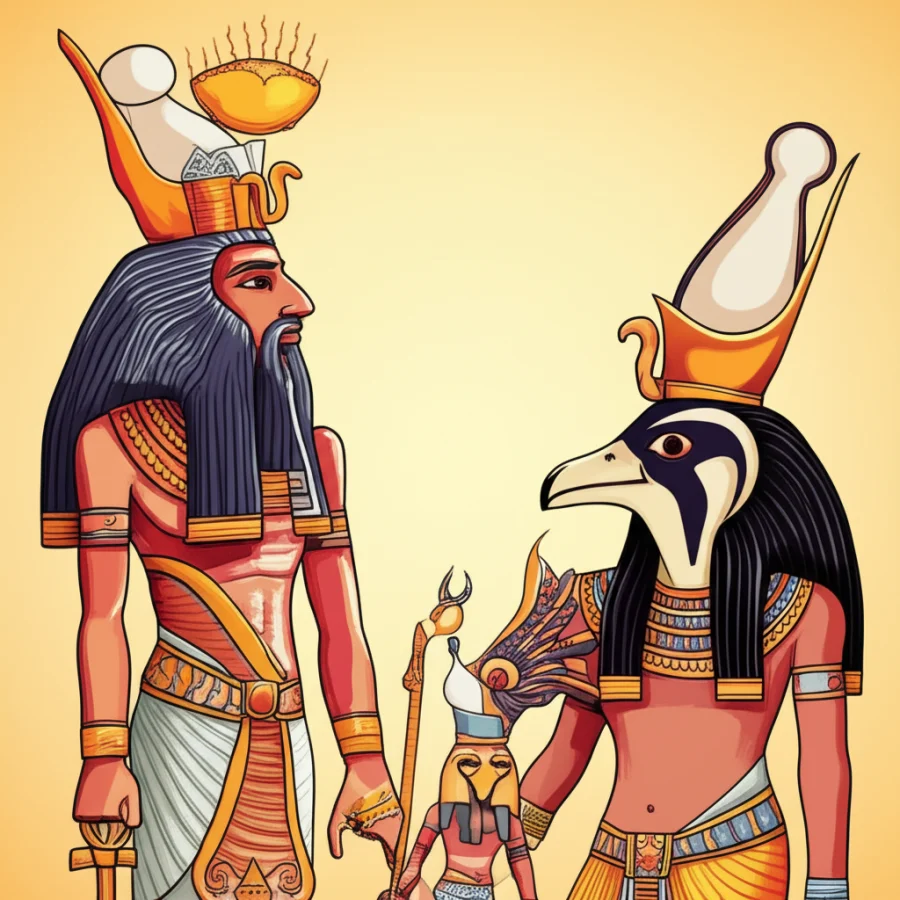
The sands of ancient Egypt, warmed by an unyielding sun, were the cradle of a rich tapestry of myths and legends. Among these, none quite capture the drama of cosmic order and its fragility like the story of Ra, the sun god, and the turbulent War of Contendings between his grandson Horus and his brother Set. This is not a tale of historical fact, but a vibrant narrative woven by the ancient Egyptians to understand the world, their place within it, and the forces that shaped their lives. These stories, passed down through generations via hieroglyphs, papyri, and oral tradition, offered explanations for the cyclical nature of the Nile, the scorching heat of the desert, and the very concept of kingship.
The cultural milieu of ancient Egypt was one deeply intertwined with the natural world. Their civilization flourished along the fertile banks of the Nile, a lifeline that dictated their agricultural cycles and their perception of time. The desert, a stark contrast to the verdant river valley, represented chaos and the unknown. Their worldview was inherently dualistic: order versus chaos, light versus darkness, life versus death. The pantheon of gods and goddesses they conceived were not distant, abstract deities, but active participants in the daily and cosmic drama, their actions mirroring the forces of nature and the challenges of human existence. In this context, the story of Ra and the struggle between Horus and Set served as a profound allegory for the eternal battle to maintain Ma’at – the principle of cosmic order, truth, justice, and balance – against the ever-present threat of Isfet, chaos and disorder.
At the heart of this celestial drama stands Ra, often depicted as a majestic falcon-headed man crowned with a solar disk encircled by a cobra. Ra represented the ultimate celestial power, the life-giving sun that traversed the sky each day, bringing light and warmth to the world. He was the king of the gods, the primeval creator, and the embodiment of supreme authority. His power was immense, his reign seemingly eternal, yet even the sun god could not escape the machinations of those who sought to disrupt the cosmic order.
His antagonist, or rather, the instigator of much of the conflict, was his brother, Set. Set was often depicted as a powerful, enigmatic creature with a distinctive animalistic head, sometimes described as a "Set animal" or an aardvark-like beast, with long ears and a curved snout. Set was the god of storms, the desert, violence, and chaos. He was the embodiment of untamed power, unpredictable and often destructive. While not inherently evil in the modern sense, Set represented the forces that threatened stability, the wild and untamed aspects of existence that needed to be contained for life to flourish.
The story of the War of Contendings is a complex narrative that unfolds over many millennia, recorded in various Egyptian texts, most notably the Great Hymn to Ra and the Contendings of Horus and Set. The foundational event that sets the stage is the murder of Osiris, Ra’s son and the rightful heir to the throne of Egypt, by his jealous brother, Set. Osiris, a benevolent king who had brought civilization to Egypt, was dismembered and scattered, plunging the land into a period of darkness and grief.
However, Osiris’s devoted wife and sister, Isis, meticulously gathered his remains and, through her magic, conceived their son, Horus. Horus, raised in secret by Isis and protected by other gods, grew into a formidable warrior and the rightful claimant to his father’s throne. The narrative then becomes a protracted struggle between Horus and Set, a cosmic battle for legitimacy and the preservation of order.
This war was not a swift, decisive conflict but a series of trials, duels, and divine judgments that tested the strength, wisdom, and cunning of both Horus and Set. Ra, as the supreme ruler, often presided over these contests, though his role could be ambivalent, sometimes leaning towards Set due to their brotherhood, and at other times favoring Horus, the rightful heir. The gods themselves were divided, with some siding with Set’s brute strength and others with Horus’s claim to justice and lineage.
Imagine these scenes: a roaring Set, his desert winds whipping around him, challenging Horus in a furious storm. Picture Horus, his falcon eyes sharp and unwavering, meeting Set’s fury with disciplined resolve. They fought not just with physical might, but also through trickery and magical duels. In one famous episode, Set disguised himself as a hippopotamus and attacked Horus’s boat, but Horus, with his keen senses, pierced the beast. In another instance, Set managed to trick Horus into a sexual encounter, an act that was meant to humiliate Horus and solidify Set’s dominance. However, Isis, ever vigilant, devised a clever counter-measure, extracting Set’s “seed” from Horus and feeding it to a gazelle, thus ensuring that Set’s power would not be passed on through Horus.
These contests were overseen by divine tribunals, where the gods would debate the merits of each claimant. It was a long and arduous process, reflecting the ancient Egyptian belief that true justice and order were not easily won. Eventually, after numerous battles and judgments, and with the persistent advocacy of Isis and the wisdom of Thoth, the god of wisdom and writing, Horus was finally declared the rightful king of Egypt. Set, though defeated in his claim to the throne, was not entirely vanquished. He retained dominion over the desert and the forces of chaos, a necessary duality that, when kept in check, allowed for the flourishing of life under Horus’s rule.
The symbolism embedded within the War of Contendings is rich and multifaceted. The conflict between Horus and Set can be seen as a representation of the eternal struggle between order (Ma’at) and chaos (Isfet). Horus embodies the established, rightful order, the divine kingship, and the principles of justice and truth. Set, on the other hand, represents the untamed forces of nature, the potential for disruption, and the inherent challenges to stability. The cyclical nature of their battles mirrored the daily journey of Ra across the sky, a constant renewal of light and order against the encroaching darkness.
The myth also served as a profound commentary on leadership and legitimacy. Horus’s victory affirmed the importance of lineage, justice, and the divine right to rule. Set’s continued existence, however, acknowledged that chaos is an intrinsic part of the universe, and that vigilance and strength are always required to maintain order. The gods’ participation in the conflict reflected the ancient Egyptians’ belief that divine forces were actively involved in human affairs, shaping destinies and influencing the course of events.
In the modern world, the myth of Ra and the War of Contendings continues to resonate. It has inspired countless works of literature, art, and popular culture. From epic fantasy novels that explore themes of divine conflict and rightful succession to video games where players embody heroic figures battling against chaotic forces, the archetypal struggle between order and chaos, embodied by Horus and Set, remains a powerful narrative engine. In academic circles, these myths are studied for their insights into ancient Egyptian religion, social structures, and their unique cosmological understanding.
It is crucial to reiterate that these are ancient stories, born from the imagination and cultural understanding of a bygone era. They are a testament to the power of human storytelling, our innate desire to explain the inexplicable and to find meaning in the universe. As Muslims, we understand that the ultimate Creator and Sustainer of all existence is Allah (God), who is One and has no partners. The narratives of Ra and the Egyptian pantheon are viewed through the lens of cultural heritage and historical inquiry, not as divine truths.
The tales of Ra and the War of Contendings serve as a fascinating window into the minds of ancient Egyptians. They offer a glimpse into a world where gods walked among mortals, where the sun was a divine chariot, and where the very fabric of existence was a constant negotiation between order and chaos. These stories, preserved through the ages, remind us of the enduring power of myth and legend, the boundless capacity of the human imagination, and the rich tapestry of cultural heritage that continues to inform and inspire us today. They are a reminder that even in the most ancient of stories, we can find echoes of our own struggles and aspirations for a world of balance and meaning.