fufufafa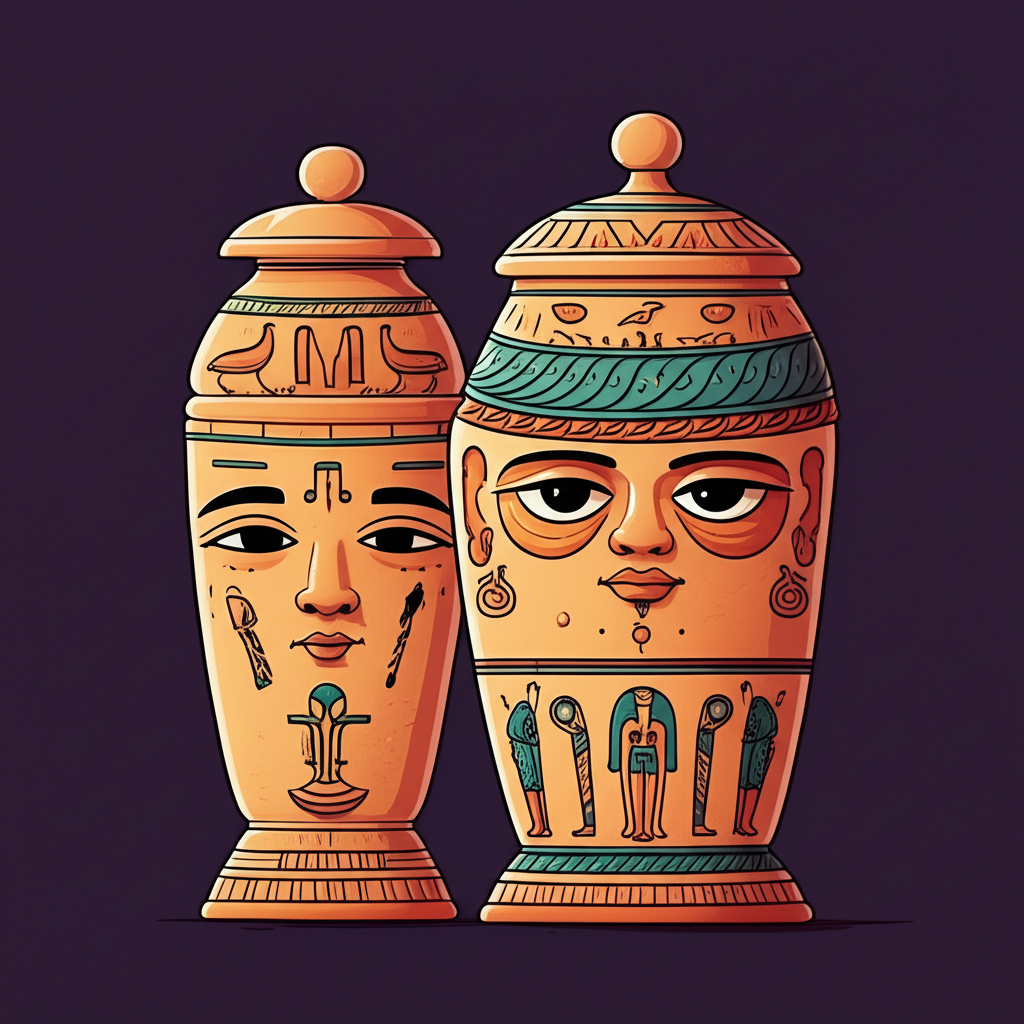
Introduction:
From the sun-baked lands of ancient Egypt, a civilization that thrived for millennia along the fertile Nile River, comes a tale steeped in mystery and reverence for the afterlife. This is the story of the Canopic Jars, vessels not of earthly treasure, but of something far more sacred: the preserved organs of the deceased. This is a traditional story, passed down through generations by the ancient Egyptians, reflecting their deep-seated beliefs about death, resurrection, and the intricate balance of the cosmos.
Origins and Cultural Background:
Imagine a world bathed in the golden light of the Egyptian sun, a world where the rhythm of life was dictated by the annual flooding of the Nile. This was a world governed by pharaohs considered divine rulers, intermediaries between humanity and the gods. The ancient Egyptians possessed a complex and elaborate belief system centered around the afterlife. They believed that death was not an end, but a transition to a new existence, a journey fraught with peril but ultimately leading to eternal life in the Field of Reeds, a paradise mirroring their earthly existence.
Their worldview was deeply influenced by the concept of Maat, the principle of cosmic order, truth, justice, and balance. Maat permeated every aspect of their lives, from the pharaoh’s rule to the individual’s moral conduct. They believed that maintaining Maat was crucial for the stability of the universe and the success of their civilization. This belief extended to the afterlife; to achieve eternal life, the deceased had to prove that they had lived in accordance with Maat. The weighing of the heart ceremony, where the deceased’s heart was weighed against the feather of Maat, was a critical part of this judgment.
The preparation for the afterlife was a meticulous and elaborate process, involving mummification, the creation of elaborate tombs filled with provisions for the journey, and the careful preservation of the organs. This is where the Canopic Jars enter the story.
Character / Creature Description:
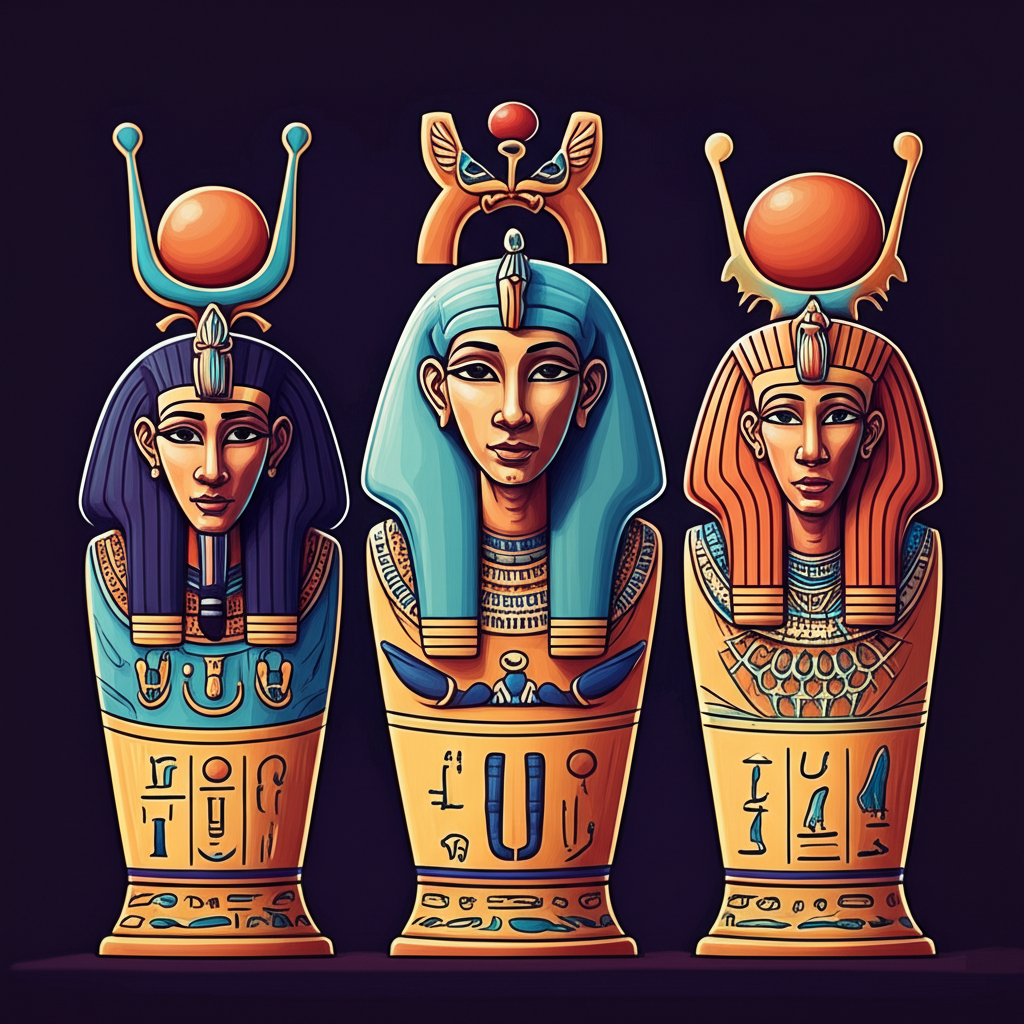
The Canopic Jars themselves are not creatures or beings in the literal sense, but rather vessels that were imbued with symbolic power and divine protection. Each jar was dedicated to one of the four sons of Horus: Imsety, Hapy, Duamutef, and Qebehsenuef. These sons were themselves protectors, each associated with a specific cardinal direction and a specific organ.
-
Imsety: Depicted with a human head, Imsety guarded the liver. He was associated with the south and was often protected by the goddess Isis. The liver, believed to be the seat of emotions and life force, needed careful protection.
-
Hapy: With the head of a baboon, Hapy watched over the lungs. He was associated with the north and was under the protection of the goddess Nephthys. The lungs, responsible for breathing and therefore life, were crucial for the deceased’s journey.
-
Duamutef: Represented with the head of a jackal, Duamutef protected the stomach. He was associated with the east and was guarded by the goddess Neith. The stomach, responsible for digestion, held importance in the provision of sustenance in the afterlife.
-
Qebehsenuef: Sporting the head of a falcon, Qebehsenuef cared for the intestines. He was associated with the west and was under the protection of the goddess Serket. The intestines, often associated with waste and impurities, were still deemed important enough to be preserved.
These four sons of Horus, protectors of the vital organs, were essential figures in the ancient Egyptian understanding of the afterlife. They were not gods to be worshipped, but symbols of protection, preservation, and the vital importance of the body’s components in the journey to eternal life.
Main Story / Narrative Retelling:
As the sun dipped below the horizon, casting long shadows across the bustling city of Thebes, the embalmers worked diligently. Inside a dimly lit chamber, filled with the scent of resins and herbs, they meticulously prepared the body of a noble for its journey to the afterlife. The noble had lived a long and prosperous life, and his family spared no expense to ensure his safe passage to the Field of Reeds.
With precise movements, the embalmers carefully removed the vital organs: the liver, lungs, stomach, and intestines. These organs, once pulsating with life, were now cleansed and treated with natron, a naturally occurring salt, to dehydrate and preserve them.
Once prepared, each organ was placed into its designated Canopic Jar. Imsety, with his human head, received the liver. Hapy, the baboon-headed guardian, sheltered the lungs. Duamutef, the jackal, watched over the stomach, and Qebehsenuef, the falcon, protected the intestines.
The jars themselves were not merely containers; they were vessels of protection, each guarded by the respective son of Horus and their associated goddess. Prayers were chanted, and spells were recited to ensure the safety and integrity of the organs throughout the long journey to the afterlife.
The Canopic Jars, now sealed and adorned with intricate decorations, were placed alongside the mummified body in the tomb. They were an integral part of the funerary equipment, ensuring that the deceased had all the necessary components for a successful resurrection and eternal life. The family believed that without these organs, carefully preserved and protected, the noble would be unable to complete his journey and would be forever lost in the realm of the dead.
Symbolism and Meaning:
The Canopic Jars represent the ancient Egyptians’ deep concern for the physical integrity of the body in the afterlife. They believed that the body was essential for the Ka, the life force, to recognize and inhabit in the next world. By preserving the organs, they aimed to ensure that the deceased would be whole and complete in the afterlife, able to enjoy the eternal paradise.
The four sons of Horus and their associated goddesses represent protection, order, and the maintenance of Maat. Each son guarding a specific organ highlights the importance of each part of the body in the journey to the afterlife. The association with the cardinal directions further emphasizes the cosmic order that the Egyptians believed was essential for a successful transition to the next world.
The entire process, from the mummification to the placement of the Canopic Jars, was a symbolic act of ensuring the continuity of life beyond death. It reflected their belief in resurrection, eternal life, and the power of ritual to influence the destiny of the deceased.
Modern Perspective:
Today, the Canopic Jars are not viewed as objects of religious veneration, but as fascinating artifacts that offer insights into the beliefs and practices of ancient Egyptian civilization. They are displayed in museums around the world, captivating visitors with their intricate designs and the stories they tell about death, the afterlife, and the sophisticated culture of ancient Egypt.
They appear in literature, movies, and video games, often as symbols of ancient power, mystery, and the allure of the afterlife. For example, they might appear in adventure films where the heroes are searching for lost treasure within an Egyptian tomb. Their image is powerful and evocative, representing a culture that was both sophisticated and deeply spiritual.
In cultural studies, the Canopic Jars are studied as examples of ancient Egyptian art, religious beliefs, and funerary practices. They provide valuable information about the society, economy, and worldview of this ancient civilization.
Conclusion:
The story of the Canopic Jars is a compelling reminder of the rich cultural heritage left behind by the ancient Egyptians. It is a story of death and resurrection, of cosmic order and divine protection, of the human desire for immortality. It is a story that continues to fascinate and inspire, offering a glimpse into the minds and hearts of a people who lived thousands of years ago.
As Muslims, we recognize that only Allah is the true Creator and Sustainer of all life. He alone has the power to grant eternal life. However, we can still appreciate the cultural significance of the Canopic Jars as a testament to the human imagination and the enduring power of storytelling. The story of the Canopic Jars reminds us of the importance of understanding and respecting different cultures and their unique perspectives on life, death, and the mysteries of the universe. It is a story to be remembered and reflected upon, not as a belief system, but as a fascinating example of human history and cultural expression.