fufufafa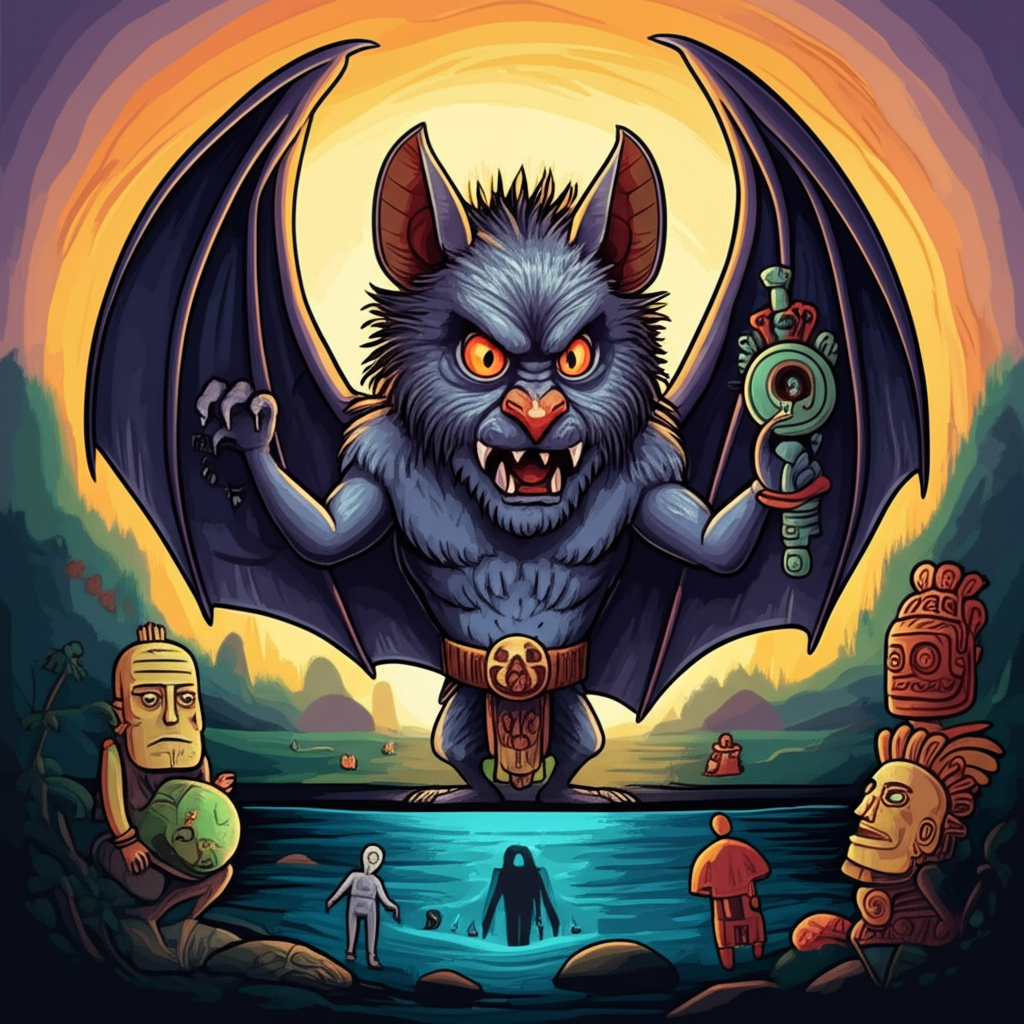
Introduction:
We journey now into the realm of ancient storytelling, to the heart of the Maya civilization, a vibrant culture that flourished in the jungles of present-day Mexico and Central America. This is a story spun from the threads of tradition, a narrative woven by the Maya ancestors to explain the mysteries of the world and the human experience. It is crucial to remember that this is a tale, a cultural artifact, not a divine truth. We explore it to understand the imaginative world of the Maya, their fears, their hopes, and the intricate ways they sought to make sense of life and death. The following narrative concerns Camazotz, a fearsome bat god, and the enigmatic River of Souls, a place spoken of in hushed whispers.
Origins and Cultural Background:
The Maya civilization, reaching its zenith between 250 and 900 CE, was a sophisticated society of astronomers, mathematicians, and artists. They built majestic cities, adorned with elaborate temples and palaces, and developed a complex hieroglyphic writing system. Their lives were interwoven with the cycles of the sun, moon, and stars, which they meticulously tracked. The natural world – the dense rainforest, the sacred cenotes (sinkholes), and the looming volcanoes – held deep significance for them. They believed the cosmos was a vibrant, interconnected web, populated by gods, humans, and other supernatural beings. Their understanding of the world was often rooted in cyclical patterns: the seasons, the rise and fall of empires, and the inevitable journey of life, death, and rebirth. Death, for the Maya, wasn’t an ending but a transformation, a passage into the underworld, Xibalba, a realm ruled by fearsome deities. Their beliefs reflected a deep reverence for the ancestors, a fear of the unknown, and a belief in the power of ritual and sacrifice to maintain cosmic balance.
Character/Creature Description: Camazotz
Camazotz, whose name translates to "death bat" or "blood bat" in the Mayan language, was a deity of the night, darkness, and sacrifice. Depicted in various forms, he was often represented as a humanoid figure with the head and wings of a bat, a creature associated with the darkness of the caves and the night. His presence was not one of benevolence; Camazotz was a harbinger of death, a symbol of the dangers that lurked in the shadows. His image appeared in the Popol Vuh, the sacred book of the Maya, where he is portrayed as one of the monstrous creatures inhabiting Xibalba. Camazotz was not merely a fearsome creature; he was a manifestation of the fear of death, the unknown, and the forces that could bring an end to life. The bat, in Maya cosmology, was linked to the underworld, caves, and the realm of the dead.
Main Story/Narrative Retelling:
The tale begins in the sun-drenched city of Palenque, a flourishing Maya kingdom. Two brave brothers, Hunahpu and Ixbalanque, renowned for their skills and courage, ventured into the underworld, Xibalba, to avenge the death of their father. Their journey was perilous, a series of trials set by the Lords of Death. One of the deadly challenges they faced was the House of Bats, a cavernous chamber in Xibalba. Here, in the deepest darkness, lived the Camazotz.
As the brothers entered the House of Bats, the air grew thick with a chilling silence, broken only by the incessant flapping of unseen wings. Thousands upon thousands of bats filled the chamber, their shadows dancing on the damp stone walls. Hunahpu, driven by a thirst for vengeance, peered into the darkness, but his gaze was quickly met by the onslaught of the Camazotz. The death bats swarmed the brothers, their razor-sharp fangs glinting in the faint light that filtered from the entrance.
Hunahpu, fearing the deadly embrace of the Camazotz, ducked down in the darkness and was beheaded. Ixbalanque, filled with grief and a desperate need to save his brother, was able to retrieve his brother’s head and cleverly replace it with a gourd. Thus, with his brother’s head replaced, Ixbalanque outwitted the death bats and eventually resurrected his brother.
After they had escaped the House of Bats, the brothers continued on their journey. Eventually, they reached the River of Souls. The river was said to be the dividing line between the land of the living and the realm of the dead, its waters reflecting the fate of the souls who crossed it. The brothers, now aware of the danger, cautiously navigated the river, their every move watched by unseen eyes. The waters whispered secrets of those who had passed through, their stories echoing in the current.
The brothers, through cunning and courage, successfully navigated the River of Souls and ultimately triumphed over the Lords of Death, bringing them back to the world.
Symbolism and Meaning:
The story of Camazotz and the River of Souls carries profound symbolic weight. Camazotz, as the death bat, embodies the fear of mortality, the darkness that awaits at the end of life’s journey. The House of Bats represents the challenges and dangers that one must face on the path to the afterlife, the trials that test courage and resilience. The brothers’ journey into Xibalba symbolizes the journey of the soul after death, the trials, the fears, and the eventual triumph over death.
The River of Souls, on the other hand, is a liminal space, a boundary between worlds. It signifies the passage from life to death, a moment of transformation and transition. The whispers of the river represent the memories of the deceased, the echoes of their lives, and the lessons they have left behind. The brothers’ ability to navigate the river symbolizes the importance of facing the unknown with courage and wisdom, and their eventual triumph over the Lords of Death represents the cyclical nature of life, death, and rebirth, a core belief of the Maya.
Modern Perspective:
The myth of Camazotz and the River of Souls continues to resonate in modern times. It has inspired artists, writers, and filmmakers. In literature, it has been explored in novels and poems, reimagined and reinterpreted to explore themes of death, fear, and the search for meaning. In movies and video games, Camazotz’s image is used to evoke a sense of darkness and terror. Cultural studies have also taken an interest in the myth, exploring the story to understand the Maya’s worldview, their beliefs, and their social structures. The story acts as a reminder that every culture has a unique perspective on life and death, and it helps bridge the gap between cultures by promoting respect and tolerance.
Conclusion:
The tale of Camazotz and the River of Souls is a captivating glimpse into the rich tapestry of Maya mythology. It is a story of darkness and light, of fear and courage, of death and rebirth. It is crucial to remember that we approach this story as a cultural artifact, a testament to the imagination and wisdom of the Maya people. It is not an invitation to belief or worship, but rather an opportunity to appreciate the power of storytelling and the enduring human quest to understand the mysteries of existence.
As Muslims, we recognize that only Allah is the true Creator and Sustainer. We believe in the One God, the source of all existence, and we embrace the beauty of creation, while understanding the limits of human knowledge. The exploration of these ancient myths can be a source of learning and appreciation for cultural heritage. It promotes an understanding of different cultures, and it broadens our understanding of human history and our shared storytelling traditions. It is through the exploration of stories like this, from different cultures, that we gain a deeper appreciation for the rich diversity of human experience.