fufufafa
Introduction:
The whispers of the ancient Visayan people, etched into the very fabric of their existence, echo across the centuries in tales of gods, spirits, and celestial battles. One such story, a captivating blend of fear and wonder, revolves around the Bakunawa, a serpentine sea dragon, and its interactions with the celestial bodies. This is a traditional story, passed down through generations of the Visayan people, a testament to their vibrant culture and their attempts to understand the mysteries of the world around them. It is important to remember that this is a story, a narrative crafted by ancient people to explain phenomena they observed and to navigate the complexities of their lives. It is not a factual account, but rather a window into their beliefs, their fears, and their imaginative worldview.
Origins and Cultural Background:
The story of the Bakunawa, and its connection to Anitun Tabu, the goddess of wind and rain, finds its roots in the pre-colonial Visayas region of the Philippines. This was a time before widespread conversion to Christianity and Islam, a period when animistic beliefs and local deities shaped the daily lives of the people. The Visayan people, renowned seafarers and skilled artisans, lived in a world steeped in the rhythms of nature. The ocean, the sky, the land – all were believed to be inhabited by spirits, or anitos, who could influence human fortunes.
Their society was largely agrarian and maritime, deeply reliant on the bounty of the sea and the fertile soil. The sun, moon, and stars guided their navigation and marked the passage of time. Natural disasters, such as typhoons, eclipses, and earthquakes, were interpreted as the wrath of the gods or the disruptive actions of powerful creatures like the Bakunawa. The environment dictated their lives, and understanding and appeasing the spirits of nature was paramount to their survival. The world was perceived as a delicate balance, where harmony was achieved through rituals, offerings, and the respect for the unseen forces that governed all things. Their understanding of the cosmos was rooted in observation, speculation, and the desire to find meaning in a world teeming with the unknown.
Character / Creature Description:
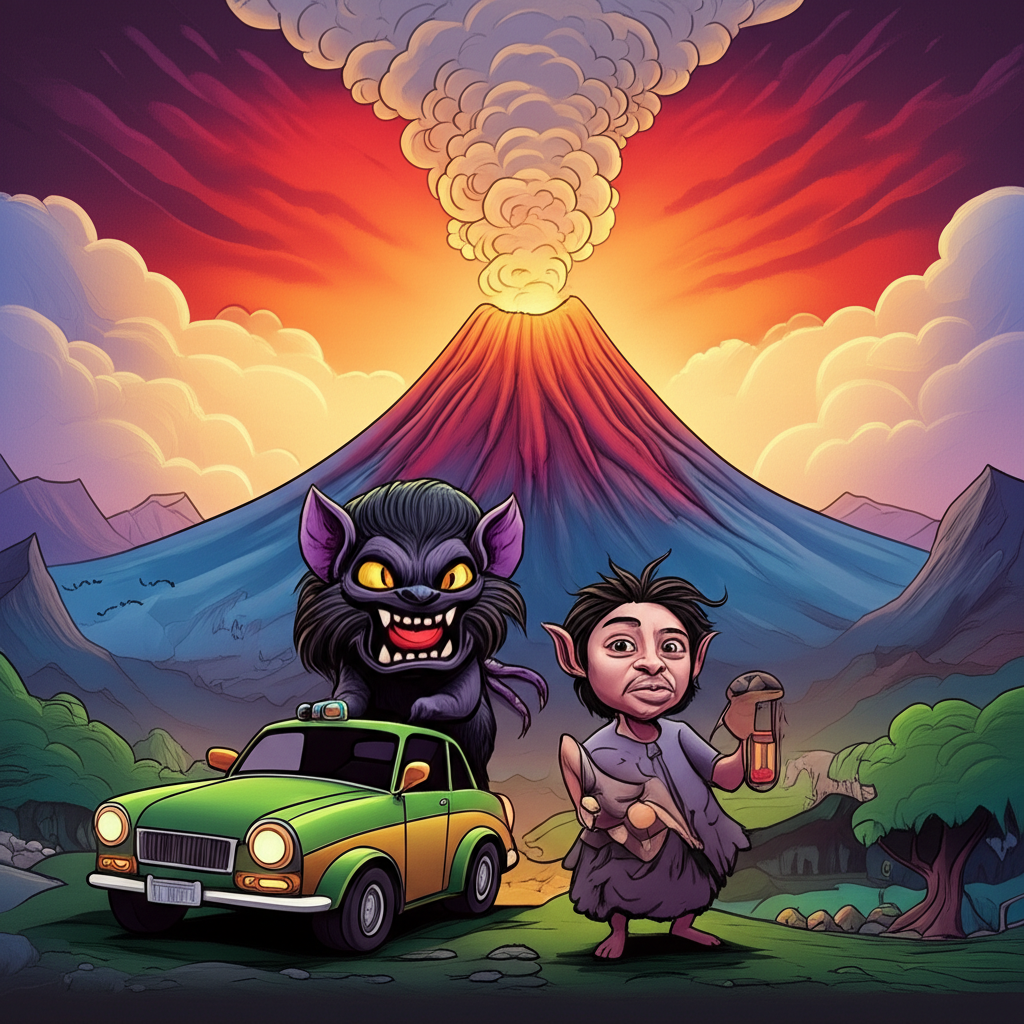
The Bakunawa, the central figure in this myth, is a colossal sea serpent, often depicted as a dragon-like creature of immense size and power. Its scales shimmered like a thousand polished obsidian mirrors, reflecting the light of the sun and moon. Its form varied in description, but it was generally envisioned as possessing a massive serpentine body, a fearsome head with a gaping maw filled with razor-sharp teeth, and often, wings that could churn the ocean into a tempest.
Symbolically, the Bakunawa represented the forces of chaos, darkness, and the unknown. It embodied the primal fear of the Visayan people towards the destructive potential of nature, the unpredictable fury of the sea, and the mysteries of the night. The Bakunawa was not inherently evil; instead, it served as a powerful metaphor for the challenges and dangers that humanity faced. Its vast size and serpentine form could also represent the cyclical nature of time and the continuous interplay of creation and destruction. The Bakunawa was a reminder that even the most beautiful and life-giving aspects of the world could be threatened by unseen forces.
Anitun Tabu, the goddess of wind and rain, is described as being a beautiful and powerful woman. She is the one who the Bakunawa is said to have battled with. The wind and rain are symbols of her power.
Main Story / Narrative Retelling:
In the ancient times, before the coming of the Spanish galleons, the sun and moon shone brightly upon the Visayas. The sun, a golden disc, traversed the sky each day, bringing warmth and light. The moon, a silver orb, illuminated the nights, guiding the seafarers and marking the passage of time. But there existed a fear, a creeping dread, that lived in the hearts of the people: the Bakunawa.
This monstrous sea serpent, driven by an insatiable hunger, sought to consume the celestial bodies. The Bakunawa, its colossal form hidden beneath the waves, would rise from the depths and attempt to swallow the moon. Whenever the Bakunawa opened its vast jaws to devour the moon, an eclipse would occur.
The people, witnessing the darkness that fell upon the land, would react with a mixture of fear and determination. They believed that the only way to save the moon was to make as much noise as possible. They would bang on gongs, beat drums, and shout at the top of their lungs, hoping to scare the Bakunawa away. The noise, they believed, would startle the beast and cause it to regurgitate the moon, restoring light to the world.
The Visayans also invoked the aid of their gods and goddesses. They prayed to the deities, pleading for help in warding off the Bakunawa. One of the most important deities involved in this battle was Anitun Tabu, the goddess of wind and rain. She would come to defend the sun and moon against the Bakunawa.
According to some versions of the story, the Bakunawa was even able to eat the moon and, at times, even the sun. But in all instances, the people would make a loud noise to make the beast regurgitate the moon or sun.
The story goes that, as a result of the Bakunawa eating the moon and sun, the goddess of wind and rain, Anitun Tabu, would come and battle the Bakunawa.
This tale served as a reminder of the fragility of the natural order and the importance of community and collective action in the face of adversity. The recurring eclipses served as a dramatic reminder of the constant battle between light and darkness, between order and chaos, a struggle that was eternally reflected in the myths and legends of the Visayan people.
Symbolism and Meaning:
The story of the Bakunawa holds profound symbolic significance. The Bakunawa itself represents primal forces – chaos, darkness, and the unpredictable power of nature. The eclipses, in this context, are not simply natural phenomena; they become dramatic representations of the struggle between good and evil, the battle for the preservation of light and order.
The actions of the people, their frantic efforts to drive away the Bakunawa with noise, reflect their deep connection to the natural world and their belief in their ability to influence the celestial order through their actions. The story can be seen as an allegory for overcoming fear and facing the unknown with courage and determination.
The story also highlights the importance of communal effort and collective action. The people understood that facing the Bakunawa required a united front, a combined effort of prayers, rituals, and the collective noise-making that was believed to frighten the creature away.
The story of the Bakunawa, therefore, served to reinforce the values of community, resilience, and the belief in the power of the human spirit to overcome adversity. It was a story that instilled hope, even in the face of the darkest of times.
Modern Perspective:
The myth of the Bakunawa continues to resonate in modern Filipino culture. It appears in various forms in literature, movies, games, and cultural studies. It provides inspiration for artistic creations, and serves as a reminder of the rich history of the Visayan people and their attempts to understand the world.
The Bakunawa can be seen as a cautionary tale about the dangers of unchecked power and the importance of respecting the environment. It is also interpreted as a symbol of the cyclical nature of life, death, and rebirth, representing the constant struggle between opposing forces. In cultural studies, the story is analyzed for its reflection of pre-colonial social structures, religious beliefs, and environmental awareness.
Conclusion:
The story of the Bakunawa, echoing from the Visayas Seas, is a testament to the power of human imagination and the enduring appeal of storytelling. It is a cultural artifact, a window into the beliefs and fears of the ancient Visayan people. It is crucial to remember that this is a story, a product of a specific time and place, not a literal truth. We, as Muslims, recognize that only Allah is the true Creator and Sustainer, the ultimate source of all power and existence.
The myth of the Bakunawa, however, offers a valuable opportunity to appreciate the rich tapestry of Filipino cultural heritage, the vibrant creativity of the human spirit, and the timeless importance of storytelling in shaping our understanding of the world. It reminds us of the power of imagination and the value of preserving the stories that connect us to our past.