
 fufufafa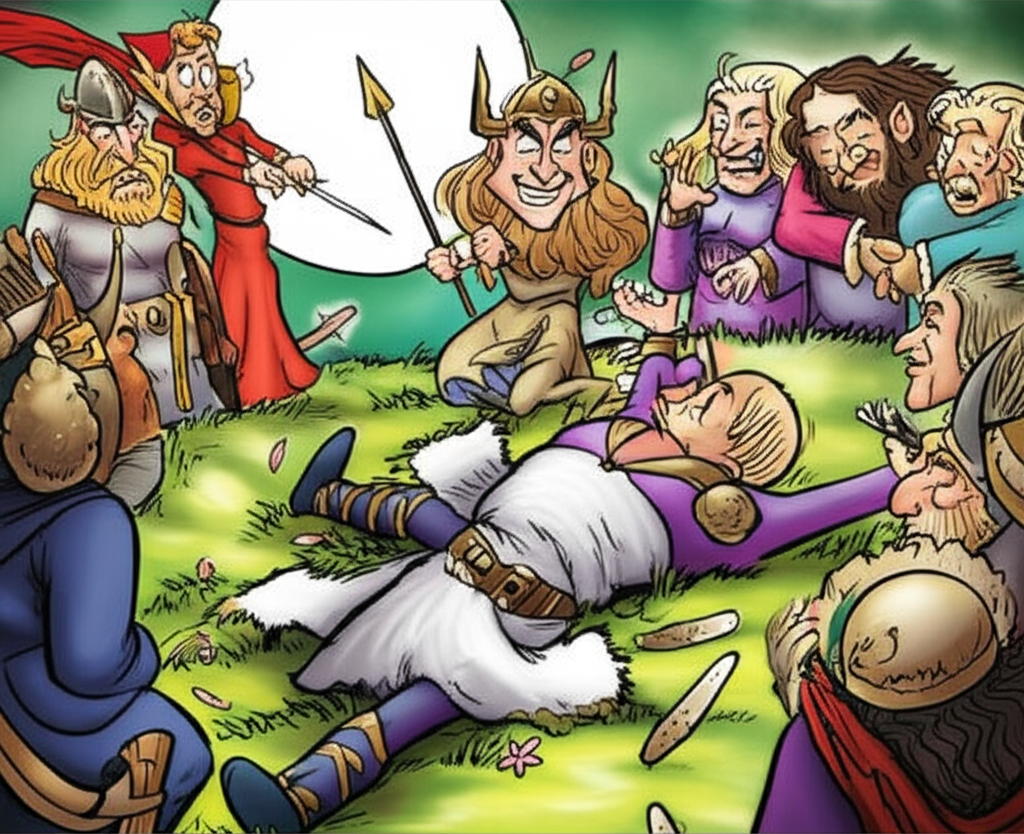
In the frost-kissed lands of ancient Scandinavia, where towering fjords met the churning sea and dense forests whispered tales of old, a rich tapestry of stories was woven by the people who called this rugged landscape home. Among the most poignant and significant of these narratives is the myth of Baldr’s death, a central event in the Norse cosmic drama that foreshadowed the ultimate doom of the gods. This is a traditional story, a legend passed down through generations by ancient communities, reflecting their worldview and values, and it is presented here solely for cultural, historical, and educational understanding, not as a matter of belief or worship.
Origins and Cultural Background
The myth of Baldr’s demise belongs to the vast corpus of Norse mythology, a collection of sagas and poems originating from the Germanic peoples of pre-Christian Scandinavia and Iceland, predominantly during what is known as the Viking Age (roughly 793–1066 CE). This was an era defined by exploration, trade, and occasional conflict, where communities lived in close communion with a powerful, often unforgiving natural world. Their society was structured around concepts of honor, fate, kinship, and the delicate balance between order and chaos.
For these ancient people, the world was not a singular plane but a complex cosmology of nine interconnected realms, all cradled within the branches and roots of the mighty World Tree, Yggdrasil. The gods and goddesses, inhabitants of Asgard, were not omnipotent beings but powerful entities bound by fate, much like mortals. They navigated a universe where the forces of nature, giants, dwarves, and other mythical beings played active roles. Life was perceived as cyclical, with creation and destruction intertwined, and even the divine realm was destined for an ultimate end – Ragnarök, the twilight of the gods, after which a new world would emerge. In this worldview, myths served not only as entertainment but also as explanations for natural phenomena, moral lessons, and reflections on the human condition, including the inevitability of loss and the struggle against overwhelming odds.
Character Descriptions
At the heart of this tragic tale are several key figures, each embodying distinct forces within the Norse mythological framework:
- Baldr: Known as Baldr the Beautiful, he was the radiant god of light, purity, beauty, and innocence. Son of Odin, the Allfather, and Frigg, the Queen of Asgard, Baldr was beloved by all beings, human and divine. His very presence brought joy and warmth to Asgard. Symbolically, Baldr represented the ideal of goodness and the flourishing of life, a beacon of hope and harmony.
- Loki: The trickster god, a jötunn (giant) by birth but sworn brother to Odin, Loki was a complex and often contradictory figure. He possessed a keen intellect, unparalleled cunning, and a mischievous nature that frequently led to trouble. While sometimes aiding the gods, Loki was also a master of deception and an agent of chaos, often driven by jealousy or a desire to subvert order. In this myth, he embodies the corrosive power of envy and destructive malice.
- **Hodr: Baldr’s blind brother, Hodr was a god of darkness, not out of malice, but due to his physical affliction. He was generally quiet and unassuming. His role in the story highlights how even well-meaning or innocent individuals can become unwitting instruments of tragedy, often due to manipulation by others.
- Frigg: Odin’s wise and foreseeing wife, the goddess of motherhood and household. Her deep love for her son, Baldr, drives her to extreme measures to protect him, yet even her formidable power and foresight cannot ultimately avert fate.
- The Mistletoe: A seemingly innocuous plant, the mistletoe holds a unique and crucial position in the narrative. Its symbolic importance lies in its apparent insignificance, yet it becomes the single, fatal vulnerability that unravels the gods’ protective spell. It represents the overlooked detail, the small flaw in an otherwise perfect defense, and the unexpected source of destruction.
The Main Story: A Shadow Falls Over Asgard
The tale begins with a creeping unease in the golden halls of Asgard. Baldr, the most beloved of the Aesir, was plagued by dark, prophetic dreams – visions of his own death. These dreams troubled the gods greatly, for Baldr’s light was essential to the vibrancy of their realm. Frigg, his devoted mother, was particularly distraught. Driven by her boundless love, she resolved to protect her son from any harm.
Frigg journeyed throughout the nine realms, speaking with every creature, every plant, every stone, and every element. She extracted solemn oaths from all things that they would never harm Baldr. Fire, water, iron, all metals, stones, earths, trees, beasts, birds, poisons, and diseases – each swore an oath, promising to leave Baldr untouched. Confident in her success, Frigg returned to Asgard, relieved that her son was now invulnerable.
With Baldr seemingly immune to all harm, the gods devised a new game for their amusement. They would gather in their assembly, throwing axes, spears, stones, and darts at Baldr, watching them harmlessly rebound from his radiant form. It was a joyous spectacle, a testament to Frigg’s love and Baldr’s charmed existence. All the gods participated, delighting in the innocent sport, all except for Loki, whose heart seethed with a familiar jealousy.
Loki watched from the sidelines, his cunning mind already working to find a flaw in Frigg’s grand design. Disguising himself as an old woman, he approached Frigg and, through clever questioning, learned of the one thing she had deemed too young and insignificant to extract an oath from: the mistletoe, a small, unassuming parasitic plant growing west of Valhalla.
With this vital piece of information, Loki’s malevolent plan took shape. He hurried to where the mistletoe grew, plucked a sprig, and fashioned it into a tiny, sharp dart. Returning to the assembly, he found Hodr, Baldr’s blind brother, standing apart from the others, unable to participate in the game. Loki approached Hodr, feigning sympathy. "Why do you not join in the sport, brother?" he asked, his voice dripping with false concern. Hodr replied that he could not see where to aim and had no weapon.
"I shall help you," Loki offered, placing the mistletoe dart into Hodr’s hand. "I will guide your aim. Cast it at Baldr now!"
Unaware of the true nature of the dart or Loki’s wicked intentions, Hodr, guided by Loki’s hand, threw the mistletoe. The small dart, the only thing that had not sworn an oath to Frigg, pierced Baldr, striking him dead.
A stunned silence fell over Asgard. The gods watched in horror as Baldr, the beautiful, the radiant, fell lifeless to the ground. The light seemed to dim from the world. Grief, profound and unbearable, overwhelmed them. Odin, Frigg, and all the Aesir wept openly, for Baldr’s death was not just a personal tragedy but a cosmic catastrophe, a sign that the end times, Ragnarök, were drawing nearer.
In their despair, Hermod the Brave, another son of Odin, volunteered to ride Sleipnir, Odin’s eight-legged steed, to Helheim, the realm of the dead, to plead with Hel, its grim ruler, for Baldr’s return. Hel agreed to release Baldr, but only on one condition: if every single thing in the nine realms, living or inanimate, would weep for Baldr, then he would be allowed to return to Asgard.
Messengers were dispatched throughout the cosmos. To the gods’ relief, every creature, every plant, every stone, and every element began to weep, their tears flowing freely for the beloved Baldr. It seemed Baldr would indeed return. But as the messengers completed their journey, they found one lone giantess, named Thokk, sitting in a cave, dry-eyed and defiant. When asked to weep for Baldr, she scoffed, "Thokk will weep dry tears for Baldr’s pyre. Let Hel hold what she has!"
The gods knew instantly that this was Loki, disguised once more, thwarting their last hope. And so, Baldr remained in Helheim, forever lost to Asgard until the world’s renewal after Ragnarök. Loki, his treachery exposed, was eventually captured and bound in a cave with venom dripping onto his face, awaiting his own role in the coming cosmic battle. Baldr’s death plunged Asgard into a sorrow from which it would never fully recover, forever marking the beginning of the end.
Symbolism and Meaning
To the ancient Norse, the death of Baldr was far more than a simple narrative; it was a profound allegory reflecting their understanding of existence. It symbolized the loss of innocence and the inevitable triumph of chaos and deceit over order and goodness. Baldr, as the god of light and purity, represented the ideal state of the world, and his demise signified the corruption and decay that would ultimately lead to Ragnarök.
The story also speaks to the powerful concept of fate, or wyrd, in Norse cosmology. Even the gods, with their immense powers, could not escape their predetermined destinies. Frigg’s valiant efforts to protect her son ultimately failed, highlighting the idea that certain events are simply fated to occur, regardless of intervention. Loki’s role underscores the destructive power of jealousy, malice, and deception, showing how seemingly small acts of wickedness can have cataclysmic consequences.
Furthermore, the myth explores themes of vulnerability and the critical importance of overlooked details. The mistletoe, an insignificant plant, became the Achilles’ heel in Baldr’s invulnerability, teaching that even the strongest defenses can have a hidden weakness. The universal weeping for Baldr, thwarted by a single defiant entity, emphasizes the fragile nature of collective goodwill and how one dissenting voice can unravel a unified effort. Ultimately, Baldr’s temporary descent into Hel and his eventual return after Ragnarök also hints at cycles of death and rebirth, a recurring motif in mythologies worldwide, offering a glimmer of hope beyond ultimate destruction.
Modern Perspective
Today, the myth of Baldr’s death continues to resonate, finding new life and interpretation in various forms of modern media and academic discourse. It is a foundational story in fantasy literature, inspiring countless authors who explore themes of light versus darkness, betrayal, and the struggle against destiny. J.R.R. Tolkien, for instance, drew heavily from Norse mythology, and echoes of Baldr’s purity and tragic fall can be seen in various characters and events within his works. Neil Gaiman’s "American Gods" and various comic book adaptations (such as Marvel’s Thor series) frequently reimagine these ancient deities and their struggles for contemporary audiences.
In video games, the Norse pantheon, including Baldr and Loki, has been prominently featured, most notably in the God of War series, where their narratives are reinterpreted through a modern lens of character development and dramatic conflict. Academically, the myth remains a rich subject for scholars of mythology, folklore, and comparative religion, offering insights into ancient Germanic worldviews, ethical systems, and the psychological impact of storytelling. It provides a window into how ancient cultures grappled with profound questions of good and evil, life and death, and the nature of cosmic order.
Conclusion
The "Death of Baldr: Songs of Midgard" is a truly enduring cultural narrative, a poignant and powerful myth that has captivated audiences for centuries. It serves as a testament to the vivid imagination and deep philosophical insights of the ancient Norse people. While it is a fascinating and intricate part of human cultural heritage, it is vital to remember that this is a traditional story, a product of human creativity and ancient worldviews, not a belief system to be practiced or worshipped. As Muslims, we recognize that only Allah (God) is the true Creator and Sustainer of the universe, and His oneness and absolute power stand alone.
Nonetheless, the study of such myths enriches our understanding of diverse human cultures, their attempts to make sense of the world, and the universal themes that echo across different civilizations. The story of Baldr reminds us of the timeless power of storytelling to convey profound truths about humanity, fate, and the enduring struggle between light and shadow, preserving a piece of our collective cultural heritage for generations to come.


