
 fufufafa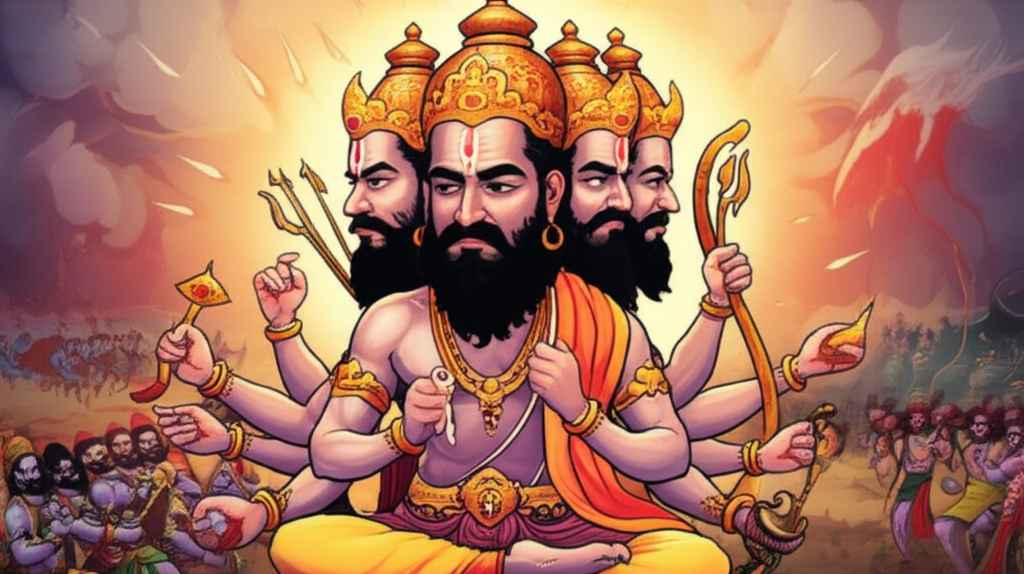
Introduction:
The Ramayana, a cornerstone of Hindu tradition, is an epic poem that resonates deeply within the cultural tapestry of India and Southeast Asia. This narrative, attributed to the sage Valmiki, tells the tale of Prince Rama of Ayodhya, his exile, and his eventual war against the demon king Ravana to rescue his wife, Sita. Embedded within this grand narrative are numerous episodes featuring divine interventions, moral dilemmas, and epic battles. One such intriguing aspect involves Brahma, the creator deity in the Hindu pantheon, and his perceived role in shaping the events of the Ramayana war. This article explores the traditional story of Brahma and the Ramayana war episodes, understanding it as a significant cultural narrative of ancient people, rather than a literal historical account.
Origins and Cultural Background:
The Ramayana likely took shape over centuries, with oral traditions preceding its written form. The core story probably emerged during the early centuries BCE, with subsequent additions and elaborations occurring during the Gupta period (3rd to 6th centuries CE). This era witnessed a flourishing of arts, literature, and philosophical thought in India. The society was deeply rooted in a hierarchical caste system, with a strong emphasis on Dharma (righteous conduct) and Karma (the law of cause and effect). The world was often perceived through the lens of mythology, with gods and demons playing active roles in human affairs. Natural phenomena, social structures, and moral principles were often explained through stories featuring deities and their interactions. The idea of Dharma was central, where humans were expected to fulfill their duties and obligations according to their station in life, contributing to the cosmic order.
Character Description: Brahma
Brahma is one of the principal deities in Hinduism, often considered the creator of the universe. He is traditionally depicted with four heads, representing the four Vedas (ancient scriptures), and four arms, holding symbolic objects such as a rosary, a water pot, and a sacrificial ladle. He is often seated on a lotus flower, which symbolizes purity and creation.
It’s crucial to understand that Brahma, as depicted in Hindu mythology, is not to be taken as a literal divine being in the Islamic context. The attributes associated with him are symbolic representations of concepts like knowledge, creation, and cosmic order. The four heads, for example, can be interpreted as representing comprehensive knowledge and the ability to perceive the world from multiple perspectives. The lotus seat signifies detachment from worldly desires, allowing for unbiased creation. The rosary signifies time and the cyclical nature of existence. These are symbolic attributes, not endorsements of divine power.
Main Story / Narrative Retelling:
The Ramayana war was no ordinary conflict; it was a cosmic battle between good and evil. Ravana, the ten-headed demon king of Lanka, had abducted Sita, Rama’s virtuous wife. Rama, aided by his loyal brother Lakshmana and the monkey general Hanuman, marched towards Lanka to confront Ravana and reclaim Sita.
According to traditional accounts, Brahma played a subtle but crucial role in the unfolding events. Before the war, it is said that Brahma, aware of the cosmic significance of the conflict, orchestrated certain events to ensure the eventual triumph of Dharma. He is believed to have influenced the birth and upbringing of key characters, guiding them towards their destinies.
One significant episode involves Ravana’s invincibility. Ravana, through rigorous penance, had obtained boons from Brahma, making him virtually indestructible by gods, demons, and other celestial beings. However, Ravana, in his arrogance, had neglected to include humans and animals in his request for immunity. Brahma, knowing Ravana’s hubris, ensured this loophole remained, allowing Rama, an avatar (incarnation) of Vishnu, to defeat him.
During the war, Brahma is said to have subtly guided the actions of the gods, who in turn aided Rama and his army. He is believed to have inspired Hanuman, the devotee of Rama, to perform extraordinary feats of strength and devotion. He also influenced the timing and nature of certain battles, ensuring that Rama faced the right challenges at the right time, ultimately leading to Ravana’s downfall. Brahma’s role was not one of direct intervention but rather one of orchestrating the cosmic stage, allowing the forces of good to triumph over evil through their own efforts and virtues.
Symbolism and Meaning:
The traditional story of Brahma’s role in the Ramayana war can be interpreted as representing several key themes. It underscores the importance of Dharma, highlighting that even the most powerful beings are ultimately subject to the cosmic law of righteousness. Ravana’s arrogance and disregard for Dharma led to his downfall, while Rama’s adherence to virtue and righteousness ensured his victory.
The story also emphasizes the idea of divine justice. Brahma’s subtle interventions can be seen as representing the unseen hand of fate, guiding events towards a predetermined outcome where good prevails. The loophole in Ravana’s boon symbolizes the limitations of power and the inevitability of consequences for those who stray from the path of righteousness.
Furthermore, the story highlights the importance of human effort and devotion. While Brahma may have orchestrated the cosmic stage, it was Rama, Lakshmana, and Hanuman who ultimately fought the battles and achieved victory. Their courage, loyalty, and devotion to Dharma serve as an inspiration for individuals to strive for righteousness in their own lives.
Modern Perspective:
The Ramayana continues to be a vibrant and influential story in modern times. It has been adapted into numerous forms, including literature, movies, television series, and video games. The character of Brahma and his role in the Ramayana war are often portrayed in these adaptations, albeit with varying degrees of accuracy and interpretation.
In cultural studies, the Ramayana is often analyzed as a complex and multifaceted text that reflects the social, political, and religious values of ancient India. Scholars explore the various interpretations of the story and its enduring relevance to contemporary society. The Ramayana is also used as a tool for understanding cultural identity, moral values, and the enduring power of storytelling.
Conclusion:
The traditional story of Brahma and the Ramayana war episodes is a significant cultural narrative that reflects the beliefs, values, and worldview of ancient Indian society. It is a story filled with symbolism and meaning, offering insights into the concepts of Dharma, divine justice, and the importance of human effort. It should be understood as a cultural story, not a religious belief.
As Muslims, we recognize that only Allah is the true Creator and Sustainer of the universe. The stories and characters of the Ramayana are part of a rich cultural heritage that allows us to appreciate the power of imagination, storytelling, and the diverse ways in which different cultures have sought to understand the world around them. By studying these narratives with an open mind and a critical eye, we can gain a deeper understanding of human history, cultural diversity, and the enduring power of storytelling traditions.


