fufufafa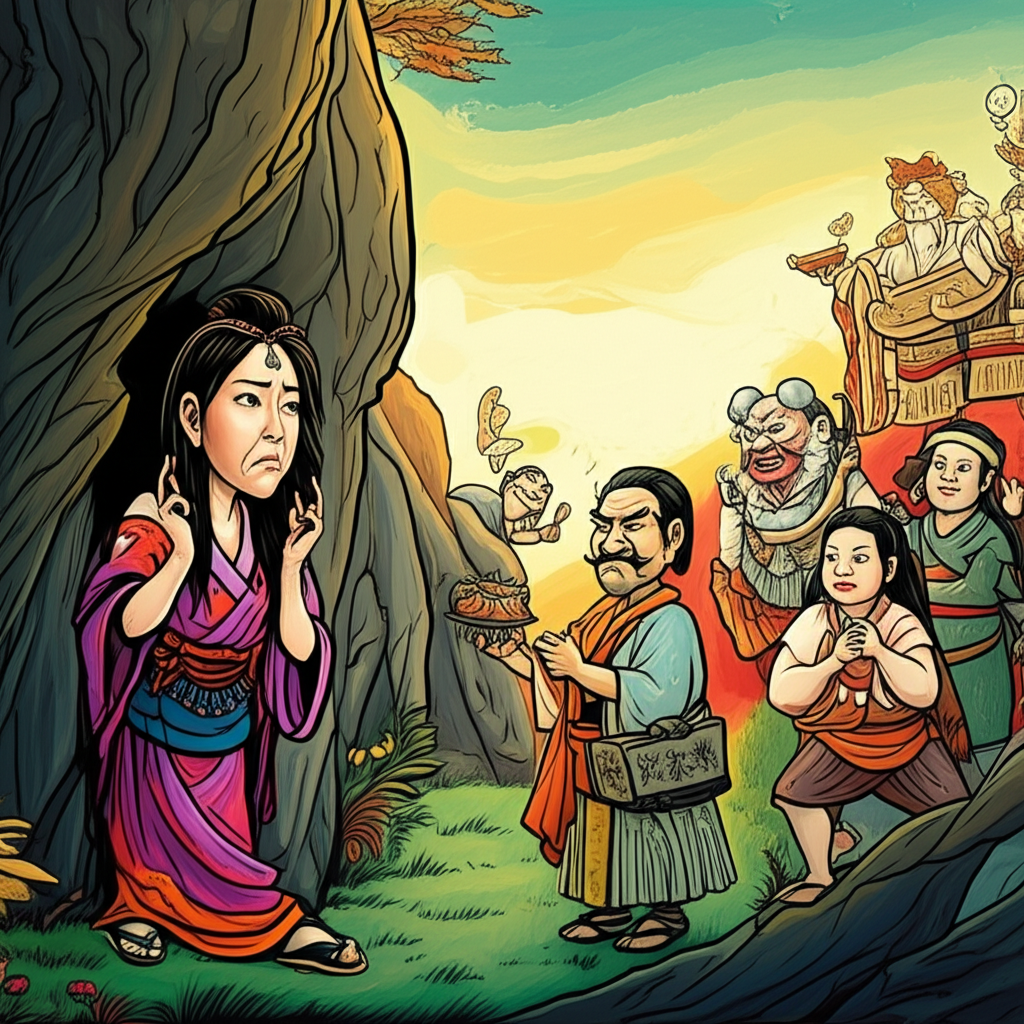
From the mist-shrouded islands of ancient Japan, where the forces of nature were seen as living deities, comes a profound and enduring tale: the myth of Amaterasu’s retreat into the Heavenly Rock Cave. This is a traditional story, passed down through generations by the early inhabitants of the archipelago, a testament to their deep connection with the natural world and their understanding of the delicate balance between light and shadow, order and chaos. It is a narrative woven into the very fabric of Japanese culture, explaining not only the cycles of the sun but also the origins of many customs and beliefs.
Origins and Cultural Background
This myth emerged from a period in Japan’s history deeply rooted in an animistic worldview, predating the widespread influence of Buddhism and Confucianism. In this ancient society, often referred to as the Jomon or early Yayoi periods, life revolved around agriculture, particularly rice cultivation, and a profound reverence for the land, mountains, rivers, and skies. The people of this era perceived their world as intimately connected with kami – deities or spirits that inhabited all aspects of nature, from towering trees to roaring storms, tranquil springs to the radiant sun.
Their understanding of existence was cyclical, marked by the changing seasons, the planting and harvest, the rising and setting of the sun. They believed that the actions of the kami directly influenced human life, bringing forth bounty or calamity. Purity (harai) was paramount, and pollution (kegare) was to be avoided, as it could offend the kami and disrupt the natural order. In this context, the sun, moon, and stars were not merely celestial bodies but living entities, personified as powerful deities whose moods and interactions directly impacted the world of humans, making a tale about the sun’s disappearance a narrative of ultimate existential dread.
Character Descriptions
At the heart of this dramatic cosmic event are several key figures, each embodying powerful natural forces or fundamental human qualities.
Amaterasu-Omikami, the Great Divinity Illuminating Heaven, stands as the central figure. She is the sun goddess, born from the left eye of the primordial deity Izanagi, and the ruler of Takama-ga-hara, the High Celestial Plain. Amaterasu embodies purity, light, warmth, and sustenance. She is often depicted as serene, radiant, and benevolent, the source of all life and growth, particularly the rice crops that were the lifeblood of ancient Japan. Her presence signifies order, clarity, and the promise of a new day. Her symbolic attributes include the sun itself, a mirror (Yata no Kagami), and the sacred rice fields under her divine care.
Her volatile younger brother, Susanoo-no-Mikoto, the god of storms, seas, and sometimes, the underworld, provides the catalyst for the crisis. Born from Izanagi’s nose, Susanoo is characterized by his tempestuous nature, prone to outbursts of rage and destructive acts. He represents the chaotic, untamed, and sometimes necessary, forces of nature – the destructive typhoon that clears the way for new growth, or the cleansing storm. His actions, though often destructive, inadvertently lead to profound change and resolution within the mythos.
Other significant kami include Ame-no-Uzume-no-Mikoto, the goddess of dawn, mirth, and revelry. Her quick wit and spirited dance are instrumental in coaxing Amaterasu from her hiding place. She symbolizes joy, creativity, and the power of communal celebration to overcome despair. Amenotajikarao, the god of strength, is the brawn behind the plan, tasked with physically moving the rock. The Eight Million Kami (Yaoyorozu-no-kami) represent the vast pantheon of Japanese deities, who collectively strategize and participate in the efforts to restore light, emphasizing the importance of communal effort and divine wisdom.
Main Story / Narrative Retelling
The tale unfolds in the luminous realm of Takama-ga-hara, the High Celestial Plain, a place of harmony and light where Amaterasu-Omikami diligently oversaw the cosmos, ensuring the sun’s steady path and the growth of the sacred rice fields. Her brother, Susanoo, however, was a being of unbridled chaos. Having been banished from Takama-ga-hara for his unruly behavior, he sought to bid farewell to his sister, a visit that escalated into a series of destructive acts.
In his fury, Susanoo trampled Amaterasu’s carefully tended rice fields, defiled her sacred weaving hall by smearing excrement, and, in a final, abhorrent act, flung a flayed pony through its roof, causing one of Amaterasu’s maidens to perish from shock. Overwhelmed by grief, disgust, and the profound pollution (kegare) brought by her brother’s actions, Amaterasu’s radiant spirit was wounded. In a moment of profound despair, she retreated into the deepest recesses of Ama-no-Iwato, the Heavenly Rock Cave, sealing its entrance with a massive boulder.
As Amaterasu, the sun goddess, vanished into the cave, the world was plunged into an abyssal darkness. The High Celestial Plain, once vibrant, grew cold and still. On the human realm below, the sun’s warmth departed, crops withered, and the land was consumed by an unending night. The kami of good fortune fell silent, and the malevolent spirits of darkness, emboldened by the absence of light, roamed freely. This was the "Songs of Yomi" – not a literal journey to the underworld, but a metaphorical descent into an underworld-like despair, where the world groaned under the weight of perpetual twilight and cold, echoing the desolation of Yomi-no-Kuni, the land of the dead.
Panic gripped the Eight Million Kami. They gathered on the banks of the Ameno-yasukawa river, a council of divine wisdom, desperate to devise a plan to lure Amaterasu out. Omoikane, the god of wisdom, proposed a daring strategy. They would create a cacophony and a spectacle so intriguing that Amaterasu could not resist peeking out.
First, they brought forth long-crowing roosters, whose calls were believed to precede the dawn. Then, they crafted a magnificent sacred sakaki tree, adorning its branches with jewels, a sacred mirror (Yata no Kagami), and strips of cloth. Finally, Ame-no-Uzume-no-Mikoto, the goddess of mirth, stepped forward. She overturned a wooden tub, using it as a drum, and began a wild, comical dance. She stripped off her clothing, exposing herself, and stomped rhythmically, her movements growing increasingly frenzied. The sight was so ludicrous, so uninhibited, that the gathered kami burst into uproarious laughter, their joyous shouts echoing across the cosmos.
Within the cave, Amaterasu, though deeply withdrawn, could not ignore the strange sounds. The incessant crowing of the roosters, followed by the unprecedented peals of laughter from her usually reserved divine kin, sparked her curiosity. "Why do the kami laugh," she wondered, "when the world is in darkness?" Cautiously, she pushed the boulder just enough to peer out.
Ame-no-Koyane and Futodama, two kami of ritual, quickly presented the sacred mirror, reflecting Amaterasu’s own brilliant image back to her. Mesmerized by her own light, and urged on by the persuasive words of Uzume, she emerged further. At that precise moment, the mighty Amenotajikarao, who had been hiding nearby, seized the opportunity. With a mighty heave, he pulled the boulder away and dragged Amaterasu fully out of the cave. Immediately, Futodama stretched a sacred rope, a shimenawa, across the cave’s entrance, preventing Amaterasu from ever retreating back into its depths.
As Amaterasu’s radiance once again bathed the world, light returned, warmth spread, and the withered crops revived. The darkness of the metaphorical Yomi lifted, and joy filled the High Celestial Plain. Susanoo, for his transgressions, was subsequently punished by having his beard cut, his fingernails and toenails extracted, and was exiled from Takama-ga-hara.
Symbolism and Meaning
This myth is rich with symbolism, offering profound insights into the worldview of ancient Japanese people. The central conflict between Amaterasu and Susanoo represents the eternal struggle between order and chaos, light and darkness, creation and destruction. Amaterasu’s light signifies life, growth, purity, and sustenance, particularly the vital importance of the sun for agricultural prosperity, especially rice. Her withdrawal plunged the world into a state akin to death, emphasizing the sun’s absolute necessity.
Susanoo’s destructive actions symbolize the unpredictable and often violent forces of nature, such as storms and floods, which, while devastating, are also part of a larger natural cycle. His exile reinforces the idea of consequences for disruptive behavior and the need to maintain cosmic and societal harmony.
The communal effort of the Eight Million Kami highlights the importance of community, cooperation, and collective wisdom in overcoming crises. Ame-no-Uzume’s dance, in particular, underscores the power of art, humor, and revelry to break through despair and restore balance. It suggests that even in the gravest darkness, joy and laughter can be a potent force for healing and renewal. The sacred mirror reflects not just Amaterasu’s image but also the idea of self-realization and the inherent divinity within, while the shimenawa represents the establishment of sacred boundaries and the protection of newly restored order.
Modern Perspective
Today, the myth of Amaterasu’s Cave continues to resonate deeply within Japanese culture and beyond. While no longer a literal explanation for the sun’s movements, it is cherished as a foundational story of Shinto, Japan’s indigenous religion, and serves as a powerful metaphor for overcoming adversity and the return of hope after despair.
Its themes are frequently explored in modern literature, manga, and anime, where Amaterasu is often portrayed as a powerful, benevolent figure, and the cave incident as a pivotal moment of cosmic crisis. Video games, such as the critically acclaimed Ōkami, directly draw inspiration from this myth, allowing players to embody Amaterasu and restore color and life to a world shrouded in darkness. Cultural studies analyze the myth for its insights into ancient Japanese society, gender roles, and the evolution of religious thought. Shinto shrines, particularly the Ise Grand Shrine dedicated to Amaterasu, continue to perform rituals that subtly echo the story’s themes of purification and renewal, maintaining a living connection to this ancient narrative.
Conclusion
The tale of Amaterasu’s retreat into the Heavenly Rock Cave and the subsequent "Songs of Yomi" is a magnificent example of a foundational myth, providing a window into the imagination and worldview of ancient Japanese people. It is a testament to the enduring human need to explain the inexplicable, to find meaning in the natural world, and to craft narratives that speak to the cyclical nature of life, death, and rebirth.
As Muslims, we firmly recognize that the true Creator and Sustainer of the sun, the moon, and all of creation is Allah, the One God, who has no partners or equals. Our faith teaches us that the sun rises and sets by His command, and His light illuminates both the physical world and the spiritual path. This understanding reinforces that these mythological narratives, while culturally rich and historically significant, are products of human imagination and interpretation, not divine revelation.
Nevertheless, we can appreciate such stories for their profound cultural heritage, their imaginative power, and their ability to convey timeless human experiences and values through the art of storytelling. They serve as valuable educational tools, allowing us to understand the diverse ways in which humanity across different eras and regions has sought to comprehend the mysteries of existence and the forces that shape our world.