
 fufufafa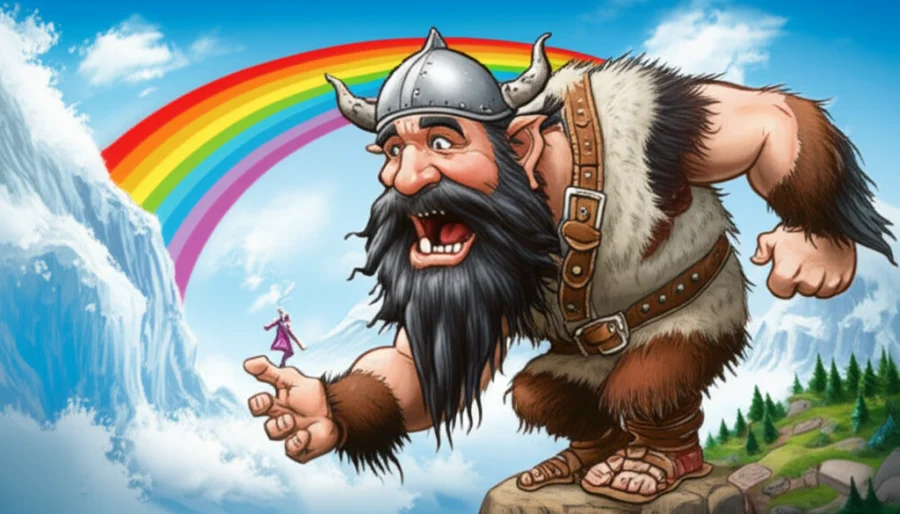
Origins and Cultural Background
The cultural era in which these myths flourished was primarily the Viking Age, roughly from the late 8th to the mid-11th century, though their roots stretch back much further into the Germanic Iron Age. This was a society deeply intertwined with nature, where survival often hinged on understanding and respecting the formidable elements. The environment was harsh: long, dark winters; towering mountains; vast, untamed forests; and the ever-present, powerful sea.
For the people of this time, the world was a living, breathing entity, teeming with unseen forces. Their worldview was polytheistic, centered around a pantheon of gods and goddesses – the Aesir and Vanir – who resided in Asgard. Yet, beyond the realm of the gods and Midgard (the human world), lay other realms, chief among them Jotunheim, the land of the Jotnar. This was not a simple, ordered universe but a dynamic one, held in precarious balance by the colossal ash tree Yggdrasil, which connected nine distinct realms. Life was viewed as a constant struggle between order and chaos, creation and destruction, with the gods representing the former and the Jotnar often embodying the latter. The fear and respect for nature’s overwhelming power were palpable, reflected in the very nature of these mythical beings.
Character / Creature Description
In Norse mythology, the Jotnar (Old Norse: Jǫtnar) are often mistranslated simply as "giants," but their nature is far more complex. They are primordial beings, representing the forces of chaos, wilderness, and the raw, untamed aspects of nature. While some are monstrous and antagonistic towards the Aesir, others possess wisdom, beauty, or are even progenitors of certain gods. They are divided into different types, such as the Hrímþursar (frost giants) and Eldjǫtnar (fire giants), each embodying specific elemental powers. Their immense size is symbolic of the overwhelming scale of natural phenomena – mountains, ice floes, raging storms – that dwarfed human existence. They are not inherently "evil" in a moral sense, but rather represent a different order, an older, more chaotic one that predates the establishment of the gods’ structured world. Their presence at the edges of the known realms signifies the boundaries of civilization and order, and the ever-present threat of primordial forces.
Bifrost, on the other hand, is the shimmering rainbow bridge that connects Midgard, the realm of humans, to Asgard, the realm of the Aesir. It is described as a bridge of three colors, burning with fire to deter the Jotnar from crossing. Guarded by the ever-vigilant god Heimdall, Bifrost is a marvel of divine craftsmanship, a pathway of celestial beauty. Symbolically, it represents the fragile link between the divine and mortal worlds, a conduit for observation and intervention, but also a vulnerable point, destined to be broken during Ragnarök, the twilight of the gods. Its beauty and its inherent danger make it a powerful symbol of connection and peril.
Main Story / Narrative Retelling: An Encounter at Bifrost’s Edge
The biting wind, laden with the scent of distant ice and primeval rock, whipped around Einar’s fur-lined cloak. He was a skald, a wanderer of words and worlds, driven by an insatiable curiosity that often led him to the fringes of the known. Legend spoke of places where Midgard frayed at its edges, where the familiar contours of the world gave way to the raw, unfiltered energies of the other realms. It was these whispered tales that had drawn him to the desolate, northern reaches, a landscape of jagged peaks and glaciers that groaned under their own immense weight.
For days, he had journeyed, pushing past the last human settlements, guided only by ancient maps etched into his memory and an unwavering sense of destiny. Then, one frigid dawn, as the sun struggled to pierce the perpetual gloom, he saw it. A ribbon of impossible color arcing across the sky, a shimmering arch of crimson, gold, and sapphire, descending from the heavens to touch the earth in the distance. Bifrost. More breathtaking than any skald’s verse could capture, it pulsed with an otherworldly light, a celestial beacon in the stark, frozen wilderness.
Einar knew the legends – the bridge to Asgard, guarded by Heimdall. But he had also heard darker whispers, tales of the Jotnar who lurked at the borders, forever seeking to breach the gods’ domain. And it was towards these very borders that Bifrost seemed to descend. Overcoming a tremor of fear with the thrill of discovery, he pressed on, drawn like a moth to a flame.
The landscape grew harsher, the air colder, a profound silence broken only by the shriek of the wind. The ground beneath his feet became treacherous, a mix of ancient ice and scree. And then, he felt it – a shift in the very atmosphere, a pressure, a vastness that dwarfed the mountains around him.
He looked up, and his breath hitched. There, in the dim light of the perpetual twilight that seemed to cling to this borderland, they stood. Not one, but several, their forms so immense they seemed to be carved from the very rock and ice around them. They were Jotnar. Their skin was the color of ancient glaciers, their hair like frozen waterfalls, their eyes glowing with a cold, ancient light that held no malice, yet promised no warmth. One, whose form was like a mountain range given sentience, leaned against a colossal peak, his breath misting in plumes that seemed to join the clouds. Another, more slender but no less tall, watched the shimmering arc of Bifrost with an intensity that suggested endless patience, an eternity of waiting.
They were not moving towards him, not threatening. They simply were. Their presence was a profound, elemental force, a manifestation of the world’s raw, untamed power. Einar felt utterly insignificant, a mere speck of dust in the face of such primordial beings. He saw the cold, unyielding power of the glaciers in their forms, the endless patience of the deep earth in their stillness, the untamed fury of the blizzards in the aura that radiated from them.
He realized then that this was not a place for humans, nor was he meant to witness such things. The Jotnar were not guardians of Bifrost, but rather the very essence of the chaotic realm it sought to keep at bay. They were the silent, watchful sentinels of Jotunheim, eternally poised at the precipice of creation and destruction, their gazes fixed on the impossible beauty of the rainbow bridge that connected them to worlds they could not – or perhaps chose not to – fully grasp.
A profound understanding settled upon Einar: the world was far vaster, far more ancient, and far more perilous than any human could truly comprehend. He turned, slowly, carefully, his heart pounding a rhythm against his ribs that was not entirely fear, but mostly awe. He retreated, leaving the silent, colossal figures to their eternal vigil, the ethereal glow of Bifrost fading behind him, a memory etched not just in his mind, but in the very core of his being. The encounter was not a battle, but a revelation – a humbling glimpse into the boundless, indifferent power of the primordial world.
Symbolism and Meaning
To the ancient Norse people, this imagined encounter would have represented several profound truths about their world. Firstly, the Jotnar were clear personifications of nature’s untamed, often hostile, power. The glaciers, the towering mountains, the crushing storms – all were formidable forces that shaped their lives and instilled both fear and reverence. The Jotnar embodied this raw, indifferent power, reminding humans of their inherent vulnerability in the face of such might.
Secondly, the story speaks to the fear of the unknown and the boundaries of the human world. The edge of Midgard, where Bifrost descends and the Jotnar dwell, signifies the limits of human understanding and control. It’s a place where chaos reigns, challenging the established order of gods and men. This constant tension between cosmic order (represented by the Aesir and Bifrost) and primordial chaos (embodied by the Jotnar) was a central theme in their worldview, reflecting the precarious balance they perceived in the universe. Finally, the encounter underscores human insignificance. A solitary wanderer confronting beings of such scale and ancient power serves as a humbling reminder of humanity’s small place within a grand, often terrifying, cosmos.
Modern Perspective
Today, Norse mythology, including the figures of the Jotnar and the concept of Bifrost, continues to captivate and inspire. Far from being forgotten, these stories have found new life in a myriad of forms. In literature, authors like Neil Gaiman have reimagined these myths for contemporary audiences, exploring their rich characterizations and complex themes. The Marvel cinematic universe, particularly the Thor franchise, has popularized these figures globally, though often taking creative liberties with their original portrayals. Video games, such as the God of War series, delve deep into Norse lore, presenting the Jotnar as powerful, often tragic, figures with intricate backstories.
In cultural studies and academic folklore, these myths are examined for their insights into ancient human psychology, societal values, and their universal archetypes. The Jotnar, in particular, are often analyzed as representations of the "other," the wild, untamed aspects of existence that challenge established norms. They symbolize humanity’s enduring fascination with and fear of forces beyond our control, a theme that resonates across cultures and time periods.
Conclusion
The narrative of an encounter with the Jotnar of Bifrost is a powerful testament to the enduring human capacity for imagination and storytelling. It is a cultural artifact, a rich tapestry woven from the beliefs and worldview of ancient people, offering profound insights into their relationship with nature, the cosmos, and the unseen forces they perceived. It is crucial to reiterate that these are traditional stories, elements of a fascinating cultural heritage, and are not to be understood as truth or divine power.
As Muslims, we recognize that Allah (SWT) alone is the true Creator and Sustainer of the heavens and the earth, and all that is within them. Our belief rests solely in the oneness of God, and the divine revelations that guide humanity. However, engaging with such cultural narratives allows us to appreciate the diverse ways in which different civilizations have sought to understand and explain the world around them. It is through these ancient stories that we gain a deeper appreciation for the boundless creativity of the human mind and the timeless tradition of passing down wisdom, wonder, and warning through the art of storytelling, reflecting humanity’s continuous journey of discovery and interpretation of the mysteries of existence.







