
 fufufafa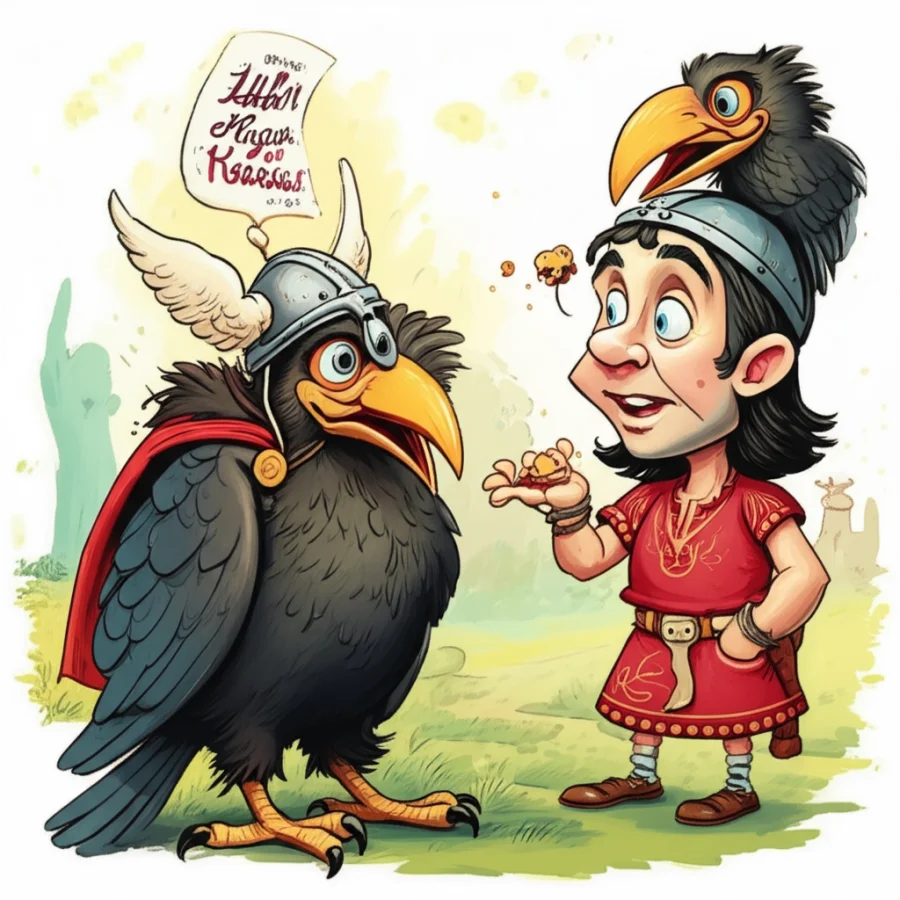
The tapestry of human history is woven with countless threads of stories, each reflecting the unique lens through which different cultures have sought to understand the world around them. Among the most enduring and evocative of these narrative traditions is Norse mythology, a rich collection of tales originating from the Germanic peoples of Scandinavia. These are not historical accounts but rather traditional stories told by ancient people, passed down through generations, shaping their worldview and cultural identity. Our journey today delves into one such mythical concept: an encounter with Huginn, one of the famed ravens of Odin, intrinsically linked to the cosmic tree Yggdrasil. It is vital to remember that this narrative is presented purely for cultural, historical, and educational understanding, and is not intended to promote belief, worship, or practice of any kind.
Origins and Cultural Background: The World of the Norse
The myths surrounding figures like Odin, Thor, and Loki, and the cosmic structure of Yggdrasil, emerged and flourished primarily during the Viking Age, roughly from the late 8th to the mid-11th centuries. This was a time of formidable seafaring, exploration, and settlement across vast stretches of Europe, but also a period deeply rooted in agricultural life in the harsh, often unforgiving northern lands. The societies that birthed these myths were often clan-based, valuing honor, bravery in battle, loyalty, and wisdom.
For the ancient Norse, the world was a vibrant, often perilous place, teeming with unseen forces and beings. Their worldview was polytheistic, populated by a pantheon of gods (Aesir and Vanir), powerful giants, mischievous elves, and industrious dwarves. They believed in a grand, interconnected cosmos, all bound together by the immense, sacred ash tree, Yggdrasil. This World Tree was not merely a tree but the very axis of existence, its roots reaching into the underworld, its trunk anchoring the mortal realm of Midgard, and its branches supporting the heavenly abodes of the gods. It was a living symbol of creation, destruction, and rebirth, a constant reminder of the cyclical nature of time and the inevitability of fate (Wyrd). Their understanding of the world was imbued with a sense of wonder and a deep connection to nature, where every mountain, river, and forest held a potential spiritual significance.
Character Description: Huginn, The Embodiment of Thought
Central to our narrative is Huginn, whose name means "thought" or "mind" in Old Norse. He is not alone in his duties; his inseparable companion is Muninn, meaning "memory." These two magnificent ravens are iconic figures in Norse mythology, serving as the constant companions of Odin, the Allfather – god of war, poetry, magic, and wisdom.
In the lore, Huginn and Muninn are depicted as sleek, dark birds, their feathers shimmering with the deep hues of twilight and their eyes sharp with an ancient, knowing intelligence. Each morning, Odin dispatches them from his high seat, Hliðskjálf, to fly across the Nine Worlds, soaring over mountains, diving into valleys, and circling the very roots and branches of Yggdrasil. They are his eyes and ears, gathering news, wisdom, and secrets from every corner of existence. Upon their return at dusk, they perch on Odin’s shoulders and whisper all they have seen and heard into his ears, thus enriching his vast reservoir of knowledge.
Symbolically, Huginn and Muninn are far more than mere birds. They represent Odin’s own intellect, his capacity for thought and his boundless memory. They are extensions of his perceptive faculties, allowing him to maintain his omniscience and mastery over the realms. Their daily journey underscores the Norse reverence for knowledge and wisdom as supreme virtues, essential for both gods and mortals. They are not to be worshipped, but rather understood as powerful metaphors for the intellectual processes that underpin understanding and leadership within the mythological framework.
Main Story: A Seeker’s Glimpse
The air grew thin and crisp as Elara, a seeker of ancient tales from a quiet fjord village, ascended the final rocky path. For weeks, she had journeyed, guided by the whispers of her ancestors and the faint, almost imperceptible hum that resonated in the deeper parts of the ancient forests. She sought not glory or riches, but a fleeting glimpse of the cosmic heart of her people’s stories: Yggdrasil, the World Tree. The legends spoke of its immense power, its roots plunging into realms unknown, its branches holding the very heavens. And at its heart, the constant vigil of Odin’s ravens.
As she broke through the treeline, a sight of breathtaking, humbling grandeur unfolded before her. There, reaching for the sky with unimaginable majesty, stood Yggdrasil. Its trunk was wider than any mountain, its bark a mosaic of ancient runes and cosmic dust, glowing with an ethereal light that seemed to pulse with the lifeblood of the universe. Its branches, thick as entire forests, disappeared into the cloud-strewn heavens, while its colossal roots burrowed into the earth, their path lost to mortal sight. The air around it crackled with an energy that was both profoundly peaceful and utterly overwhelming, a silent testament to its role as the axis of all existence.
Elara found a hidden ledge, overgrown with moss, overlooking a vast, shimmering expanse where one of Yggdrasil’s great roots emerged before descending once more into shadow. It was here, the old stories said, that the Allfather’s messengers often paused. She waited, patiently, for what felt like an eternity, the silence broken only by the gentle rustling of unseen leaves and the distant murmur of water.
Then, a shadow, impossibly large, swept across the glimmering root. It was not one, but two, dark forms, cutting through the vastness of the sky with effortless grace. They descended with the quiet certainty of returning voyagers, their powerful wings beating the air with a rhythmic whoosh. As they drew nearer, Elara could discern their forms: ravens, but unlike any she had ever seen. Their feathers were an iridescent black, gleaming with hints of indigo and violet in the strange light. Their eyes, though distant, seemed to hold the depth of forgotten ages, reflecting countless sunrises and sunsets over a myriad of worlds.
One of them, Huginn, landed first on a gnarled offshoot of the great root, his claws gripping the ancient wood. His companion, Muninn, settled beside him a moment later. They did not squawk or ruffle their feathers in typical bird fashion. Instead, they stood in profound stillness, their heads cocked slightly, as if listening to the cosmic whispers carried on the wind. Elara felt an intense surge of awe, a profound sense of witnessing the very ‘thought’ and ‘memory’ of the world coalesce before her. It was as if she could almost perceive the vast influx of knowledge pouring into them, the myriad sights and sounds of the Nine Realms being absorbed and cataloged.
Their presence was not threatening, nor overtly magical, but intensely significant. There was no direct interaction, no nod of recognition. They simply were, fulfilling their ancient, perpetual task. After a long moment, Huginn turned his head, his gaze sweeping across the landscape. Though his eyes did not meet hers, Elara felt as though he saw through her, perceiving the very fabric of her thoughts, her memories, her longing for understanding. It was a fleeting, unsettling, yet deeply profound connection. Then, with a synchronized beat of their powerful wings, the two ravens launched themselves back into the sky, spiraling upwards, growing smaller and smaller until they became mere specks against the luminous sky, destined to return to Odin’s shoulders and whisper the day’s gathered wisdom. Elara watched until they vanished, leaving behind only the echoing silence and the indelible imprint of a cosmic encounter.
Symbolism and Meaning: Ancient Reflections
To the ancient Norse, the tale of Huginn and Muninn, and indeed the entire framework of Yggdrasil, carried profound symbolic weight. Huginn, as "Thought," represented the crucial human faculty of intellect, planning, and understanding. Muninn, as "Memory," embodied the importance of history, tradition, and learning from past experiences. Together, they symbolized the complete process of acquiring and retaining knowledge, vital attributes for any leader, warrior, or farmer in their often-challenging world.
Their daily flight across the Nine Worlds underscored the Norse belief in the interconnectedness of all things and the constant flow of information throughout the cosmos. For a people whose lives were often dictated by the elements and unpredictable events, the concept of a god who knew all, informed by his vigilant ravens, might have offered a sense of cosmic order and ultimate, albeit mysterious, wisdom. They represented the distant, all-seeing eye of fate and divine oversight, serving as a reminder that actions, deeds, and even thoughts, were observed and remembered.
Modern Perspective: Enduring Inspiration
Today, Norse mythology, including the figures of Huginn and Muninn, continues to captivate and inspire. It is interpreted not as a system of belief, but as a rich cultural heritage, a testament to the human imagination. In literature, figures like Neil Gaiman have masterfully reinterpreted these myths for contemporary audiences, while countless fantasy novels draw upon their archetypes. In cinema and television, the Marvel Cinematic Universe has brought a highly stylized version of Norse gods to global audiences, and historical dramas like "Vikings" delve into the cultural context from which these stories sprang. Video games, such as "God of War" and "Assassin’s Creed Valhalla," immerse players in beautifully rendered worlds inspired by Norse cosmology, allowing them to encounter these mythological elements in interactive ways.
Academically, these myths are studied in fields ranging from comparative religion and folklore to literary criticism and psychology. They offer insights into ancient worldviews, societal values, and the universal human quest for meaning. Huginn and Muninn, in particular, remain potent symbols of knowledge, wisdom, and the enduring power of observation and memory.
Conclusion: A Legacy of Stories
The encounter with Huginn of Yggdrasil, as narrated here, is a journey into the imaginative heart of Norse mythology—a cultural story, not a belief. It is a testament to the profound creativity and intellectual curiosity of ancient peoples as they sought to explain the mysteries of existence through intricate narratives and symbolic figures. As Muslims, we recognize that only Allah is the true Creator and Sustainer, the All-Knowing, the Source of all wisdom and knowledge, who encompasses all thought and memory, and whose power and majesty are beyond human comprehension or mythological depiction.
Yet, we can appreciate the rich tapestry of human cultural heritage. Stories like that of Huginn and Muninn remind us of the universal human impulse to create meaning, to explore the boundaries of imagination, and to pass down insights through generations. They stand as enduring monuments to the power of storytelling, offering a window into the minds of those who came before us, and enriching our understanding of the diverse ways humanity has sought to comprehend its place in the vast, awe-inspiring cosmos.







