fufufafa
Introduction:
The Enuma Elish, a captivating creation myth, hails from ancient Mesopotamia, a cradle of civilization nestled between the Tigris and Euphrates rivers, in what is now modern-day Iraq. This epic poem, inscribed on clay tablets in the Akkadian language, is a cornerstone of Mesopotamian mythology, a collection of stories and beliefs that shaped the worldview of its people. It is a traditional story, a window into the minds of the ancient Mesopotamians, a narrative they used to explain the origins of the universe, the gods, and humanity. It is crucial to remember that this is a story, a product of human imagination and cultural expression, and not a statement of verifiable fact. We explore it here to understand the historical context and cultural significance of this ancient narrative.
Origins and Cultural Background:
The Enuma Elish flourished in a society that predates the common era by several millennia, specifically during the Babylonian period (c. 18th – 6th centuries BCE). This was a time of burgeoning cities, complex social structures, and advancements in writing, mathematics, and astronomy. The Mesopotamian environment was harsh and unpredictable. Flooding rivers, scorching summers, and limited natural resources demanded resilience and ingenuity. The people were deeply connected to the natural world, observing the movements of the sun, moon, and stars, and developing sophisticated agricultural practices to survive.
Their worldview was shaped by a profound sense of awe and fear of the forces of nature. They believed the world was governed by a pantheon of powerful, often capricious gods and goddesses, each associated with specific elements, natural phenomena, and aspects of human life. These deities were believed to be anthropomorphic, possessing human-like qualities such as emotions, desires, and flaws. The Mesopotamians believed in a cyclical view of time, where events were often repeated and influenced by the gods’ whims. Their goal was to appease the gods through offerings, rituals, and the construction of elaborate temples, hoping to maintain order and prosperity in their lives. The Enuma Elish was likely recited during important religious festivals, particularly the New Year festival, providing a framework for understanding the world’s creation and the role of the gods in maintaining cosmic order.
Character / Creature Description:
The Enuma Elish is populated by a cast of powerful divine beings. At the beginning, before anything else, there was only Apsu, the sweet waters of the underworld, and Tiamat, the salt waters of the primordial ocean. They mingled and created other gods, like Lahmu and Lahamu, the silt and sediment of the sea, who in turn gave rise to Anshar and Kishar, the horizon. From Anshar and Kishar came Anu, the sky god, who eventually begat Ea (also known as Enki), the god of wisdom, magic, and fresh water.
Tiamat, the mother of the gods, is portrayed as a monstrous, primordial dragon, embodying the chaos and untamed forces of the deep. She is not simply evil, but rather represents the raw, untamed potential from which the universe emerged. Apsu, initially, embodies the calm, freshwater, but he becomes troubled by the boisterous younger gods.
Ea (Enki) is a cunning and resourceful god, often depicted as a protector of humanity. He is a god of wisdom, who ultimately defeats Apsu and thus begins the events of the epic.
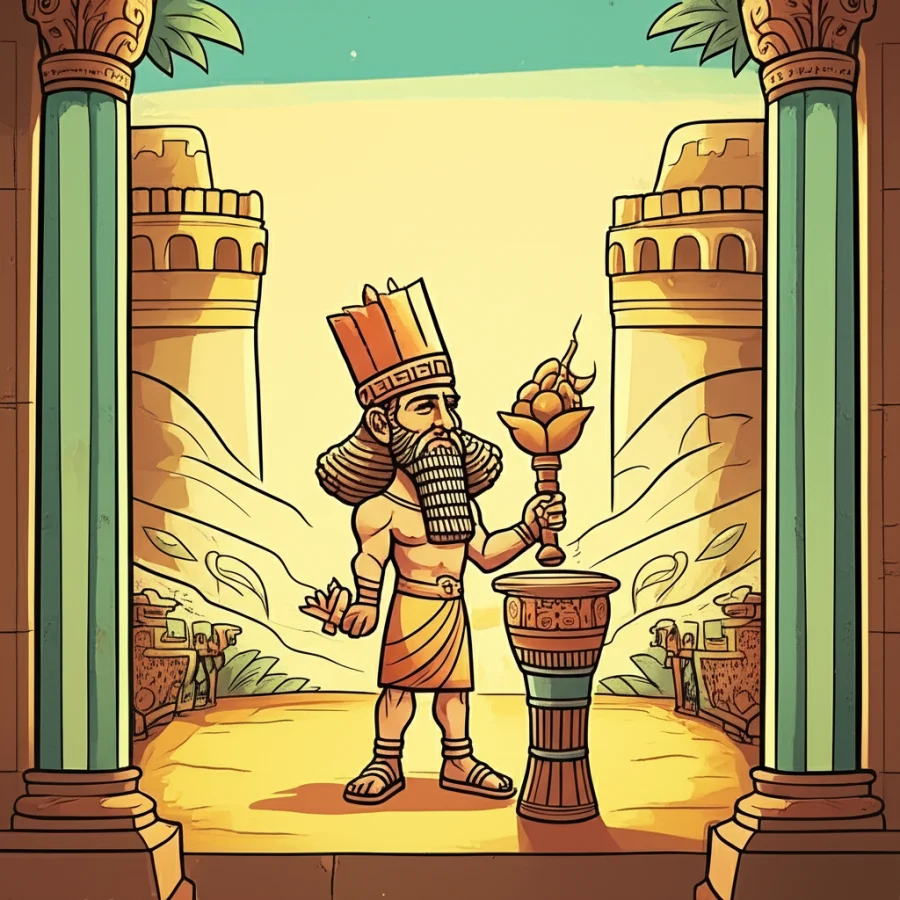
The hero of the story, however, is Marduk, the son of Ea. He is a young, vigorous, and supremely powerful god who is destined to defeat Tiamat and establish order in the cosmos. He is described with radiant features, possessing multiple eyes, powerful limbs, and the ability to wield powerful weapons. He is not a purely benevolent figure, as the story highlights his ruthless approach to maintaining order.
Main Story / Narrative Retelling:
In the beginning, before the heavens and the earth existed, there was only Apsu, the sweet, subterranean waters, and Tiamat, the vast, salty ocean. They mingled, their waters intermingling, and from this union arose the first generation of gods. These younger gods, however, were noisy and disruptive, irritating the tranquility of Apsu. He, along with his advisor Mummu, plotted to destroy them, believing their boisterousness threatened the established order.
Hearing of the plot, Ea, the wise god of fresh water, confronted Apsu. Using his cunning and magical powers, Ea lulled Apsu into a deep sleep and killed him, establishing his dwelling in the now-empty abode. This act, however, angered Tiamat, who saw the death of her consort as an insult. She was also stirred by the actions of her husband, Kingu, who had been appointed her champion.
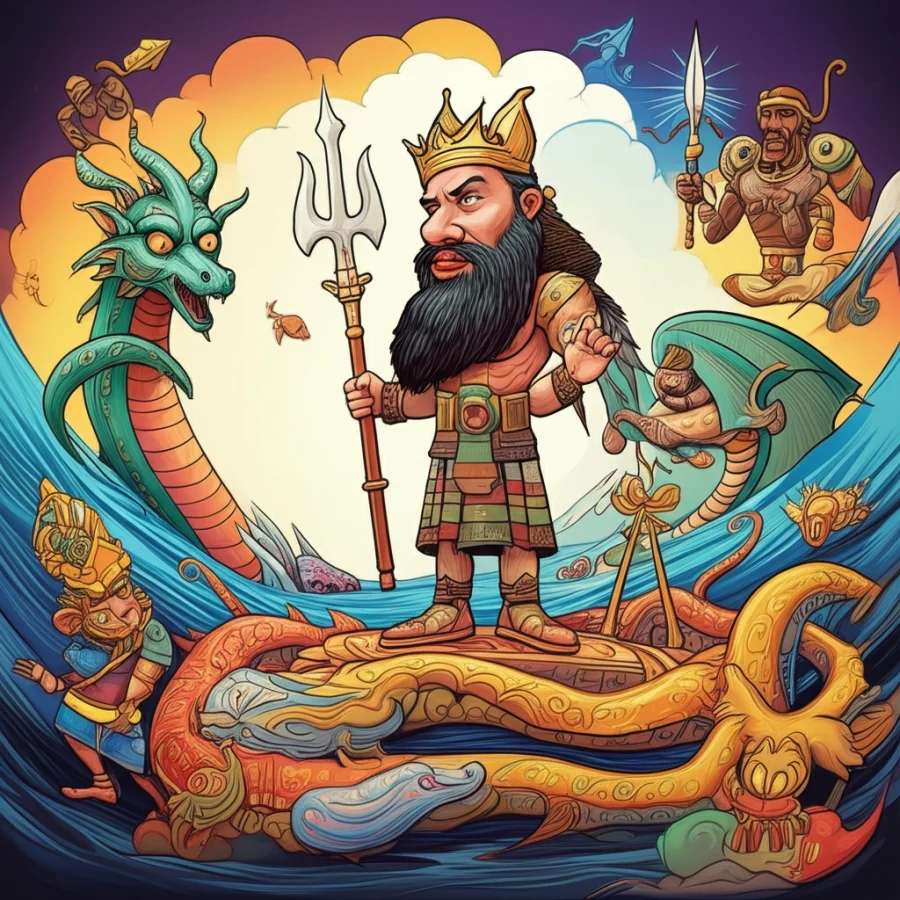
Driven by a desire for revenge and the chaos of the primordial ocean, Tiamat prepared for war, creating a terrifying army of monstrous creatures to do her bidding. Among them were dragons, giant serpents, scorpion-men, and other fearsome beasts, all designed to overthrow the existing order.
The gods were thrown into terror, unsure how to withstand Tiamat’s onslaught. Only Marduk, the son of Ea, possessed the strength and the courage to face her. Marduk agreed to fight Tiamat on the condition that he be granted supreme authority over the gods. The other gods, desperate for a savior, agreed.
Armed with powerful weapons, including a bow and arrows, a net, and the four winds, Marduk confronted Tiamat. A fierce battle ensued. Marduk unleashed the winds to trap Tiamat, then pierced her belly with an arrow. He then split her body in two, using one half to form the heavens and the other to create the earth. From the blood of Kingu, the leader of Tiamat’s army, Marduk fashioned humanity, to serve the gods.
With Tiamat defeated, Marduk established order in the cosmos. He built temples for the gods, appointed them their roles, and established the constellations. He created the calendar, established the paths of the sun, moon, and stars, and ensured the cyclical rhythm of time. The Enuma Elish culminates with the glorification of Marduk as the supreme god, the ruler of the universe.
Symbolism and Meaning:
The Enuma Elish is rich in symbolism. Tiamat represents the chaotic, primordial waters, the untamed forces of nature that existed before creation. Marduk, on the other hand, embodies order, structure, and the triumph of civilization over chaos. The battle between them can be interpreted as a struggle between the forces of chaos and the forces of order, a fundamental theme in Mesopotamian thought.
The story also reflects the Mesopotamian belief in the divine right of kings. Marduk’s rise to power mirrors the earthly kings, who were seen as divinely appointed rulers. The Enuma Elish likely served as a justification for the Babylonian kings’ authority, solidifying their position as the representatives of order and stability in a world perceived as constantly threatened by chaos.
The creation of humanity from Kingu’s blood also highlights the Mesopotamian understanding of the relationship between humans and the gods. Humanity’s purpose was to serve the gods, to provide for their needs, and to maintain the temples and religious rituals. This belief reflected the importance of religious practices in maintaining the cosmic order and ensuring the prosperity of the society.
Modern Perspective:
The Enuma Elish continues to captivate scholars, writers, and artists today. It has been translated into numerous languages and studied by historians, archaeologists, and religious scholars. Its influence can be seen in various forms of modern media.
In literature, the Enuma Elish has inspired countless fantasy novels, poems, and plays. Its themes of creation, chaos, and the struggle for order resonate with contemporary audiences. In movies and video games, the epic’s characters and creatures have provided inspiration for visual designs and narrative structures. The story’s archetypal characters, such as the hero (Marduk) and the monstrous antagonist (Tiamat), continue to influence storytelling conventions. In cultural studies, the Enuma Elish provides valuable insights into the beliefs, values, and worldview of the ancient Mesopotamians. It is studied as a primary source for understanding the development of religious thought, the origins of mythology, and the human fascination with creation stories.
Conclusion:
The Enuma Elish is a testament to the power of the human imagination and the enduring appeal of storytelling. It is a cultural artifact, a window into the minds of the ancient Mesopotamians, and a reminder of the rich tapestry of human history. It’s a story, a narrative crafted to explain the unexplainable, a way to make sense of the world and our place within it.
As Muslims, we acknowledge that only Allah, the Almighty, is the true Creator and Sustainer of the universe. We recognize that all other narratives of creation, including the Enuma Elish, are the products of human imagination and cultural expression. Studying these stories is valuable for understanding history, culture, and the human experience, but it is essential to maintain our core belief in the oneness of Allah and His divine creation.
The Enuma Elish, like all myths, is a legacy of our cultural heritage. It allows us to explore the depths of human creativity and the enduring power of storytelling. It reminds us of the diverse ways in which humans have sought to understand the world, and it encourages us to appreciate the richness and complexity of human history. It is a story to be learned from, not to be believed as fact.