fufufafa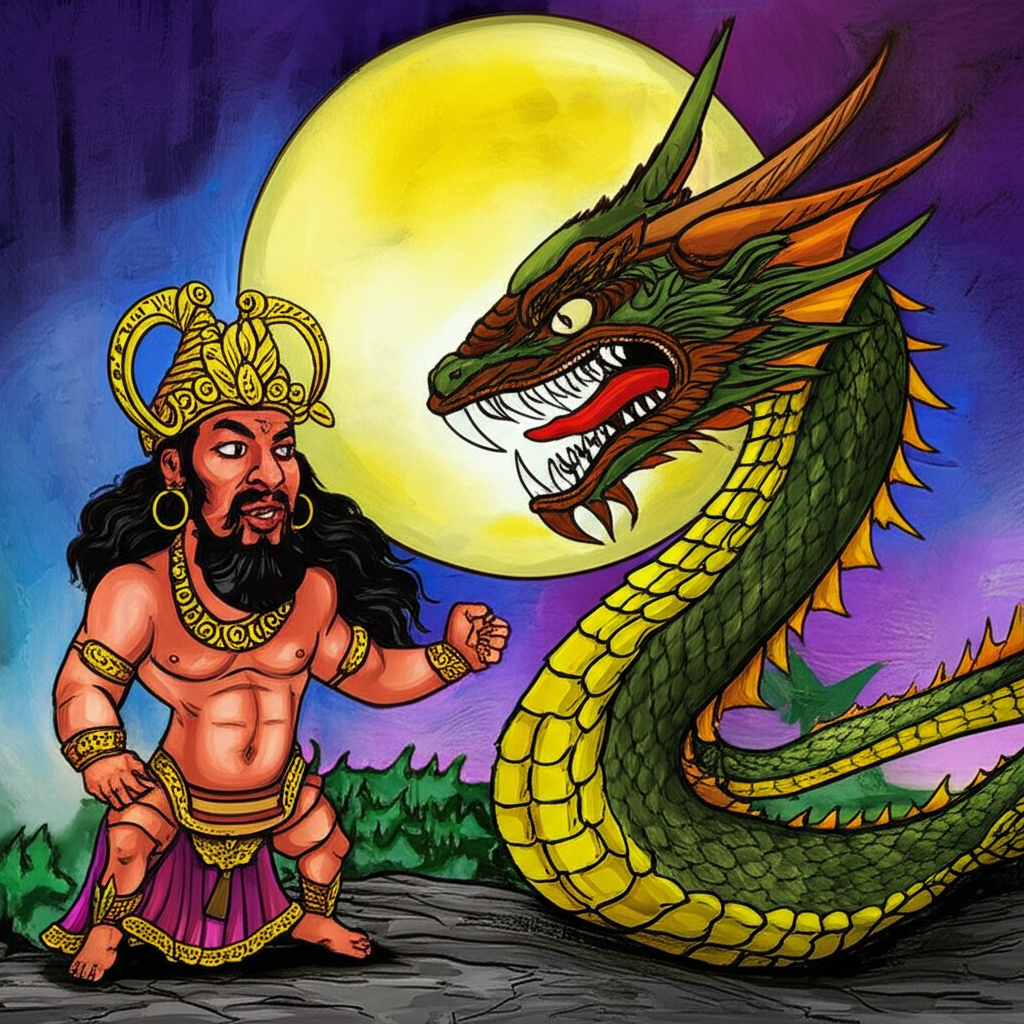
The vast archipelago of the Philippines, a tapestry woven with emerald islands and sapphire seas, has long been a cradle of rich and vibrant folklore. Among the myriad tales whispered around crackling fires and passed down through generations, the legend of Bathala and the trial of Bakunawa and the Moon stands as a testament to the ancient Filipinos’ keen observation of the cosmos and their imaginative attempts to explain its mysteries. This is not a historical account, nor a religious doctrine, but a traditional story, a cultural narrative shared by ancient people to make sense of the celestial ballet above and the primal forces they perceived at play.
Centuries ago, in a time when the rhythm of life was dictated by the sun’s arc and the moon’s phases, the early Filipinos lived in close harmony with the natural world. Their understanding of the universe was deeply intertwined with the visible phenomena around them. The immense ocean, the towering volcanoes, the unpredictable storms, and the celestial bodies were not mere elements of their environment but potent forces, often personified and imbued with purpose. In this worldview, the heavens were a realm of powerful beings, and the moon, a luminous orb that guided their nights, held a special significance. Their myths were a blend of awe, respect, and a touch of apprehension towards the forces that shaped their existence.
Central to this narrative is the figure of Bathala. In many pre-Hispanic Philippine mythologies, Bathala Mei Kapal, often referred to simply as Bathala, was conceived as the supreme being, the creator of all things. He was not a deity to be worshipped in the way many later religions understand it, but rather the ultimate source of existence, the grand architect of the universe. Bathala represented order, creation, and the overarching power that governed the cosmos. His presence was felt in the rustling leaves, the crashing waves, and the distant glow of the stars. He was the silent observer, the ultimate judge, and the source of all life and its eventual return.
Opposing this celestial order, or perhaps testing it, was Bakunawa. Bakunawa is depicted as a colossal serpent or dragon, a creature of immense power and insatiable appetite. Its body was said to be vast, capable of encircling the entire world, and its scales shimmered with the darkness of the deep sea and the gleam of forgotten treasures. Bakunawa was not inherently evil in the modern sense, but rather a force of primal chaos, a manifestation of the untamed, the unknown, and the destructive potential that lurked beneath the surface of the world. Its existence represented the deep, fathomless waters and the terrifying unknown that lay beyond human comprehension.
The narrative of Bathala and the trial of Bakunawa and the Moon unfolds as a cosmic drama, a struggle for balance between light and shadow. According to the ancient tales, Bakunawa, driven by an insatiable hunger, would rise from its watery lair in the deepest parts of the ocean. Its target was none other than the radiant moon, which it sought to devour. The moon, a symbol of purity, guidance, and the cyclical nature of time, was seen as a vital component of the celestial order. When Bakunawa would attempt to swallow the moon, the night sky would be plunged into darkness, and a palpable fear would grip the hearts of the people.
In their desperation, the ancient Filipinos would engage in a ritualistic cacophony. They would bang on pots, clang gongs, and shout to the heavens, their voices a desperate plea to Bathala. This was not an act of worship, but a communication, a desperate attempt to alert the supreme being to the peril that threatened their nights. They believed that Bathala, the creator, would hear their pleas and intervene.
The legend posits that Bathala, in his wisdom and power, would then confront Bakunawa. The trial was not necessarily a physical battle in the way we might imagine a fight between two beings. Instead, it was a test of wills, a display of celestial authority. Bathala, through his divine might, would compel Bakunawa to release its celestial prey. Some versions of the story describe Bathala creating numerous moons, which Bakunawa would chase and consume, tiring itself out and eventually releasing the true moon. Other accounts suggest that Bathala would simply command Bakunawa to retreat, its hunger momentarily sated or its will broken by the superior power of the creator.
The recurring attempt of Bakunawa to consume the moon, and Bathala’s subsequent intervention, served as an explanation for lunar eclipses. When the moon appeared to be partially or fully obscured, it was understood as Bakunawa’s successful, albeit temporary, act of consumption. The subsequent reappearance of the moon was seen as Bathala’s triumph, restoring the natural order and banishing the darkness.
The symbolism embedded within this myth is profound and multi-layered. The moon, for instance, represented not only light and guidance but also feminine energy, cyclical renewal, and the passage of time. Bakunawa, on the other hand, embodied the primal forces of chaos, the unknown depths of the sea, and the fear of the abyss. Bathala, as the supreme creator, represented order, cosmic balance, and the ultimate authority that could quell the forces of destruction. The act of the people banging pots and pans symbolized their active participation in maintaining cosmic harmony, their collective voice reaching out to the divine for protection and restoration. It spoke to their understanding that even in the face of overwhelming natural phenomena, humanity had a role to play, albeit through symbolic actions.
In modern times, the myth of Bathala and the trial of Bakunawa and the Moon continues to resonate, albeit through a different lens. It has been adapted and reimagined in various forms of media, from children’s storybooks that introduce young Filipinos to their cultural heritage, to visually stunning animated films that bring the cosmic struggle to life. In literature and games, Bakunawa often appears as a formidable antagonist, a powerful dragon-like creature representing ancient challenges or untamed forces. Cultural studies scholars analyze these myths as invaluable windows into the worldview, values, and anxieties of ancient Filipino societies. They offer insights into how early peoples perceived their place in the universe and their relationship with the natural and supernatural realms.
It is crucial to reiterate that this captivating narrative is a product of human imagination, a cultural artifact passed down through generations. It is a testament to the ingenuity of ancient storytellers who sought to explain the inexplicable through compelling tales. As Muslims, we recognize that only Allah (SWT) is the true Creator, Sustainer, and Sovereign of the universe. Our faith teaches us the singularity of God and the absolute truth of His creation. However, understanding and appreciating these ancient myths, like the story of Bathala and Bakunawa, allows us to connect with our shared human heritage. It allows us to explore the diverse ways in which people have sought meaning and order in the world around them, celebrating the power of storytelling and the enduring legacy of cultural traditions that continue to shape our understanding of ourselves and the world.