fufufafa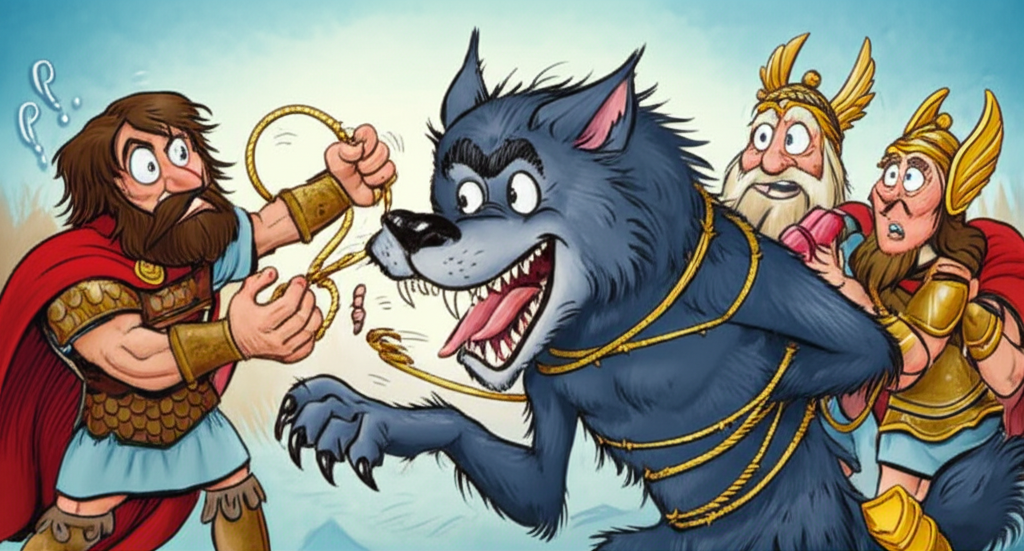
In the frigid, windswept landscapes of ancient Scandinavia, where the long nights were pierced by the aurora borealis and the unforgiving winters shaped the very lives of its inhabitants, a rich tapestry of myths and legends was woven. These were not mere bedtime stories, but profound narratives that helped the Norse people understand their world, their place within it, and the forces that shaped their existence. Among these enduring tales, the saga of Fenrir, the monstrous wolf, and his ultimate binding stands as a potent testament to the power of prophecy, the struggle against overwhelming chaos, and the enduring, albeit grim, hope for a new beginning. This is not a recounting of divine truth, but a journey into the imaginative realm of ancient storytellers, a cultural artifact that offers a glimpse into the worldview of a bygone era.
The cultural milieu that gave rise to the tale of Fenrir was one of stark contrasts and relentless challenges. The Norse people, primarily agrarian and seafaring, lived in a world where nature’s power was both their provider and their adversary. They faced harsh weather, unpredictable seas, and the constant threat of famine. Their cosmology reflected this duality, envisioning a universe populated by gods, giants, dwarves, and a myriad of creatures, all locked in an eternal cycle of creation and destruction. Their understanding of the world was deeply intertwined with the cycles of the seasons, the ferocity of storms, and the primal forces of nature. In this environment, where survival often depended on keen observation and a healthy respect for the untamed, the concept of inevitable doom, or Ragnarök, held a significant place in their collective consciousness. This was a worldview where fate, or wyrd, was a powerful current, and the actions of both mortals and gods were often seen as playing out a grand, predetermined drama.
At the heart of this particular myth lies Fenrir, a creature of immense and terrifying power. He is not simply a wolf; he is depicted as a monstrous offspring of Loki, the trickster god, and the giantess Angrboda. Fenrir is characterized by his colossal size, his insatiable hunger, and a fangs so sharp they could rend the heavens. His eyes are said to burn with an infernal light, and his roar is the sound of the earth groaning under immense pressure. Symbolically, Fenrir represents untamed, destructive force, the embodiment of primal chaos that threatens to consume all order. He is the embodiment of anarchy, the wild, uncontrollable element that even the gods fear. His lineage from Loki, the embodiment of cunning and deceit, further amplifies his threat, suggesting a perversion of natural order and a force born from disruption.
The narrative of Fenrir’s binding unfolds as a chilling prophecy within the broader context of Ragnarök, the twilight of the gods. The Aesir, the gods of Asgard, become increasingly aware of Fenrir’s growing strength and the dire predictions surrounding him. They know that he is destined to break free and devour Odin, the Allfather himself. Driven by a mixture of fear and a grim sense of duty, they attempt to chain him. Their initial efforts are futile. The first fetter, a chain named Læðingr, is easily shattered by the wolf. The second, Dromi, proves equally inadequate. It is then that they turn to the dwarves, the master craftsmen of the underworld, and commission a magical chain, Gleipnir. This artifact, impossibly light and seemingly made of nothing, is described as being woven from the sound of a cat’s footsteps, the beard of a woman, the roots of a mountain, the sinews of a bear, the breath of a fish, and the spittle of a bird. Such improbable ingredients underscore the supernatural nature of the binding and the lengths to which the gods must go to contain this immense threat.
When presented with Gleipnir, Fenrir is suspicious. He demands that one of the gods place their hand in his mouth as a pledge of good faith, a sign that they do not intend to deceive him. Tyr, the god of law and justice, a god known for his courage and integrity, bravely steps forward. He places his right hand in Fenrir’s gaping maw. The gods then bind Fenrir with Gleipnir, and as they tighten the magical cord, the wolf struggles with all his might. He roars and strains, but the fetter holds, growing stronger with every effort to break free. In his rage and despair, Fenrir bites off Tyr’s hand, leaving the god a cripple, a stark symbol of the sacrifices made to maintain order. Fenrir is then cast into a deep chasm, where he remains bound, his howls echoing through the ages, a constant reminder of the chaos that lies dormant, waiting for the prophesied dawn of Ragnarök.
The symbolism woven into this myth is rich and multifaceted. Fenrir’s insatiable hunger and destructive potential can be seen as representing the primal forces of nature that the Norse people constantly battled – the wild, untamed aspects of the world that could bring devastation. His binding, achieved through cunning and sacrifice rather than brute force alone, speaks to the importance of wisdom, foresight, and the willingness to make difficult choices in the face of overwhelming odds. Tyr’s sacrifice, losing his hand to ensure the binding, highlights the concept of justice and the personal cost of upholding order. The magical nature of Gleipnir, crafted from intangible elements, suggests that true strength can lie in the unseen, in the forces that are not immediately apparent, and in the cleverness of invention. Ultimately, the myth foreshadows Ragnarök, a concept that, while bleak, also held a kernel of hope. The destruction was not an end, but a cleansing, a prelude to a new world born from the ashes.
In modern times, the myth of Fenrir continues to resonate, appearing in various forms of popular culture. He is a formidable antagonist in fantasy literature, a monstrous creature in video games, and a recurring figure in cinematic interpretations of Norse mythology. These modern retellings often explore themes of prophecy, the struggle between order and chaos, and the tragic destinies of both gods and monsters. In academic circles, the myth is studied as a valuable source for understanding Norse beliefs, social structures, and their relationship with the natural world. It offers insights into their anxieties, their aspirations, and their enduring fascination with the cyclical nature of existence.
It is important to reiterate that the story of Fenrir and his binding is a traditional narrative, a product of the rich cultural heritage of ancient Scandinavia. It is a testament to human imagination and the enduring power of storytelling to explore complex ideas about life, death, and the forces that shape our reality. As Muslims, we recognize that only Allah is the true Creator and Sustainer of all existence, and that the ultimate truths lie in divine revelation. However, by understanding these ancient stories, we gain a deeper appreciation for the diversity of human thought, the evolution of cultural narratives, and the timeless human desire to make sense of the world through the power of myth and legend. The howling fury of Fenrir, echoing from the mythical fires of Muspelheim, serves as a compelling reminder of the stories that have shaped human culture, inviting us to reflect on the enduring power of narrative and the vastness of our shared human heritage.