fufufafa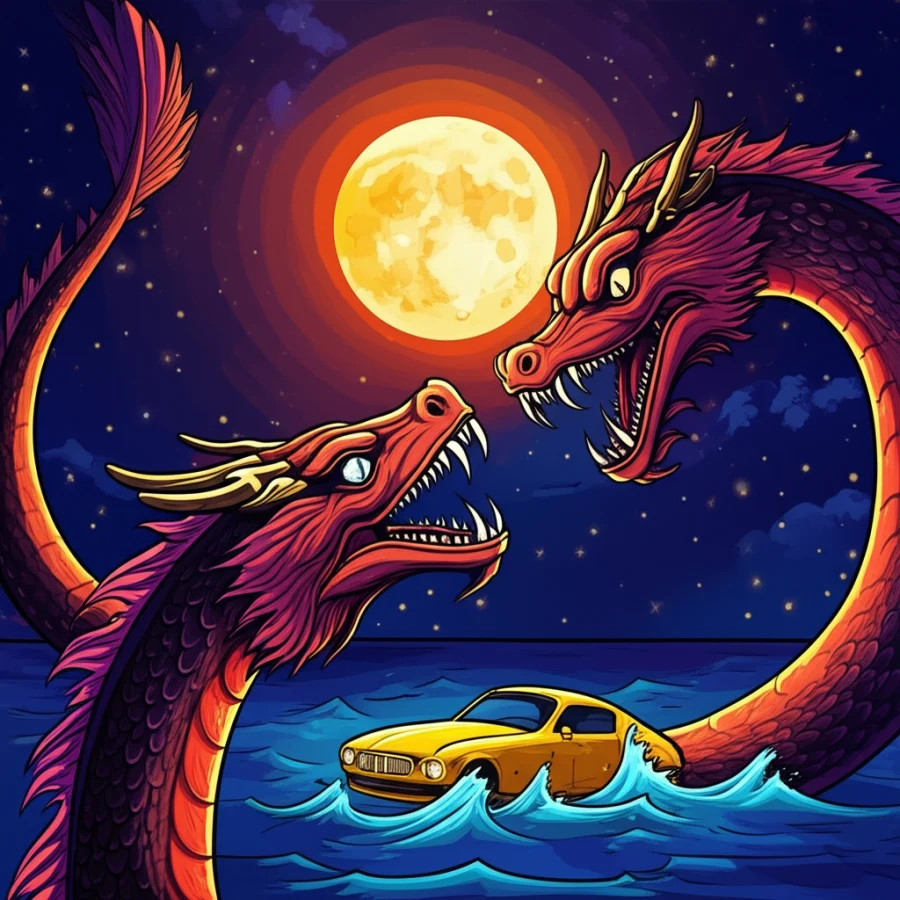
The vast, emerald expanse of the Visayas seas, dotted with a tapestry of islands, holds within its depths not just abundant life, but also echoes of ancient tales. For generations, before the advent of modern science and Abrahamic faiths, the indigenous peoples of the Philippine archipelago sought to understand the world around them through stories. Among these, few are as compelling and enduring as the legend of Bakunawa and the Moon, a foundational myth from the Visayan region that offered an imaginative explanation for the celestial dance and, crucially, the very origins and character of the seas that cradled their lives. This is a traditional story, passed down through oral tradition by ancient communities, not a historical fact or a divine revelation, but a testament to the human spirit’s innate desire to make sense of the cosmos.
Echoes from an Ancient World: The Visayan Cosmos
To truly appreciate the Bakunawa myth, one must step back into the pre-colonial Visayan world, a vibrant tapestry of maritime communities and agricultural societies. Life revolved around the rhythms of nature: the sun for planting and harvesting, the stars for navigation, and the moon for tides and the passage of time. These were people deeply connected to their environment, their existence intertwined with the sea that provided sustenance, facilitated trade, and served as both a pathway and a formidable frontier.
In this animistic worldview, the natural world was alive with spirits – benevolent diwata and mischievous engkanto residing in trees, rivers, and the very air. The cosmos was not a sterile, mechanical system, but a living, breathing entity, where every phenomenon, from a gentle breeze to a raging typhoon, held meaning and agency. Celestial bodies, particularly the sun and moon, were not mere spheres of rock and gas, but powerful deities or manifestations of divine will, influencing human fate and the earth’s bounty. Eclipses, therefore, were not mere astronomical alignments but profound disruptions, portents of great change, or, in the case of the moon, a terrifying act of cosmic predation that demanded human intervention. The deep, dark ocean, too, was a realm of both wonder and dread, its mysteries often personified by colossal creatures that stirred the waters and shaped the land.
Bakunawa: The Serpent of the Deep
At the heart of this ancient narrative stands Bakunawa, a creature of awe-inspiring proportions and primal power. Bakunawa is depicted as a gigantic sea serpent or a colossal dragon, a magnificent and terrifying entity that embodies the profound mystery and untamed force of the deep ocean. Its scales shimmered like a thousand polished obsidian shards, its fins rippled like vast underwater banners, and its eyes glowed with an ancient, hungry light. It was a being of immense size, capable of encircling islands and stirring the very foundations of the earth with its movements.
Symbolically, Bakunawa represented several profound concepts to the ancient Visayans. It was the embodiment of chaotic natural forces, the unpredictable and destructive aspects of the sea – typhoons, tsunamis, and the treacherous depths that claimed lives and livelihoods. It also symbolized an insatiable hunger, a primordial urge that could disrupt the established order of the cosmos. Yet, it wasn’t purely evil in the Western sense; rather, it was a force of nature, driven by instinct and beauty, an essential part of the grand, often terrifying, balance of the universe. Its periodic appearance and disappearance, tied to the moon, represented cycles of destruction and renewal, darkness and light, inherent in the world.
The Cosmic Feast and the Birth of the Seas
The myth begins in a time when the world was bathed in an ethereal, almost constant twilight, for there were not one, but seven moons gracing the night sky. Each moon shone with its own distinct luminescence, casting a myriad of soft glows upon the earth, making the nights almost as bright as day. The land was fertile, the air was gentle, and humanity thrived under this celestial splendor, their lives illuminated by a constant, gentle light.
Bakunawa, the magnificent serpent of the deep, dwelled in the fathomless trenches of the ocean. From its dark abode, it would gaze upwards, captivated by the breathtaking beauty of the seven moons. Their radiant glow, a celestial feast for its ancient eyes, stirred within it an irresistible, primordial hunger. The serpent, accustomed to the dim, cold light filtering into its abyssal domain, coveted the moons’ brilliance with an intensity that grew with each passing night.
One fateful evening, overcome by its insatiable desire, Bakunawa began its ascent from the ocean’s deepest chasm. Its colossal body, larger than any mountain, rose from the dark waters, displacing unimaginable volumes of the sea. As it broke the surface, the waves it created crashed upon the shore with unprecedented fury, shaking the very foundations of the islands. With a gaping maw that could swallow entire landscapes, Bakunawa lunged towards the nearest moon. The celestial sphere, a beacon of light and calm, was consumed in an instant, plunging a portion of the world into deeper shadow.
Humanity watched in terror as, one by one, the moons began to disappear. Bakunawa, emboldened by its success, continued its cosmic feast, swallowing six of the seven moons. The world grew progressively darker, the once vibrant nights now shrouded in an oppressive gloom. The seas, once gently illuminated, became vast, dark, and menacing, reflecting the despair of the land. The sheer scale of Bakunawa’s movements, its immense body churning the waters as it rose and fell, carved out the deep trenches and vast basins that would become the Visayan seas. The very act of its rising from the abyss to devour the moons, and its subsequent descent, deepened the ocean floor and stirred the primordial waters, creating the immense, profound depths and the complex, varied currents that characterize the region’s marine landscape. The absence of the moons’ constant light further enhanced the perceived vastness and mystery of these newly formed, darker waters, transforming what might have been shallower, more illuminated expanses into the deep, enigmatic seas known to the Visayan people.
Only one moon remained, a solitary beacon against the encroaching darkness. Panic gripped humanity. Fearing a world plunged into eternal night, they knew they had to act. They gathered their drums, their gongs, their conch shells, and their voices. As Bakunawa once again began its slow, terrifying ascent towards the last moon, the people unleashed a cacophony of sound. They beat their gongs and drums with frantic intensity, blew their conch shells in mournful, piercing wails, and shouted with all their might, hoping to startle the colossal beast.
The overwhelming noise, an urgent plea from the world above, startled Bakunawa. The serpent paused, momentarily disoriented by the unexpected clamor. Some say the sound caused it to spit out the moon it had just swallowed, allowing it to return to the sky – an explanation for the phenomenon of lunar eclipses. Other versions suggest the noise simply deterred it from consuming the final moon, ensuring that humanity would never be left in total darkness. Thus, the last moon was saved, and the world was left with a single, precious orb to light its nights. The vast, deep, and sometimes turbulent Visayas seas, however, remained as a testament to Bakunawa’s cosmic hunger and the immense forces that shaped their world.
Symbolism and Enduring Meaning
The myth of Bakunawa and the Moon is rich with symbolism, offering profound insights into the worldview of the ancient Visayans. Foremost, it serves as an explanation for natural phenomena: the existence of a single moon, the terrifying yet cyclical nature of lunar eclipses, and the very character of the deep, often turbulent seas around them. Bakunawa embodies the immense and often unpredictable power of nature, particularly the ocean. Its insatiable hunger represents the destructive forces of typhoons, tsunamis, and volcanic eruptions, which could dramatically alter landscapes and human lives.
The people’s desperate act of creating noise highlights the theme of human agency and collective action. It suggests that even in the face of overwhelming cosmic forces, humanity is not entirely powerless. Through unity and determination, they can influence the balance of the world, even if only to temporarily deter or placate a powerful entity. The myth also speaks to the duality of light and darkness, order and chaos. The moons represent divine order, beauty, and illumination, while Bakunawa embodies primal chaos and the ever-present threat of darkness. The story, therefore, is a narrative about the delicate balance between these forces, a balance that humanity strives to maintain.
Furthermore, the tale profoundly shaped the perception of the Visayan seas. The sheer scale of Bakunawa’s movements, its gargantuan body rising from and descending into the depths, became the primordial architect of the vastness and profound depths that characterize these waters. The swallowed moons, now gone, left a void that was filled by the ocean, contributing to its immensity. The turbulence and powerful currents, the endless expanse of blue, all found their explanation in the epic struggle between the celestial lights and the ancient serpent. The seas were not just water; they were the scarred canvas of a cosmic battle, a constant reminder of the primal forces that shaped their world.
Bakunawa in the Modern World
While no longer held as a literal truth, the legend of Bakunawa and the Moon continues to resonate deeply within Filipino culture, particularly in the Visayas. It is celebrated as a vital piece of pre-colonial heritage, a testament to the rich imagination and sophisticated worldview of ancient Filipinos. Bakunawa has transcended its original role as an explanatory myth to become a powerful cultural icon.
Today, Bakunawa can be found in various forms of modern media and artistic expression. It inspires contemporary Filipino literature, lending its mystique to fantasy novels and short stories. Artists depict its grandeur in paintings, sculptures, and digital art, often reimagining its form in breathtaking detail. In the realm of gaming and film, Bakunawa has appeared as a formidable mythical creature, a boss character, or a symbolic presence, introducing this ancient tale to new generations. Cultural studies and folklore programs in universities analyze the myth for its anthropological, psychological, and literary significance, further preserving and disseminating its legacy. Festivals and cultural events in the Philippines sometimes feature Bakunawa, bringing its story to life through performances and parades, ensuring that this magnificent serpent remains etched in the collective consciousness.
A Legacy of Imagination and Understanding
The legend of Bakunawa and the Moon stands as a powerful testament to the human capacity for imagination and storytelling. It is a cultural narrative, born from a time when people looked to the heavens and the vast, unknown ocean for answers, weaving intricate tales to explain the inexplicable. This myth, like countless others across the globe, is a window into the minds of our ancestors, revealing their fears, their hopes, and their understanding of a world far grander and more mysterious than we often perceive today.
As Muslims, we recognize that only Allah, the Most High, is the true Creator and Sustainer of the heavens and the earth, the fashioner of every star, moon, and ocean. The intricate design and perfect balance of the cosmos are His alone, and the scientific explanations we now possess for celestial events and geological formations are but glimpses into the infinite wisdom of His creation.
Nevertheless, the story of Bakunawa and the Moon remains a cherished part of Filipino cultural heritage. It is a beautiful example of how ancient societies used narrative to explore profound questions about existence, to instill moral lessons, and to foster a shared understanding of their world. It reminds us of the enduring power of storytelling, not as a source of truth, but as a vibrant thread in the fabric of human history, connecting us to the imaginative spirit of those who came before.