fufufafa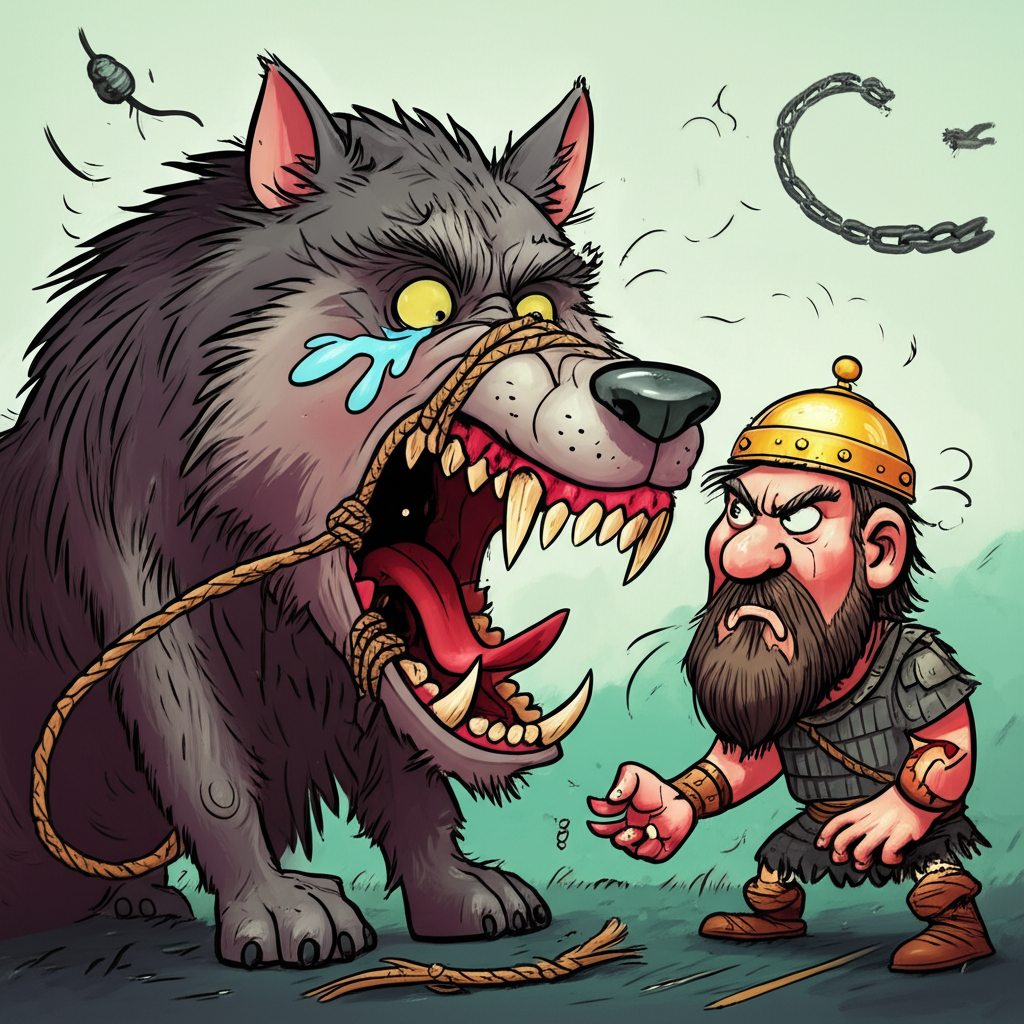
The vast, frozen lands of ancient Scandinavia and Iceland, home to the Norse peoples, were steeped in a rich tapestry of myth and legend. Among these tales, passed down through generations of oral tradition and later recorded in texts like the Poetic and Prose Eddas, none perhaps encapsulated the primal fear of chaos and the grim inevitability of fate quite like the story of Fenrir, the monstrous wolf. This narrative, a cornerstone of Norse cosmology, is a traditional story told by ancient people, a reflection of their worldview, and is presented here purely for cultural, historical, and educational understanding, not as truth or for belief, worship, or practice.
Origins and Cultural Background: A World of Frost and Fate
The myths of the Norse pantheon emerged from a society shaped by the harsh realities of Northern Europe during the Viking Age and earlier Iron Age. These were communities of farmers, warriors, and seafarers, intimately connected to the rhythms of nature, the vast, unforgiving sea, and the dense, mysterious forests. Their world was one of stark contrasts: long, dark winters followed by brief, vibrant summers; the constant threat of famine, battle, and the unknown. This environment fostered a worldview that embraced both stoic resilience and a deep reverence for the forces beyond human control.
People of this era viewed the cosmos as a complex structure of nine realms, interconnected by the world-tree Yggdrasil. Asgard, the realm of the Aesir gods, stood as a bastion of order, while Jotunheim, the land of the giants (Jotnar), represented the untamed, chaotic forces of nature that constantly threatened to overwhelm the established order. Fate, or wyrd, was a powerful, immutable concept; even the gods themselves were bound by its decrees, knowing their ultimate end in the cataclysmic battle of Ragnarök. It was within this understanding of a world balanced precariously between order and chaos, light and shadow, that the tale of Fenrir took shape.
Fenrir: The Embodiment of Unchecked Chaos
At the heart of this particular myth stands Fenrir, a creature of immense and terrifying power. He is not merely a large wolf, but a cosmic entity, the offspring of Loki, the trickster god (himself of giant lineage), and the giantess Angrboda from Jotunheim. Fenrir’s siblings include Jörmungandr, the Midgard Serpent, and Hel, ruler of the underworld. Each of Loki’s children with Angrboda embodied a significant threat to the cosmic order maintained by the Aesir, directly representing the chaotic "aftermath" of the volatile union between Asgardian cunning and Jotunheim’s primal force.
Fenrir is described as a wolf of ever-growing size, his jaws capable of swallowing the sun and moon. His symbolic attributes are profound: he represents unchecked, destructive force, the primal fear of chaos unbound, and the inevitable, destructive end that awaits even the mightiest of gods. He is the personification of a prophecy, a living harbinger of Ragnarök, destined to devour Odin himself. The ancient Norse did not view him as a figure to be worshipped or adored, but rather as a terrifying, almost elemental force that must be contained, a stark reminder of the fragile balance of their world.
The Binding of Fenrir: A Narrative of Fear and Sacrifice
The story of Fenrir’s binding begins in Asgard, the realm of the Aesir gods. As Fenrir grew, so too did the gods’ apprehension. His immense size and ferocity became a source of grave concern, especially after prophecies foretold his role in the destruction of their world. The Aesir, led by Odin, the Allfather, understood that Fenrir could not be reasoned with or controlled by conventional means. He was too wild, too powerful, a living embodiment of the chaos that constantly threatened their ordered existence.
Their initial attempts to contain the wolf were deceptively simple, designed to make Fenrir believe he was merely participating in a test of strength. They forged a mighty chain, thick and strong, named Lædingr, and challenged Fenrir to break free. With a casual stretch of his powerful limbs, the wolf snapped the chain as if it were a mere thread. Undeterred, the gods forged an even stronger chain, Drómi, twice as stout as the first. Again, Fenrir, with a shrug and a grunt, shattered it with ease. Each success only fueled his arrogance and the gods’ despair, confirming the terrifying extent of his power.
Realizing that mortal chains were useless, Odin dispatched Skirnir, Freyr’s messenger, to the realm of the dark elves (or dwarves) in Svartalfheim. These master smiths, renowned for their unparalleled craftsmanship and ability to work with magic, were tasked with creating an unbreakable bond. They fashioned Gleipnir, a fetter unlike any other. It was not made of metal, but from six impossible ingredients: the sound of a cat’s footfall, the beard of a woman, the roots of a mountain, the sinews of a bear, the breath of a fish, and the spittle of a bird. These seemingly non-existent components, woven together with powerful magic, created a bond as thin and soft as silk, yet stronger than any iron chain.
The gods then lured Fenrir to the island of Lyngvi, situated in the middle of the vast Lake Amsvartnir. They presented Gleipnir to him, claiming it was merely another test, a trifle compared to his previous triumphs. Fenrir, however, was no fool. He eyed the slender, delicate ribbon with suspicion. "This band appears too weak for me to gain any fame from breaking it," he growled, "but if it is made with cunning and magic, I will not allow it to be placed upon me." He suspected a trick, demanding that one of the gods place their hand in his mouth as a pledge of good faith.
Silence descended upon the assembled Aesir. To volunteer meant almost certain dismemberment, a sacrifice that few were willing to make. But then, Tyr, the brave and honorable god of war and justice, stepped forward. Known for his unwavering courage and commitment to order, Tyr understood the grave necessity of the moment. Without hesitation, he placed his right hand deep into Fenrir’s gaping maw.
With Tyr’s hand as collateral, Fenrir allowed Gleipnir to be placed upon him. As the gods tightened the silken ribbon, the magic of its impossible ingredients took hold. Fenrir struggled, twisting and thrashing with all his might, but the more he fought, the tighter Gleipnir became. The soft ribbon held firm, trapping the monstrous wolf. In a furious snap, Fenrir’s mighty jaws closed, severing Tyr’s hand at the wrist. A cry of pain escaped the god, but it was quickly drowned out by the triumphant laughter of the other Aesir, for their great enemy was finally bound.
To prevent Fenrir from causing further harm, the gods drove a sword through his jaws, wedging them open to prevent him from biting. From his perpetually open mouth flowed rivers of slobber, forming the river Ván. And there Fenrir remained, chained to a rock deep beneath the earth, howling in impotent rage, until the fateful day of Ragnarök, when he is prophesied to break free and devour Odin.
Symbolism and Meaning: Reflecting a Pre-Modern World
To the ancient Norse, the Binding of Fenrir was far more than an entertaining tale. It was a profound reflection of their understanding of the world. The story embodied their fear of uncontrolled natural forces and the chaotic elements personified by Jotunheim and its monstrous offspring. Fenrir represented the destructive power that lay dormant, yet ever-present, beneath the veneer of order. His inevitable breaking free at Ragnarök spoke to their belief in the cyclical nature of existence – a grand cycle of creation, order, chaos, destruction, and eventual renewal.
Tyr’s sacrifice was a powerful symbol of the price of maintaining order and justice. It illustrated that even the gods had to make immense sacrifices to protect their world from overwhelming chaos. It taught lessons about courage, selflessness, and the grim necessity of making difficult choices for the greater good. The story also highlighted the tension between wisdom and brute strength, and the understanding that true power often lay not in sheer force, but in cunning, magic, and strategic sacrifice. It underscored the concept of wyrd, or fate, showing that even with all their power, the gods could only postpone, not prevent, the wolf’s ultimate role in the cosmic drama.
Modern Perspective: Echoes in Contemporary Culture
In the modern world, the myth of Fenrir and his binding continues to resonate, albeit through a different lens. No longer a story of literal belief, it has transcended its origins to become a powerful cultural touchstone. In literature, Fenrir’s imagery of the colossal, bound wolf awaiting his release is a popular trope, inspiring countless fantasy novels and comics that explore themes of prophecy, inevitable doom, and heroic sacrifice.
In the realm of cinema and television, the character of Fenrir, or figures heavily inspired by him, frequently appears, most notably in the Marvel Cinematic Universe where the character (though significantly adapted) serves as a formidable antagonist. Video games, such as the God of War series and Assassin’s Creed Valhalla, draw heavily on Norse mythology, often depicting Fenrir as a terrifying boss or a pivotal figure in their narratives, allowing players to interact with these ancient myths in dynamic ways. Beyond entertainment, scholars of mythology, folklore, and cultural studies continue to analyze the tale, dissecting its psychological, sociological, and historical implications, using it as a window into the minds and values of the ancient Norse.
Conclusion: A Legacy of Imagination
The Binding of Fenrir stands as a testament to the enduring power of human imagination and the timeless tradition of storytelling. It is a cultural narrative from ancient Northern Europe, a complex tapestry woven from the fears, hopes, and observations of people long past. It is not a belief system to be adopted or worshipped, but a profound piece of cultural heritage that offers insights into how pre-modern societies grappled with existential questions of chaos, order, and destiny.
As Muslims, we recognize that only Allah is the true Creator and Sustainer of all existence, and our belief is firmly rooted in His oneness and absolute power. We understand that such mythological tales, while rich in narrative and cultural significance, are products of human creativity and attempts to explain the world without divine guidance. They remind us of the diverse ways humanity has sought to comprehend the universe, to find meaning in suffering, and to articulate the eternal struggle between constructive forces and destructive chaos. The legacy of Fenrir’s binding, therefore, is not one of divinity, but of the profound human capacity for imagination, for crafting narratives that speak to universal truths, and for preserving a rich, cultural heritage that continues to fascinate and educate.