fufufafa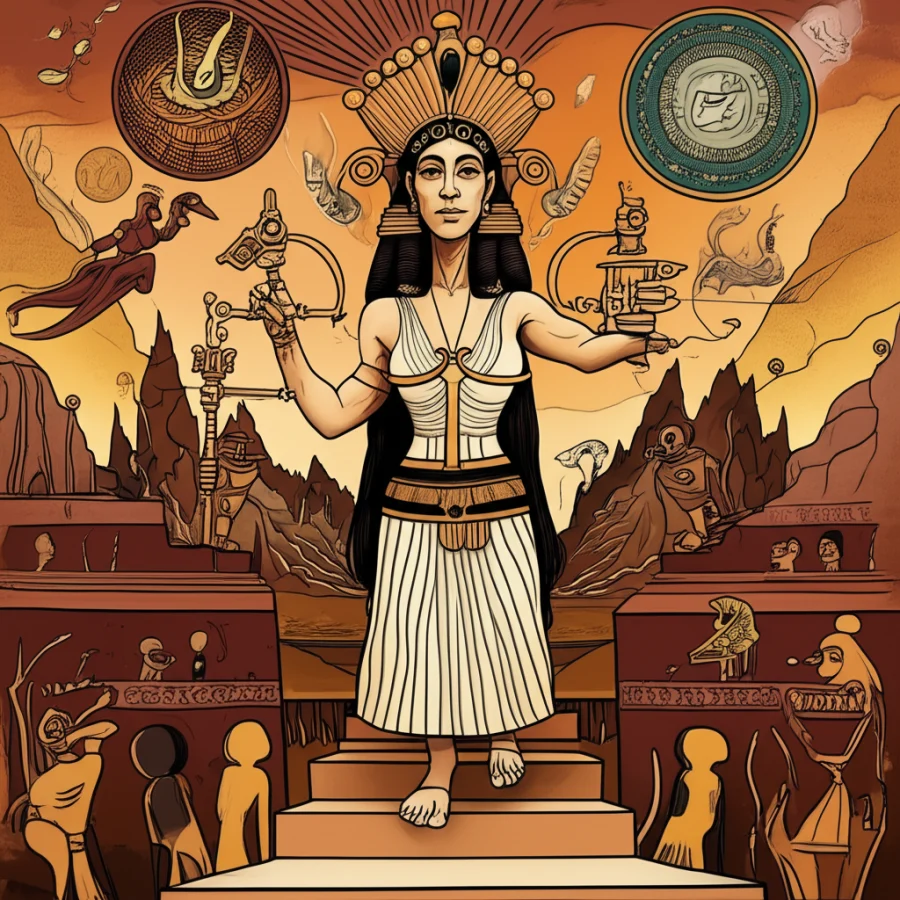
Introduction:
From the sun-baked lands of ancient Mesopotamia, cradled between the Tigris and Euphrates rivers, comes the epic tale of Inanna, Queen of Heaven and Earth. This is not a record of divine events, but a traditional story, a myth passed down through generations by the Sumerians and later the Akkadians. It is a window into their worldview, their fears, and their understanding of the cosmos, a story etched onto clay tablets millennia ago. We explore it now not as an article of faith, but as a piece of human history, a testament to the enduring power of storytelling.
Origins and Cultural Background:
The story of Inanna’s descent likely originated during the Sumerian period (c. 4500-1900 BCE) and was later adopted and adapted by the Akkadians who conquered Sumer around 2300 BCE. This was a world steeped in agricultural dependence, where the cycles of nature dictated life and death. The Sumerians and Akkadians lived in city-states, each ruled by a king who was seen as an intermediary between the gods and the people. The cosmos was understood as a hierarchical structure, with the gods residing in the heavens and influencing earthly affairs. Fertility, both of the land and of the people, was paramount, and the deities associated with these aspects were highly revered. The people believed that pleasing the gods through rituals and offerings was essential for maintaining prosperity and averting disaster. Their literature, including myths like Inanna’s descent, served not only as entertainment but also as a means of explaining the world around them and reinforcing social norms.
Character Description: Inanna
Inanna, also known as Ishtar to the Akkadians, was a complex and powerful goddess. She was the Queen of Heaven and Earth, associated with love, beauty, sex, war, justice, and political power. Her symbolic attributes are rich and varied: the eight-pointed star, representing the planet Venus; the lion, symbolizing her strength and courage; and various forms of attire and jewelry, signifying her status and allure. Inanna was not simply a benevolent figure; she was also capable of wrath and destruction. Her descent into the underworld can be interpreted as a symbolic representation of the cyclical nature of life, death, and rebirth, and perhaps also as a reflection on the limits of power and the inevitability of mortality. We must understand these attributes as literary tools, not as objects of worship or reverence.
Main Story: The Narrative Retelling
Inanna, restless and ambitious, decided to journey to the underworld, the realm of her sister, Ereshkigal, Queen of the Great Below. She gathered her seven me, the divine powers and attributes that defined her queenship – her crown, her measuring rod, her lapis lazuli necklace, and so on. She instructed her faithful minister, Ninshubur, "If I do not return after three days, go to the gods Enlil, Nanna, and Enki. Plead with them to save me from the underworld."
Adorned in her finery, Inanna descended through the seven gates of the underworld. At each gate, the gatekeeper demanded she remove an item of her regalia. Inanna, though reluctant, complied, until she stood naked and powerless before Ereshkigal.
Ereshkigal, consumed by grief and rage, fixed Inanna with a deathly glare. Inanna was transformed into a corpse and hung upon a hook.
On the third day, when Inanna did not return, Ninshubur followed her mistress’s instructions. He pleaded with Enlil and Nanna, but they refused to intervene. Only Enki, the god of wisdom and cunning, took pity on Inanna.
Enki fashioned two small creatures from the dirt under his fingernails. He gave them the bread of life and the water of life and instructed them to descend to the underworld. When they found Ereshkigal writhing in pain, they offered her sympathy. Ereshkigal, touched by their compassion, offered them a gift. They requested the corpse of Inanna.
Using the bread of life and the water of life, the creatures revived Inanna. But there was a price to be paid. The laws of the underworld dictated that no one could leave without providing a replacement.
Demons accompanied Inanna as she ascended, searching for a substitute. They found Ninshubur, weeping for her mistress, but Inanna refused to let her faithful servant be taken. They continued until they reached Inanna’s home city of Uruk. There, they found Dumuzi, Inanna’s husband, sitting on his throne, feasting and reveling, showing no sign of mourning. Enraged by his indifference, Inanna decreed that Dumuzi would take her place in the underworld for half the year. The other half of the year, his sister Geshtinanna would take his place, allowing him to return to the land of the living. And so, the cycle of seasons, of life and death, was established.
Another text, known as the "Curse of Akkad," tells a different, but related story. It describes how Naram-Sin, a powerful Akkadian king, angered Inanna by looting her temple in Nippur. In her fury, Inanna withdrew her favor from Akkad, bringing famine, war, and destruction upon the land. This text serves as a warning against hubris and the consequences of disrespecting the gods.
Symbolism and Meaning:
The story of Inanna’s descent is rich with symbolism. It can be interpreted as a metaphor for the agricultural cycle, with Inanna’s absence from the world representing the barrenness of winter and her return signifying the renewal of spring. It also explores themes of power, ambition, and the limitations of mortality. The "Curse of Akkad" serves as a cautionary tale about the dangers of arrogance and the importance of maintaining balance in the world. For the ancient people, these stories provided a framework for understanding their place in the cosmos and the forces that shaped their lives.
Modern Perspective:
The myth of Inanna continues to resonate in modern culture. Her story has been retold in numerous books, poems, and plays. She appears in various video games and is often referenced in academic studies of mythology and comparative religion. The themes explored in her myth – power, sexuality, death, and rebirth – remain relevant and continue to inspire artists and writers. Modern interpretations often focus on Inanna as a symbol of female empowerment and a challenger of patriarchal structures.
Conclusion:
The tale of Inanna’s descent and the "Curse of Akkad" is a captivating story from the ancient world. It offers a glimpse into the beliefs and values of the Sumerians and Akkadians, providing insights into their understanding of the world and their place within it. It is essential to remember that this is a cultural story, a product of human imagination, and not a belief system. As Muslims, we acknowledge that only Allah is the true Creator and Sustainer of the universe. The story of Inanna, however, serves as a valuable reminder of our shared human heritage and the enduring power of storytelling to explore profound themes and connect us to the past. It is a testament to the creativity and imagination of our ancestors and a reminder of the importance of preserving and studying our cultural heritage.