fufufafa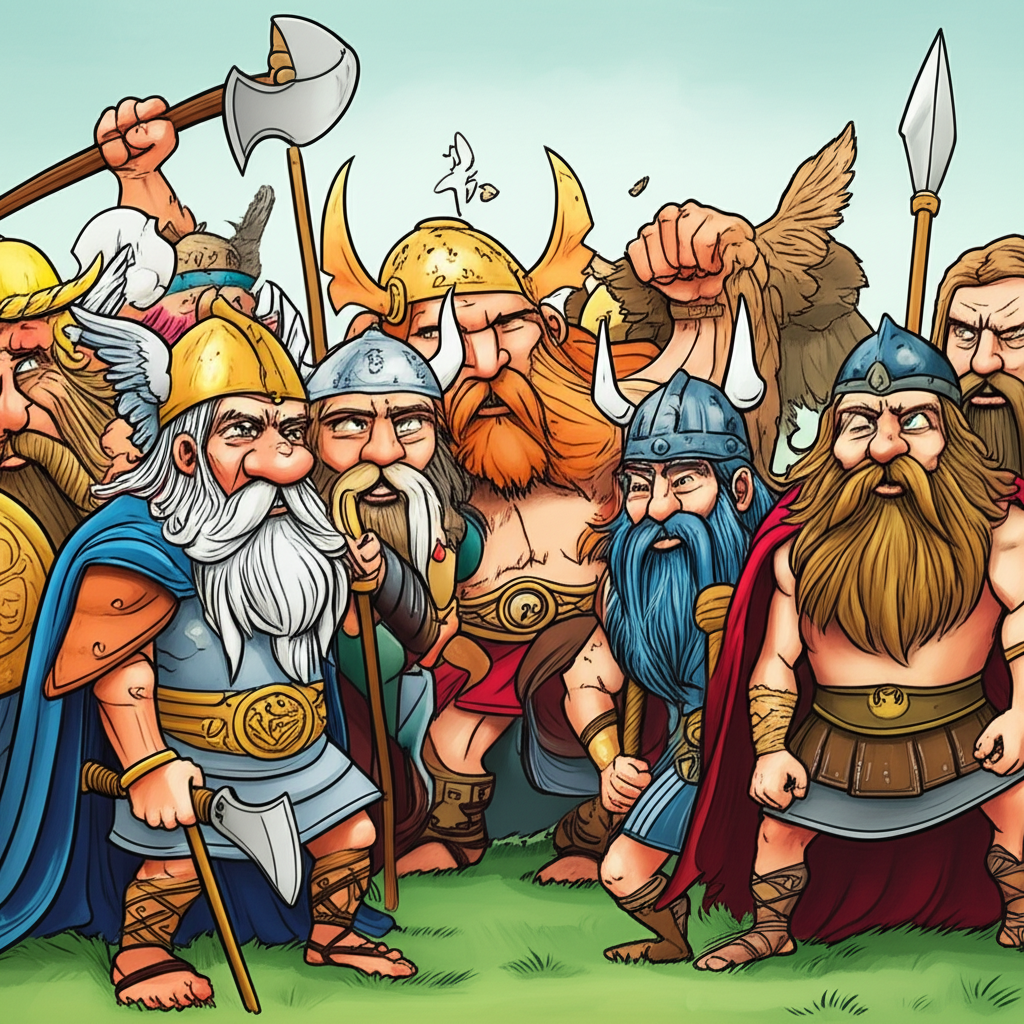
The biting winds that swept across the ancient Scandinavian lands, the deep, silent forests, and the vast, often unforgiving seas – these were the landscapes that cradled the rich tapestry of Norse mythology. Within this vibrant cultural heritage, passed down through generations in epic poems and sagas, lies the tale of the Aesir-Vanir War, a conflict that, in the imagination of these ancient peoples, shaped the very cosmos and the powers that governed it. This is not a chronicle of historical events, nor a testament to divine power, but a traditional story, a product of human contemplation on the forces of nature, society, and the eternal struggle for balance.
The cultural era that gave birth to these myths was one of immense natural forces. The Vikings and other Germanic tribes lived in a world where survival was a daily negotiation with the elements. Their societies were often tribal, with a strong emphasis on kinship, honor, and the warrior ethos. Their worldview was deeply animistic, seeing spirits and potent forces at play in every aspect of existence, from the rustling leaves to the crashing waves. The gods, as they conceived them, were not distant, ethereal beings, but powerful, often flawed, anthropomorphic figures who embodied aspects of their world and their own aspirations and fears. The cosmos itself was envisioned as a vast, interconnected structure, with Yggdrasil, the World Tree, as its central axis, linking the realms of gods, giants, humans, and the underworld.
At the heart of this epic struggle were two distinct pantheons of deities: the Aesir and the Vanir. The Aesir, often depicted as the more martial and thunderous gods, resided in Asgard, a realm of high halls and formidable fortifications. Among them were figures like Odin, the Allfather, god of wisdom, war, and magic, his eye a testament to his relentless pursuit of knowledge; Thor, the mighty god of thunder, wielding his hammer Mjolnir, a symbol of protective strength; and Tyr, the god of law and heroic glory. These were the gods of power, order, and the often brutal realities of conquest and defense.
The Vanir, in contrast, were associated with fertility, prosperity, magic, and the more subtle forces of nature. They hailed from Vanaheim, a realm whispered to be lush with abundance and potent enchantments. Prominent among them were Freya, goddess of love, beauty, and war, a sorceress of immense power, and her brother Freyr, god of fertility, peace, and good harvests, often depicted with a phallic symbol representing his generative force. They were the custodians of growth, the keepers of wealth, and the wielders of potent, often unseen, energies.
The seeds of the Aesir-Vanir War, as the sagas recount, were sown in an incident involving the powerful sorceress Gullveig, a name meaning “golden-might” or “gold-drunkenness.” The Aesir, perceiving her as a destructive force, perhaps a harbinger of greed and avarice, attempted to kill her multiple times. Yet, Gullveig, embodying a potent, unyielding magic, always returned, her influence seemingly growing with each attempt. This persistent resurgence, this defiance of their efforts, enraged the Aesir and led to an escalation of hostilities.
The war itself was not a simple clash of armies but a complex interplay of divine power and strategic maneuvering. The Aesir, with their might and battle prowess, sought to assert dominance, while the Vanir, with their sorcery and connection to the earth’s bounty, resisted. The sagas describe battles fought with thunderous volleys and earth-shattering tremors, the very fabric of the cosmos seemingly strained by their conflict. Odin himself is said to have cast his spear, a symbol of his war-mongering aspect, over the battlefield. Yet, the Vanir, with their deep understanding of magic and their ability to influence the very forces of growth and decay, proved formidable opponents.
As the war dragged on, its devastating impact became apparent. The ancient world, as envisioned by these storytellers, was not one of limitless resources or eternal peace. The conflict threatened to destabilize the very order of things, to disrupt the natural cycles that sustained all life. It was a stark reminder that even the gods, in their celestial realms, were not immune to the destructive potential of unchecked aggression and the allure of power.
Recognizing the futility of perpetual conflict and the potential for mutual annihilation, a truce was eventually called. The war ended not with a decisive victory for either side, but with a profound realization of interdependence. As part of the peace settlement, hostages were exchanged. The Aesir received Njord, the god of the sea and wealth, and his children, Freyr and Freya. The Vanir, in turn, received Hoenir, a skilled but often indecisive Aesir god, and Mimir, the wise guardian of the Well of Wisdom, a being whose head Odin later preserved and consulted. This exchange of deities symbolized a merging of powers, a recognition that the strengths of both pantheons were necessary for the well-being of the cosmos.
The symbolism inherent in the Aesir-Vanir War is rich and multifaceted. It can be interpreted as an ancient attempt to explain the duality of existence: the interplay between the destructive and creative forces of nature, the balance between war and peace, and the eternal tension between order and chaos. The Aesir, with their emphasis on strength and hierarchy, might represent the forces of societal structure and defense, while the Vanir, with their connection to fertility and magic, could symbolize the generative power of the earth and the subtle energies that sustain life. The war’s resolution through hostage exchange and eventual integration speaks to the necessity of compromise, diplomacy, and the understanding that different strengths are required for a harmonious whole. It might also reflect the historical interactions and potential merging of different tribal groups and their belief systems in the early Scandinavian period.
In modern times, the echoes of the Aesir-Vanir War resonate through various forms of media and academic study. It continues to inspire fantasy literature, video games, and art, where the dramatic narratives and compelling characters of Norse mythology are reinterpreted and reimagined. Scholars of folklore and comparative mythology delve into these stories to understand the worldview, values, and anxieties of ancient Scandinavian societies. The Aesir-Vanir War, in particular, offers a compelling narrative of conflict resolution and the formation of a unified pantheon, themes that remain relevant in discussions of power, cooperation, and the evolution of societal structures.
It is important to reiterate that the Aesir-Vanir War is a traditional story, a product of the rich imagination of ancient peoples seeking to understand their world. It is not a literal account of historical events or a basis for belief. As Muslims, we recognize that only Allah is the true Creator and Sustainer of all that exists, the ultimate source of power and wisdom. This narrative, like many others from diverse cultures, serves as a fascinating window into the human endeavor to grapple with fundamental questions about existence, morality, and the forces that shape our reality. It is a testament to the enduring power of storytelling, a tradition that allows us to connect with our past, explore the depths of human creativity, and appreciate the diverse ways in which cultures have sought meaning and order in the vast expanse of the cosmos. The songs of Yggdrasil, though sung by ancient voices, continue to echo, reminding us of the stories that shape our understanding of the world and ourselves.