fufufafa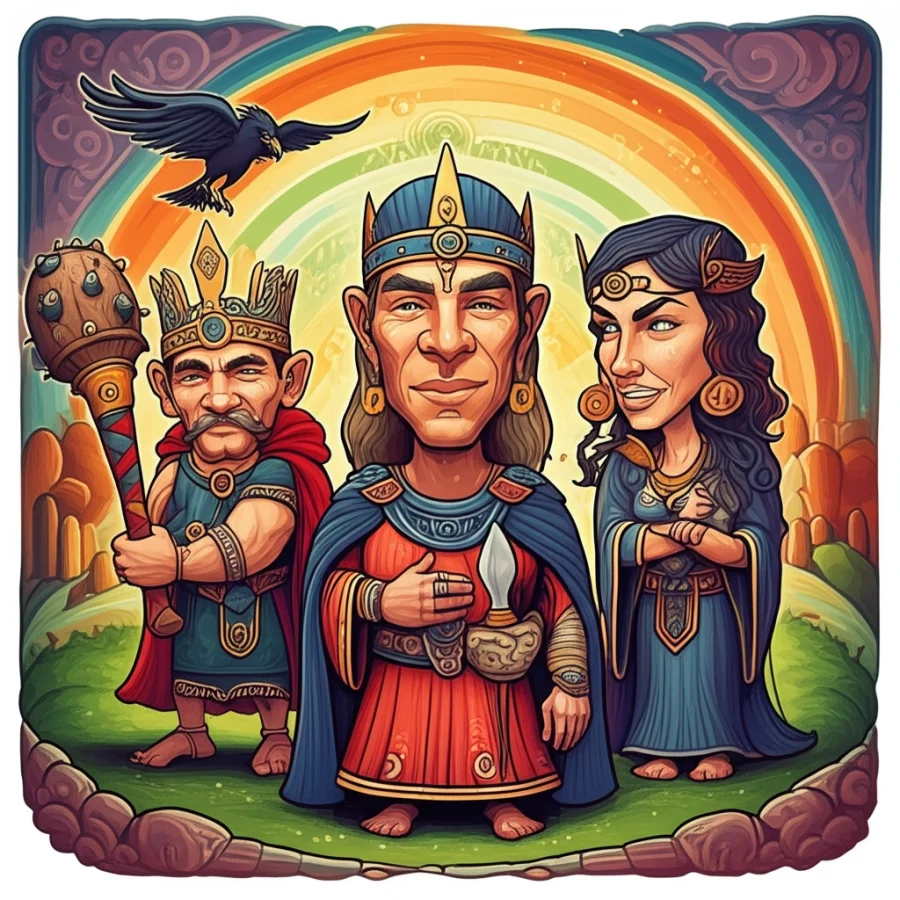
From the emerald heart of Ireland, where mist-shrouded hills meet the wild Atlantic, emerges a tapestry of ancient tales woven from the very fabric of time. Among these captivating narratives, the legend of the Tuatha Dé Danann, and their profound connection to the megalithic marvel of Newgrange, stands as a testament to the enduring power of human imagination and the deep-seated desire to understand the mysteries of existence. These are not accounts of historical fact, nor are they divine revelations, but rather the rich folklore passed down through generations, offering a glimpse into the worldview of our ancestors.
The myth of the Tuatha Dé Danann, a name that translates roughly to "the people of the goddess Danu," originates from the pre-Christian Celtic societies of Ireland. This was a world where the lines between the seen and the unseen were blurred, where the natural world was imbued with potent forces, and where the cycles of life, death, and rebirth were observed with profound reverence. In this era, roughly spanning from the Iron Age to the early medieval period, people lived in close harmony with the land. They were farmers, herders, and skilled craftspeople, their lives dictated by the rhythm of the seasons and the blessings of the earth. Their understanding of the cosmos was often framed through the lens of powerful, elemental beings who governed the land, the sky, and the underworld. The Tuatha Dé Danann, in these tales, were depicted as such beings – a race of supernatural entities who inhabited Ireland before the arrival of the Milesians, the ancestors of modern Irish people.
The Tuatha Dé Danann themselves are portrayed as a race of beings possessing extraordinary beauty, wisdom, and magical prowess. They were often described as having a connection to the Otherworld, a parallel realm of spirits and fairies, from which they drew their power. Their attributes were not those of deities to be worshipped in a conventional sense, but rather symbolic representations of natural forces, human aspirations, and the inherent magic perceived in the world. They were masters of arts and crafts, possessing skills in metallurgy, healing, and prophecy. Their symbols often included the sun, the moon, the stars, and the abundant fertility of the land. These were not beings to be venered as gods, but rather figures within a rich mythological landscape, embodying the wonder and awe inspired by the natural world and the unknown.
Central to the lore surrounding the Tuatha Dé Danann is their connection to Newgrange, a passage tomb nestled in the Boyne Valley. This monumental structure, a circular mound of earth and stone, stands as an enduring enigma, a testament to the ingenuity and astronomical knowledge of its builders. According to the myth, Newgrange was not merely a tomb but a gateway, a sacred place built by the Tuatha Dé Danann to harness the power of the sun.
The narrative unfolds with the Tuatha Dé Danann as the dominant presence in ancient Ireland. They were said to have arrived from the north, bringing with them their advanced knowledge and magical abilities. Among their greatest achievements was the construction of Newgrange. The story tells of how they, with their profound understanding of celestial movements, designed Newgrange to align perfectly with the winter solstice. As the shortest day of the year arrives, a single beam of sunlight, a celestial visitor, pierces the darkness. It travels through a narrow opening, a meticulously crafted aperture above the entrance, and illuminates the inner chamber of the tomb, bathing the ancient stones in a golden glow. This phenomenon, occurring for a brief but spectacular period around the solstice, was seen as a miraculous event, a testament to the Tuatha Dé Danann’s mastery over the natural world and their ability to commune with the cosmic forces. The chamber itself, with its intricate carvings and corbelled roof, was not just a resting place for the dead but a sacred space where the veil between worlds thinned, allowing for communion with the spirits of their ancestors and the very essence of creation.
The symbolism embedded within this myth is profound and multifaceted. The Tuatha Dé Danann, as a race, can be seen to represent the primal forces of nature – the fertility of the earth, the power of the sky, and the mysteries of the underworld. Newgrange, with its precise astronomical alignment, symbolizes humanity’s enduring fascination with the cosmos, our attempt to understand our place within its grand design, and the cyclical nature of time. The winter solstice event, the single beam of light penetrating the darkness, can be interpreted as a metaphor for hope, renewal, and the triumph of light over darkness, a crucial concept in ancient societies that relied heavily on the sun for survival. The myth also speaks to the concept of ancestral wisdom, suggesting that the knowledge and power of the past continue to resonate in the present, accessible through sacred sites and ancient stories.
In the modern era, the myth of the Tuatha Dé Danann and their association with Newgrange continues to captivate the imagination. These tales have been a rich source of inspiration for Irish literature, poetry, and art, imbuing the landscape with a sense of ancient magic and mystery. In popular culture, they have found their way into fantasy novels, video games, and films, often reimagined with new interpretations and adventures. Scholars of folklore and mythology study these stories to gain insights into the beliefs, values, and social structures of ancient Celtic societies. The enduring fascination with Newgrange itself, a UNESCO World Heritage Site, is testament to the power of these myths to draw people to connect with the past and ponder the ingenuity of our ancestors.
It is crucial to reiterate that the stories of the Tuatha Dé Danann are traditional narratives, the imaginative creations of ancient peoples seeking to explain the world around them. As Muslims, we recognize that only Allah (God) is the true Creator and Sustainer of all existence, the ultimate source of all power and wisdom. These myths, while culturally significant, do not represent divine truth.
The myth of the Tuatha Dé Danann and their connection to Newgrange serves as a powerful reminder of the enduring legacy of human storytelling. It highlights our innate desire to explore the unknown, to find meaning in the cycles of nature, and to connect with the wisdom of those who came before us. These tales, woven from the threads of culture and imagination, continue to enrich our understanding of the human experience, offering a window into the minds and hearts of ancient peoples and celebrating the timeless tradition of passing down stories that echo through the ages.