fufufafa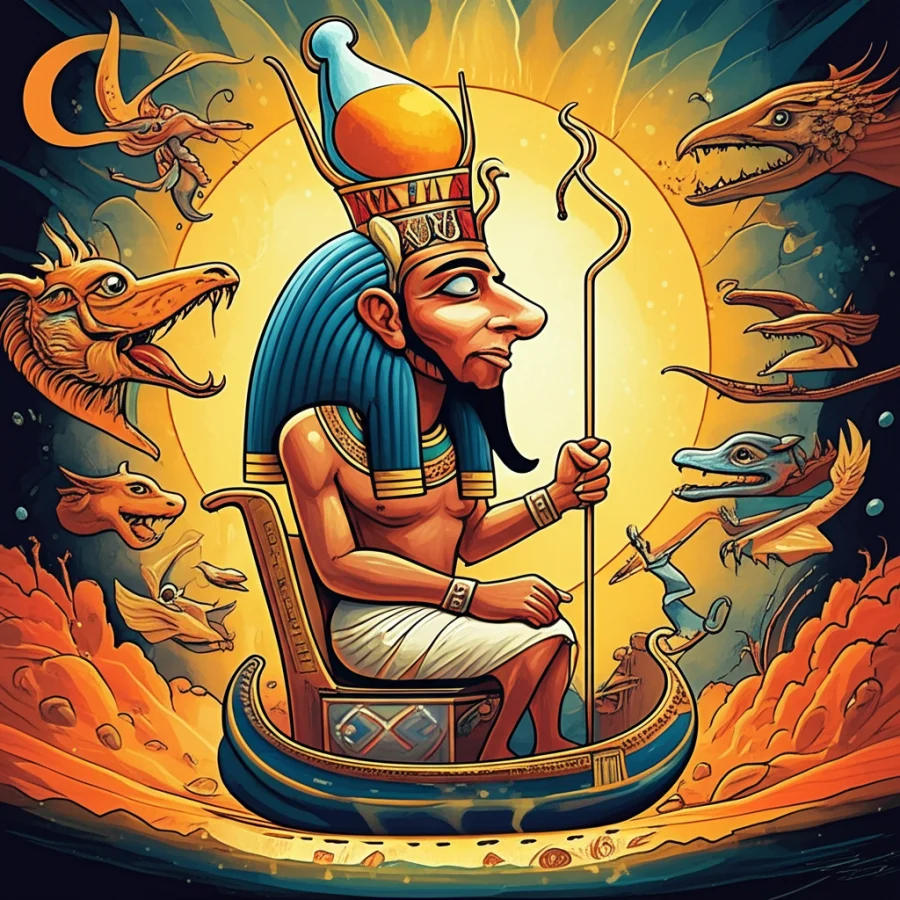
The sands of time whisper tales from ancient Egypt, a civilization that flourished along the life-giving Nile River thousands of years ago. Among the rich tapestry of their beliefs, one of the most enduring and profound narratives revolves around Ra, the sun god, and his perilous nightly voyage through the underworld. This is not a chronicle of historical events, nor a matter of current faith, but rather a traditional story passed down through generations, offering a glimpse into the worldview of a people who sought to understand the cosmos and their place within it.
The era in which these myths took root was one deeply intertwined with the natural world. The Egyptians lived in a land of stark contrasts: the fertile, verdant banks of the Nile, teeming with life, and the vast, unforgiving desert. The rhythm of their lives was dictated by the sun’s ascent and descent, the annual flooding of the Nile, and the changing seasons. They viewed the world as a place imbued with divine forces, where the celestial bodies and natural phenomena were manifestations of powerful gods. The sun, in particular, was the ultimate source of life, warmth, and order. Its daily journey across the sky was not merely a scientific observation but a sacred drama, a testament to the enduring power of creation. The night, conversely, was a time of vulnerability, of potential chaos, and the underworld was a mysterious realm where the sun, after its earthly demise, faced formidable challenges.
At the heart of this narrative stands Ra, a figure of immense power and central importance in the ancient Egyptian pantheon. He was often depicted as a man with the head of a falcon, crowned with a sun disk encircled by a cobra. This imagery was not meant to be taken literally as a deity to be worshipped, but rather as symbolic representations of his attributes. The falcon’s keen eyesight and soaring flight symbolized Ra’s omnipresence and his dominion over the heavens. The sun disk represented his life-giving energy, his warmth, and his eternal radiance. The uraeus, the protective cobra, signified his authority and his ability to ward off evil. Ra was the embodiment of creation, order, and the cosmic cycle of death and rebirth.
The myth of Ra’s night journey begins as the sun god, after his daily reign, descends into the western horizon, disappearing from the world of the living. This descent is not an end, but a transition into the Duat, the Egyptian underworld, a shadowy realm inhabited by spirits and monstrous beings. As Ra’s solar bark, the "Barque of Millions of Years," navigates the dark currents of the Duat, it embarks on a perilous journey that mirrors the human experience of facing the unknown and confronting one’s inner demons. The Duat is a landscape of trials, where the sun god must traverse through twelve distinct regions, each representing a different hour of the night.
During this nocturnal voyage, Ra faces a multitude of adversaries. The most formidable of these is Apophis (or Apep), the serpent of chaos. Apophis embodies darkness, disorder, and the forces that seek to unmake creation. He lies in wait, intending to swallow Ra’s bark whole, thus plunging the world into eternal darkness. Ra, with the help of his divine retinue, including figures like Thoth (god of wisdom) and Set (god of storms and chaos, but also a protector in this context), must battle and repel Apophis. This struggle is depicted as a fierce and arduous conflict, where the fate of the cosmos hangs in the balance. Each night, Ra is victorious, pushing back the forces of chaos and ensuring that the sun will rise again.
Beyond Apophis, Ra encounters other challenges within the Duat. He navigates through lakes of fire, crosses treacherous waterways, and encounters the souls of the deceased who are undergoing their own judgment. The journey is a metaphor for the constant struggle between order and chaos, light and darkness, life and death. Ra’s success in overcoming these obstacles each night is what guarantees the continuation of the world, the rebirth of the sun, and the renewal of life on Earth.
The symbolism embedded within the myth of Ra’s night journey is rich and multifaceted. Primarily, it represents the concept of cyclical renewal and the triumph of order over chaos. The sun’s disappearance each evening was not seen as an end, but as a necessary part of a larger, cosmic cycle of death and rebirth. This mirrored the cycles of nature that the Egyptians observed: the dying of crops in winter, followed by their resurgence in spring, the ebb and flow of the Nile, and the transition from day to night. The struggle against Apophis symbolized the constant effort required to maintain cosmic balance and to prevent the descent into primal chaos. It also offered a framework for understanding the inevitability of death, presenting it not as an absolute end, but as a transition that could lead to a renewed existence, much like Ra’s daily resurrection. Furthermore, the journey through the Duat could be interpreted as a moral allegory, suggesting that even the most powerful beings must face their trials and that the path to renewal is often fraught with difficulty.
In modern times, the myths of ancient Egypt, including the tale of Ra’s night journey, continue to captivate our imagination. They are explored in literature, from historical fiction to fantasy novels, where the imagery of ancient gods and their epic struggles is often employed. In film and television, these narratives have been adapted into epic adventures, bringing the grandeur of the Egyptian world to life. The realm of video games also frequently draws inspiration from Egyptian mythology, allowing players to interact with these ancient stories and characters. Beyond entertainment, these myths are a vital subject of study in cultural anthropology, religious studies, and Egyptology, providing invaluable insights into the beliefs, values, and societal structures of one of history’s most influential civilizations.
In conclusion, the story of Ra and the trial of the sun’s night journey is a profound example of how ancient peoples sought to make sense of the world around them through narrative. It is a testament to their ingenuity, their capacity for imagination, and their deep connection to the natural cycles that governed their lives. It is crucial to remember that this is a traditional story, a product of ancient cultural beliefs, and not a matter of current dogma or worship. As Muslims, we recognize that only Allah is the true Creator and Sustainer of all that exists. The appreciation of these ancient narratives lies in their value as cultural heritage, their exploration of universal themes of struggle and renewal, and their enduring power as a tradition of storytelling that continues to inform and inspire us today.