fufufafa
The Polynesian archipelago, a scattered necklace of emerald islands across the vast Pacific, is a realm steeped in ancient stories. Among these islands, the mythical homeland of Hawaiki, a place of origin and return, serves as a potent backdrop for tales of creation, heroism, and encounters with the supernatural. It is from this rich tapestry of oral tradition, woven by the hands of generations of islanders, that we encounter the Mo’o, formidable beings that inhabit the liminal spaces between the known world and the unseen. These are not tales to be believed as literal truth, but rather fascinating narratives passed down by ancient peoples, offering glimpses into their understanding of the world, their fears, and their reverence for the powerful forces they perceived around them.
The cultural era in which these myths took root was one deeply intertwined with the natural world. For the ancient Hawaiians, for instance, the very land, sea, and sky were alive with spirit. The immense power of the ocean, the sudden fury of volcanic eruptions, the silent growth of the jungle – these were not random occurrences but manifestations of divine or semi-divine beings. Their worldview was animistic, where everything possessed a soul or life force. Understanding these forces, and appeasing them, was crucial for survival. The world was a place of balance, and the Mo’o, in their own way, represented a part of that intricate, often unpredictable, ecological and spiritual equilibrium.
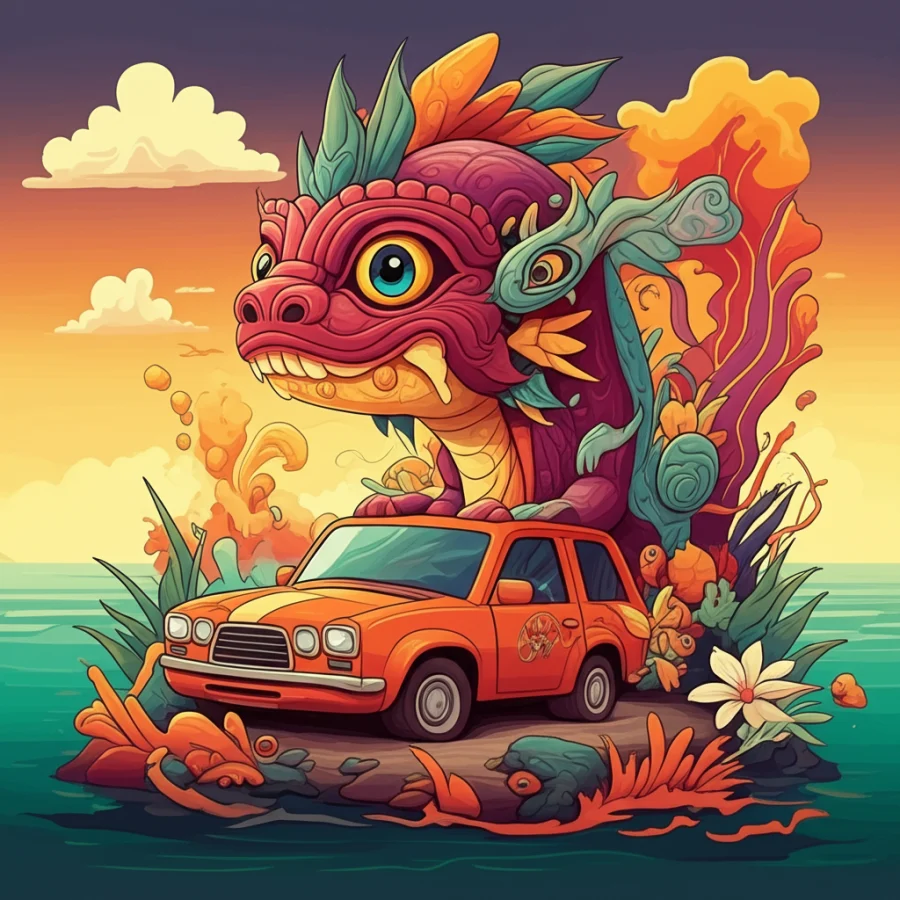
The Mo’o themselves are most commonly depicted as reptilian beings, often with serpentine or lizard-like forms. Their attributes are not those of divine worship, but rather symbolic representations of primal forces. They are associated with water – with deep pools, hidden springs, and the dark depths of rivers. Their scales are said to shimmer with an otherworldly luminescence, and their eyes are often described as burning with an ancient, knowing gaze. They embody the power and mystery of water, its ability to sustain life, but also its potential for overwhelming destruction. In some traditions, they are seen as guardians of sacred places, their presence a warning to those who would trespass or desecrate. Their strength is immense, and their connection to the earth is profound, suggesting a deep, untamed energy that predates human understanding.
Imagine a time when the world was still being shaped, when the boundaries between the physical and the spiritual were fluid. Our narrative begins on one such island, perhaps lush and vibrant, but also shadowed by ancient forests and carved by winding waterways. A young hunter, named Kai, known for his skill and his quiet respect for the natural world, ventures deeper into the interior than usual, seeking a rare medicinal herb for his ailing elder. The air grows heavy, the usual chirping of birds falls silent, and a strange stillness descends. He finds himself at the edge of a secluded, crystalline pool, its surface unnervingly still, reflecting the dense canopy above like a dark mirror.
As Kai cautiously approaches, a ripple disturbs the placid water, not from a falling leaf, but from something rising. Slowly, majestically, a colossal form emerges. It is the Mo’o, its scales like polished obsidian catching the dappled sunlight, its long, powerful body coiling from the depths. Its head, crowned with what appear to be fronds of ancient seaweed, turns towards Kai. Its eyes, large and intelligent, hold a depth that seems to encompass the history of the island itself. There is no immediate aggression, but a palpable sense of ancient power and an unspoken authority. Kai, frozen not by fear but by an overwhelming sense of awe and the recognition of something profoundly powerful, stands still. The Mo’o does not speak in words, but a low, resonant hum emanates from its being, a sound that vibrates in Kai’s bones, conveying a message of boundaries, of respect, and of the ancient pacts that govern the natural world. It seems to understand Kai’s purpose, his innocent intent, and in a slow, deliberate movement, it dips its head towards a cluster of the very herbs Kai seeks, growing on a moss-covered rock near the water’s edge. Then, with a silent grace that belies its immense size, it submerges back into the depths, leaving Kai alone with the lingering hum and a profound understanding.
The symbolism inherent in such a tale is rich and varied. The Mo’o, in its connection to water, could represent the life-giving and destructive forces of nature, the ultimate power of the environment that humans depend upon. Its guardianship of sacred places speaks to the importance of respecting the land and its spiritual significance. The encounter with Kai, devoid of violence and marked by a quiet understanding, might symbolize the wisdom that can be gained through humility and respect for the unknown, a recognition that the natural world holds powers beyond human comprehension. It could also be a narrative to instill caution about venturing into uncharted territories, a reminder of the unseen forces that govern the wild.
In contemporary times, the Mo’o, like many figures from ancient mythologies, continues to capture the imagination. They appear in modern literature as enigmatic guardians or formidable adversaries in fantasy novels set in Pacific-inspired worlds. In video games, their reptilian forms and connection to water can translate into powerful, elemental bosses. Cultural studies scholars analyze these myths to understand the worldview of ancient Polynesian societies, their relationship with their environment, and the ways they constructed meaning in their lives. The Mo’o, stripped of their literal context, become powerful archetypes of nature’s raw power and the enduring mystery of the unseen.
It is essential to reiterate that the encounter with the Mo’o of Hawaiki is a traditional story, a product of the rich cultural heritage and the imaginative spirit of ancient peoples. As Muslims, we firmly believe that only Allah (God) is the true Creator and Sustainer of all existence. These narratives, while fascinating, do not hold divine truth. However, they serve as invaluable windows into the past, allowing us to appreciate the ingenuity of human storytelling, the deep connection our ancestors felt with the world around them, and the enduring power of imagination to shape our understanding and our heritage. They remind us of the diverse ways humans have sought to explain the inexplicable, and the beauty that can be found in the enduring traditions that connect us to those who came before.