fufufafa
The vast Pacific Ocean, a canvas of sapphire and emerald, cradles a tapestry of islands, each with its own unique stories whispered on the trade winds. Among these, the Samoan archipelago, with its verdant peaks and pristine coastlines, is a land steeped in a rich oral tradition. For generations, the stories of ancient Samoans have been passed down, weaving together the natural world, the spiritual realm, and the human experience. These are not accounts of verifiable events, but rather imaginative narratives born from a deep connection to their environment and a profound sense of wonder. One such tale, echoing from the mists of time, speaks of encounters with the Mo’o, beings intricately linked to the waters and the land.
In the cultural era when these stories took root, the Samoan people lived in close harmony with the rhythms of nature. Their world was one where the ocean teemed with life, the forests held unseen presences, and the elements – sun, rain, wind – were imbued with potent energy. Life was a constant negotiation with the forces around them, and understanding these forces often took the form of personification and narrative. The world was perceived as alive, animated by spirits and forces that influenced the daily lives of the villagers. Myths and legends served as a framework for understanding the inexplicable, for explaining natural phenomena, and for imparting moral lessons and societal values. The Mo’o, in this context, were not worshipped as deities, but rather understood as powerful, often capricious, beings that inhabited specific domains.
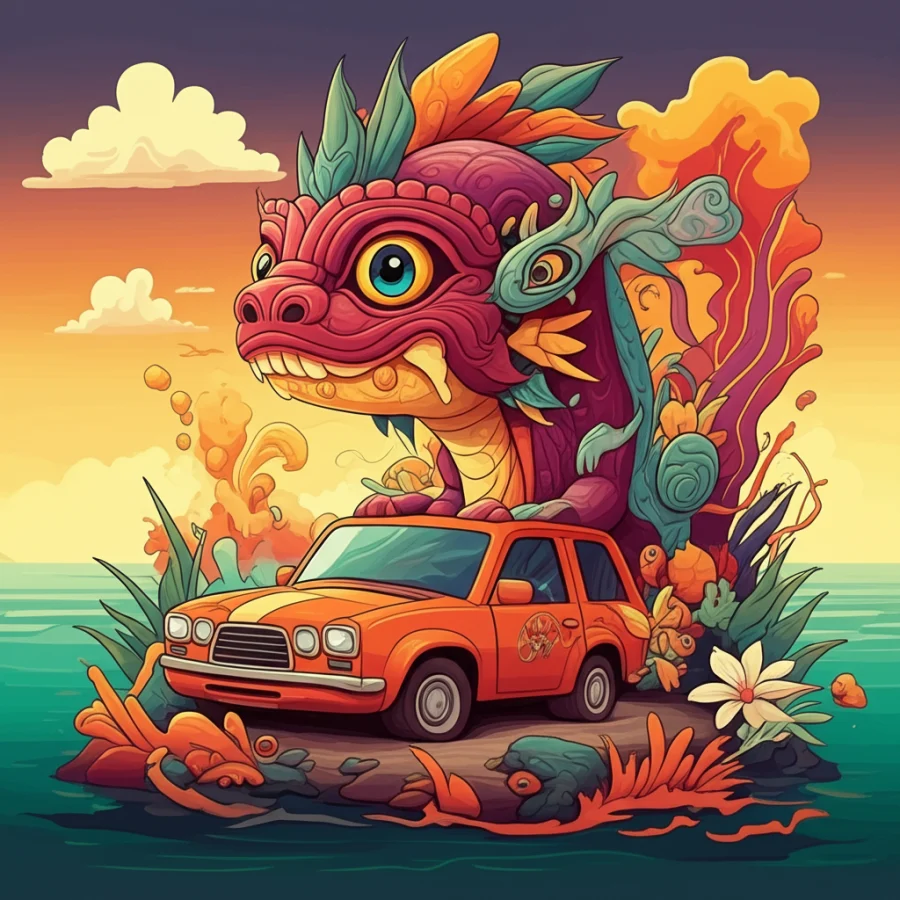
The Mo’o are depicted as serpentine creatures, often with a reptilian form, dwelling in freshwater sources like springs, rivers, and taro patches, as well as along the coastlines. Their appearance is frequently described as being large and powerful, with scales that shimmer like water under sunlight. They are often associated with the color green, reflecting the lush vegetation of their watery abodes. Symbolically, the Mo’o can be seen as representing the untamed power of water – its life-giving properties essential for agriculture and sustenance, but also its potential for destruction through floods and storms. Their presence in freshwater sources may have also symbolized the vital importance of these resources to the survival of the communities. The Mo’o are not inherently malevolent, but their actions are often driven by their own mysterious motivations, and an encounter with them could be fraught with peril for the unwary.
Imagine a young man named Pesi, his skin bronzed by the Samoan sun, his muscles taut from a day’s work in the taro fields. The air was thick with the scent of damp earth and tropical blossoms. Pesi was tasked with fetching water from a secluded spring, a place rumored to be a favored haunt of the Mo’o. He carried his coconut shell, its surface smooth from use, and his heart beat a little faster as he approached the edge of the jungle. The sun dappled through the dense canopy, casting shifting patterns on the moss-covered stones. The spring itself was a pool of crystal-clear water, fed by an unseen source, its surface undisturbed save for the occasional ripple.
As Pesi knelt to fill his shell, a low hiss, like the rustling of dry leaves, broke the silence. He froze, his eyes scanning the water’s edge. Then, he saw it. Emerging from the depths of the spring, slowly, deliberately, was a head. It was scaled, with eyes that seemed to hold an ancient, unreadable intelligence. The creature was massive, its body coiling and uncoiling beneath the surface, a ripple of emerald green in the clear water. It was the Mo’o.
Pesi’s breath hitched. He had heard the stories, tales of the Mo’o that guarded their territories fiercely, that could ensnare the careless with their liquid embrace. He remembered his elders’ advice: show respect, do not disturb, and never take more than you need. He remained still, his gaze meeting the creature’s unblinking stare. He could feel a strange energy emanating from it, a primal power that resonated with the very essence of the land. He slowly, deliberately, lowered his coconut shell into the water. The Mo’o watched, its serpentine neck extended, its tongue flicking out occasionally. Pesi filled his shell, his movements measured and calm. He then bowed his head slightly, a gesture of deference, and backed away slowly, never taking his eyes off the creature.
The Mo’o made no aggressive move. It simply watched him retreat, a silent sentinel of its watery domain. As Pesi emerged from the shadows of the jungle, the weight of the water in his shell felt heavier, not just from its liquid burden, but from the palpable sense of having brushed against a power that transcended the ordinary. He had encountered the Mo’o, not through a clash of wills, but through a quiet understanding, a recognition of its presence and a respectful acknowledgment of its territory.
To the ancient Samoans, the Mo’o likely represented various aspects of their world. Their association with water, a source of life and fertility, could symbolize the abundance and prosperity that a healthy environment provided. Conversely, their potential for aggression and their dominion over dangerous waters could represent the inherent risks and unpredictability of nature, serving as a cautionary tale against overstepping boundaries or disrespecting the natural world. The Mo’o might also have embodied the unseen forces that governed their lives, encouraging humility and a deep respect for the powers that lay beyond human control. Their solitary nature and their connection to specific places could also represent the importance of respecting territorial boundaries and the sanctity of certain natural sites.
In contemporary times, the Mo’o continues to live on, not as a creature of flesh and blood, but as a potent symbol within Samoan culture and beyond. These ancient narratives are preserved and reinterpreted in literature, academic studies of folklore, and even in modern artistic expressions. While not the focus of mainstream Hollywood blockbusters, the essence of such mythical beings often finds its way into stories exploring themes of nature’s power, the spiritual connection to land, and the enduring legacy of indigenous traditions. These retellings serve to keep the cultural heritage alive, allowing new generations to engage with the imaginative world of their ancestors.
It is important to reiterate that the Mo’o is a figure from traditional storytelling, a product of ancient Samoan imagination and cultural expression. These narratives, while rich in cultural significance and symbolic meaning, are not to be interpreted as factual accounts or as objects of belief. As Muslims, we hold the unwavering conviction that only Allah (God) is the true Creator and Sustainer of all that exists, and that all power and dominion belong to Him alone. Reflecting on these ancient myths allows us to appreciate the ingenuity of human storytelling, the diverse ways in which cultures have sought to understand their world, and the enduring power of imagination to connect us to the past and to the rich tapestry of human heritage. The whispers of the water’s edge, in the form of these ancient tales, continue to remind us of the stories that shape our understanding and the enduring allure of the narrative tradition.