fufufafa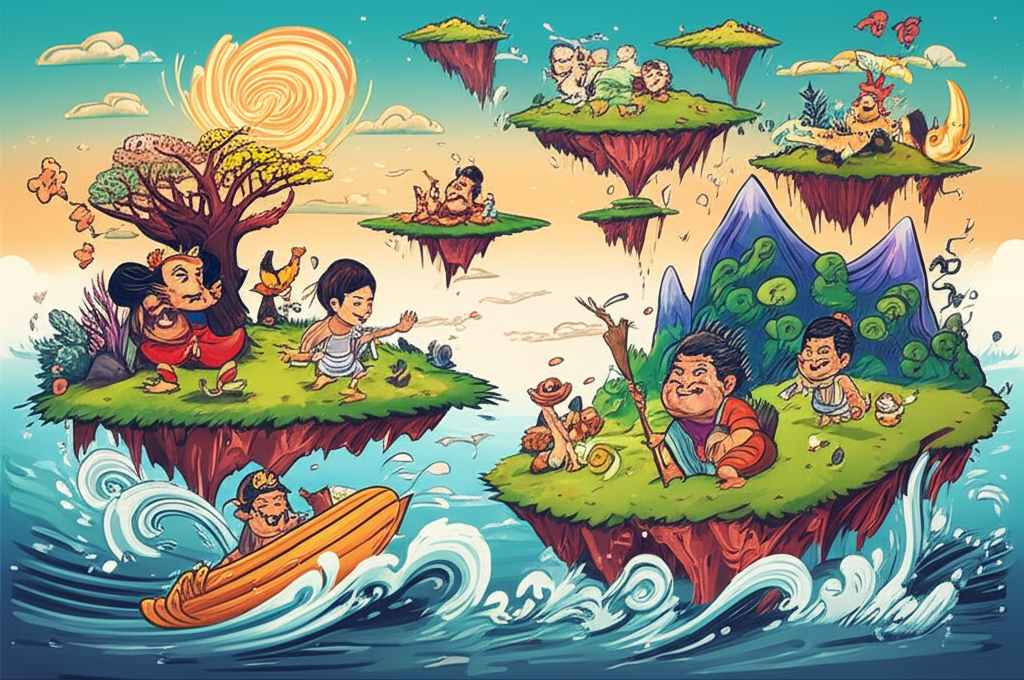
From the mist-shrouded shores of ancient Japan, where the Pacific’s restless waves have sculpted a dramatic coastline for millennia, arises a collection of profoundly influential myths and legends. Among these, the stories surrounding the creation of the islands, particularly those attributed to the land of Izumo, hold a special place in the tapestry of Japanese folklore. These are not accounts of historical fact, nor are they meant to be taken as literal divine pronouncements. Instead, they are the enduring echoes of a people grappling with the fundamental questions of existence, their understanding of the world, and their place within it.
The era in which these tales likely took root was one of deep connection to the natural world. Imagine a society where the rhythms of the seasons dictated life, where the unpredictable power of earthquakes and typhoons instilled both awe and trepidation, and where the vast, inscrutable ocean was both a source of sustenance and a formidable barrier. In such a context, the world was not simply a collection of inanimate objects; it was alive, imbued with spirit and agency. The natural phenomena that shaped their lives were understood through the lens of powerful, often anthropomorphic beings. The land itself was seen as having a consciousness, and the origins of mountains, rivers, and indeed, the very islands upon which they lived, were woven into narratives that explained their existence and offered a framework for understanding the cosmos. The Izumo region, with its ancient shrines and a rich history of Shinto practice, became a focal point for many of these foundational creation stories.
Central to these primordial songs of creation is the figure of Izanagi-no-Mikoto and his consort, Izanami-no-Mikoto. They are not presented as deities in the modern sense, but rather as primal progenitors, ancient beings who existed before the differentiation of the heavens and earth. Their symbolic attributes lie in their roles as the divine couple responsible for initiating existence. Izanagi, often depicted as a sky-father archetype, and Izanami, a mother-earth figure, represent the fundamental duality that ancient peoples often observed in the universe – the active and passive, the masculine and feminine, the celestial and terrestrial. Their actions are not necessarily driven by moral imperatives as we understand them, but by a cosmic urge to bring order and form to an unmanifested void. They embody the foundational energies of creation, the very impulse that leads to the emergence of form from formlessness.
The narrative of creation begins in a chaotic, undifferentiated state. Imagine a vast, swirling expanse, a primordial ocean that had not yet settled into distinct realms. In this boundless realm resided Izanagi and Izanami. The gods, in their nascent form, desired to bring order to this formless expanse and to create lands upon which life could flourish. They stood upon the Heavenly Floating Bridge, a celestial pathway connecting the ethereal realm to the nascent world, and Izanagi, holding a jeweled spear, stirred the brine of the ocean. As he withdrew the spear, drops of brine fell from its tip, coalescing and solidifying to form the first island, Onogoro-shima.
This first island became their dwelling place, a tangible manifestation of their cosmic endeavor. From this humble beginning, they embarked on a grand act of procreation, not just of islands, but of the very landmasses that would become Japan. They circled Onogoro-shima, each following the other, and when they met, they exchanged vows. Their union, fueled by this primal desire to create, led to the birth of the islands of Japan. Each island, from the vast Honshu to the smaller islets, was brought into being through their divine coupling, a testament to the generative power of their existence. They then proceeded to create other divine beings, personifications of natural elements like mountains, rivers, and even the winds, further populating their newly formed world. However, their journey was not without sorrow and loss. The birth of the fire god, Kagutsuchi, led to Izanami’s mortal injury and eventual demise, marking the introduction of death into their nascent creation. Izanagi, in his grief and rage, slew Kagutsuchi, and his blood, too, gave rise to further divine beings, illustrating how even destruction could be a catalyst for new beginnings in this ancient cosmology.
To the ancient people who shared these stories, the creation of the islands by Izanagi and Izanami likely represented several profound concepts. Firstly, it offered an explanation for the very existence of their homeland, a tangible connection to the primordial forces that shaped their world. The islands were not simply geological formations; they were the children of divine beings, imbued with a sacred lineage. Secondly, the myth served as a powerful metaphor for fertility and procreation. The union of Izanagi and Izanami, and their subsequent creation of land and gods, mirrored the natural cycles of birth and growth that were essential for survival. It provided a narrative framework for understanding the generative power of nature. Furthermore, the story likely touched upon themes of order emerging from chaos. The initial formless void giving way to distinct islands and divine beings represented the human desire to find structure and meaning in a world that could often feel unpredictable and overwhelming. The journey of the divine couple, their triumphs and their sorrows, could also have served as a way to understand the complexities of life, including the inevitable presence of death and the subsequent cycles of renewal.
In the modern world, the creation myths of Izumo and the birth of Japan continue to resonate, albeit through different lenses. They are not worshipped as divine truths, but are studied and celebrated as vital components of Japanese cultural heritage. In literature, these stories form the bedrock of countless novels and epic poems, reinterpreting the actions of the kami (gods or spirits) for contemporary audiences. In the realm of popular culture, they are a rich source of inspiration for anime, manga, and video games, where the figures of Izanagi, Izanami, and other mythological beings are often reimagined with vibrant artistic flair. Academically, these myths are subjects of intense study in cultural studies, religious studies, and folklore, offering insights into the worldview, values, and societal structures of ancient Japan. They are seen as invaluable windows into the human imagination and the enduring quest to understand our origins.
In conclusion, the creation of the islands as sung in the tales of Izumo is a profound example of ancient storytelling, a testament to the human capacity for imagination and the desire to make sense of the world. It is a cultural narrative, a legacy passed down through generations, offering a glimpse into the spiritual and intellectual landscape of our ancestors. As Muslims, we understand that the true and only Creator and Sustainer of all existence is Allah (SWT). These stories, therefore, are appreciated for their historical and cultural significance, for the artistry of their narrative, and for the enduring power of human storytelling to explore the mysteries of life and the universe. They remind us of the rich tapestry of human cultural heritage and the diverse ways in which different societies have sought to understand their place in the grand narrative of existence.