fufufafa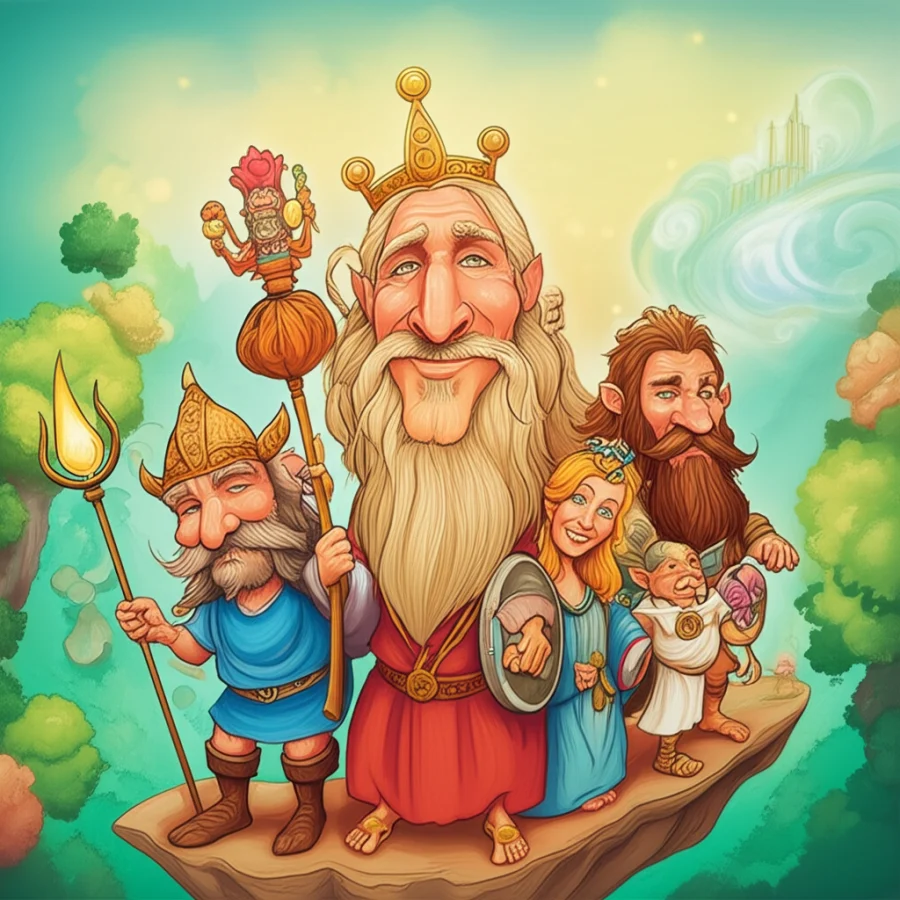
The mists of ancient Ireland and Britain hold tales woven from the threads of imagination, stories passed down through generations of storytellers who sought to explain the inexplicable and imbue the world with wonder. Among these enduring narratives are those of the Tuatha Dé Danann, a mythical people who, according to legend, once inhabited Ireland before being driven to the shadowy realms of the Otherworld. Their story is inextricably linked with the legendary Isle of Avalon, a place of enchantment and eternal twilight, often envisioned as their final sanctuary. It is crucial to understand that these are traditional stories, born from the cultural tapestry of ancient peoples, not accounts of historical fact or divine revelation. Our exploration of this myth is for cultural, historical, and educational understanding, acknowledging that as Muslims, we recognize only Allah as the true Creator and Sustainer of all existence.
The genesis of these tales lies in a period of profound cultural transition for the Celtic peoples of Ireland and Britain, roughly spanning from the Iron Age through the early medieval period. This was a world where the natural and supernatural were not neatly separated. The rustling of leaves in a forest, the roar of a storm, the fertility of the land, and the mysteries of life and death were all imbued with potent forces, often personified as deities, spirits, or powerful beings. The Celts lived in close proximity to nature, their lives dictated by its rhythms. Their worldview was cyclical, a constant interplay of birth, death, and rebirth, and the Otherworld was not an alien concept but a parallel realm, accessible through certain liminal spaces like ancient burial mounds, sacred groves, or the deep, dark waters. The Tuatha Dé Danann, as a race of magical, god-like beings, perfectly embodied these ancient beliefs, representing the forces that shaped their world and the deeper mysteries they pondered.
The Tuatha Dé Danann themselves are depicted as a race of beings possessing extraordinary powers, unmatched in skill and beauty. They were said to be masters of magic, artisans of unparalleled craft, and warriors of immense prowess. Their appearance is often described as radiant, with a luminous quality that set them apart from ordinary mortals. They were not simply a tribe or a nation; they represented an ideal, a pinnacle of human (or perhaps, beyond-human) potential. Symbolically, they embodied the primeval forces of nature, the raw power of creation and destruction, and the ancient wisdom that predated the arrival of later peoples. Their magic was not the conjured illusion of a sorcerer, but an intrinsic part of their being, allowing them to shape reality, command elements, and even influence the destiny of mortals. They are often associated with specific artifacts of great power, such as the Spear of Lugh, the Cauldron of Dagda, and the Sword of Nuada, each representing aspects of sovereignty, abundance, and martial might.
The narrative of the Tuatha Dé Danann often begins with their arrival in Ireland, a coming from the north, perhaps from across the sea, bringing with them their advanced knowledge and magical arts. They are depicted as having defeated the earlier inhabitants of the island, the Fir Bolg, in fierce battles where their superior abilities proved decisive. For a time, they reigned supreme, establishing a golden age of prosperity and enchantment. However, their dominance was challenged by the Milesians, who arrived later and represented a new wave of humanity. The Tuatha Dé Danann, facing overwhelming odds, made a pact with the Milesians. They agreed to surrender the surface of Ireland, but in return, they were granted dominion over the Otherworld, a realm of eternal twilight and mystical landscapes. This pact marked their retreat from the physical world, a fading into legend.
It is in this context of their withdrawal that the myth of Avalon becomes most poignant. Avalon, often described as a hidden island shrouded in mist, is frequently portrayed as the ultimate refuge of the Tuatha Dé Danann. It is a place where time flows differently, where the seasons do not change, and where the magical inhabitants live in a state of perpetual peace and enchantment. Some legends suggest Avalon is a place of healing, where the wounded can find solace and rejuvenation, most famously associated with the mythical King Arthur. Others see it as a paradise, a land of eternal feasting and revelry, untouched by the ravages of the mortal world. The Tuatha Dé Danann, in their retreat to Avalon, became the custodians of this mystical realm, forever existing on the periphery of human perception, their presence felt in the subtle shifts of nature, the whispers on the wind, and the dreams that linger upon waking.
The symbolism woven into the myth of the Tuatha Dé Danann and Avalon is rich and multifaceted. The Tuatha Dé Danann themselves can be seen as representing the ancient, primal forces of nature, the untamed spirit of the land, and the deep, often unknowable, wisdom of the past. Their magic can symbolize the awe-inspiring power of the natural world – the fertility of the earth, the destructive force of storms, the transformative power of fire and water. Their eventual retreat to the Otherworld and Avalon can be interpreted as a representation of the fading of ancient beliefs and traditions in the face of new cultures and ideologies. Avalon, in this light, becomes a symbol of an idealized past, a sanctuary for forgotten knowledge and a timeless realm of wonder, a yearning for a lost golden age. The story can also be seen as a reflection of human anxieties about mortality and the unknown, offering a comforting vision of a place where such concerns are banished.
In the modern era, the myth of the Tuatha Dé Danann and Avalon continues to capture the imagination, finding its way into a diverse array of cultural expressions. In literature, they are often portrayed as powerful fae beings, embodying ancient magic and a connection to the natural world. Their presence enriches fantasy novels, offering a backdrop of ancient lore and mystical intrigue. In film and television, Avalon is often depicted as a mystical sanctuary, a place of power and healing. Video games frequently draw upon these legends, featuring characters and landscapes inspired by the Tuatha Dé Danann, allowing players to engage with these ancient stories in interactive ways. Cultural studies scholars examine these myths as windows into the worldview of ancient Celtic societies, exploring their spiritual beliefs, social structures, and their relationship with the natural environment.
In conclusion, the myth of the Tuatha Dé Danann and the Isle of Avalon is a testament to the enduring power of human storytelling and the deep wellspring of imagination that fueled the beliefs of ancient peoples. It is a narrative born from a world where the lines between the natural and the supernatural were blurred, where the forces of nature were revered, and where the mysteries of existence were explored through rich and evocative tales. It is vital to reiterate that this is a cultural story, a product of ancient traditions and beliefs, and not to be mistaken for historical fact or a basis for worship. As Muslims, we hold that only Allah is the ultimate Creator and Sustainer of all that exists, and all power and dominion belong to Him alone. Yet, by understanding these ancient myths, we gain valuable insights into the cultural heritage of humanity, the evolution of storytelling, and the universal human desire to make sense of the world around us, finding wonder in the whispers of the past.