
 fufufafa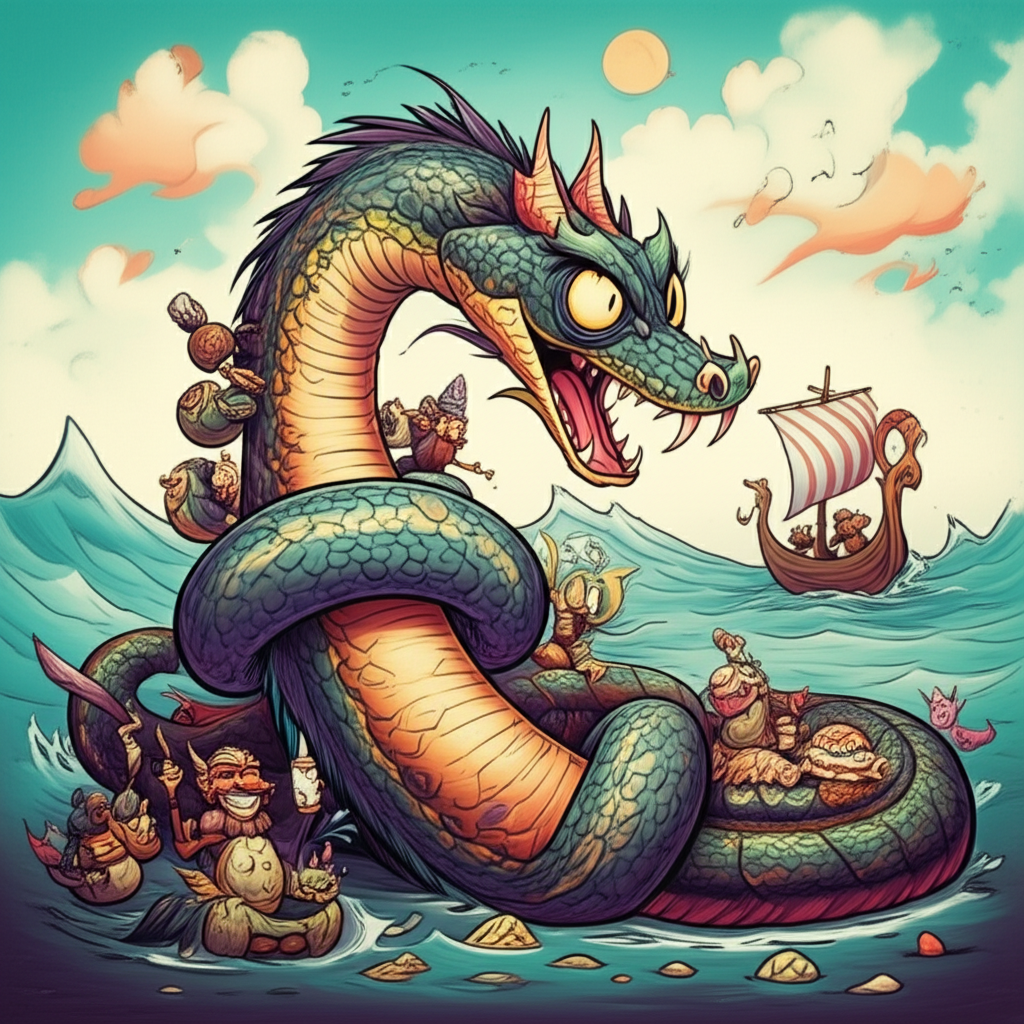
The frigid winds, biting and relentless, are often the first harbingers of tales from the lands of the ancient Norse. From the icy fjords of Scandinavia, a rich tapestry of myths and legends was woven, stories passed down through generations around crackling fires, tales of gods, giants, and the awe-inspiring forces of nature. Among these ancient narratives, one of the most potent and unsettling concerns the Jörmungandr, the Midgard Serpent, a creature whose immensity and primal power have long captured the human imagination. This is not a chronicle of a true event, nor an endorsement of any belief system, but rather a journey into the heart of a traditional story, an exploration of how our ancestors sought to understand the world around them through the power of narrative.
The cultural bedrock upon which these Norse myths were built was one of stark contrasts and profound respect for the elements. Imagine a society living in a land where the seasons dictated life and death, where the long, dark winters demanded resilience and the brief, vibrant summers were a gift. This was an era where the natural world was not just a backdrop, but a living, breathing entity, imbued with spirits and forces that could be both benevolent and terrifying. The Norse viewed the world as a cosmic tree, Yggdrasil, connecting nine realms, a delicate balance maintained by powerful beings. They understood the raw power of the sea, the earth, and the sky, and their mythology often served as a framework for comprehending these immense, often unpredictable, forces. Their worldview was one of constant struggle, of fate, and of the ever-present potential for chaos.
Central to the narrative we explore is the Jörmungandr, often translated as the "Great Serpent" or the "World Serpent." This colossal being is not depicted as a creature of flesh and blood in the way we understand it today, but rather as a primordial force, a manifestation of the boundless ocean that encircles the known world. Its most striking attribute is its sheer, unimaginable size. It is said to be so vast that it can coil around the entirety of Midgard, the realm of humans, its own tail held firmly within its jaws. This act of self-containment is symbolic of the eternal cycle of existence, of beginnings and endings, and of the inherent interconnectedness of all things. Its scales are described as being like the churning waves of the sea, its eyes like the fathomless depths, and its roar like the tempest’s fury. It represents the untamed, primal energy of the ocean, a force that can both sustain life and bring utter destruction. It is a symbol of the infinite, the unknowable, and the potential for cosmic upheaval.
Let us then, step into the realm of imagination and recount a hypothetical encounter, not as a historical event, but as a story that might have been whispered in the longhouse. Imagine a lone fisherman, a man named Bjorn, his face weathered by salt spray and his hands calloused from years of wrestling with the sea. He ventured further than usual, drawn by rumors of an abundant catch in a distant, uncharted bay. The sea that day was unusually calm, almost unnervingly so, the water a glassy, unbroken surface reflecting the pale northern sky. As Bjorn rowed his sturdy vessel towards the horizon, a strange stillness descended. The birds fell silent, and the usual chatter of the waves against the hull ceased.
Then, a ripple disturbed the placid water, a disturbance that grew with alarming speed. It was not the gentle swell of a passing ship, but something far grander, far more profound. The water began to heave, to churn, and to rise. Bjorn, his heart pounding in his chest, could only stare in stunned disbelief as a colossal, scaled head broke the surface. It was immense, larger than his entire boat, its eyes like twin emeralds, ancient and indifferent. This was no ordinary sea creature; this was the Jörmungandr, a being of myth made manifest before him.
The serpent’s form continued to unfurl, a colossal arc of serpentine might. Its body, a tapestry of dark, iridescent scales, stretched as far as Bjorn’s eyes could see, disappearing into the mist that now shrouded the sea. He could feel the vibrations of its movement through the very planks of his boat, a low, resonant hum that seemed to emanate from the depths of the world. The air grew heavy, thick with the scent of brine and something ancient, something primal. Bjorn, a man who had faced many a storm, felt a fear unlike any he had known. It was not the fear of drowning, but the fear of insignificance, of being a mere speck in the face of such overwhelming, primordial power. The Jörmungandr, in its majestic indifference, simply continued its endless circuit, its gaze seemingly passing through Bjorn, as if he were no more than a fleeting thought. The encounter was not one of battle or communication, but of pure, awe-inspiring observation, a fleeting glimpse into the immense, cyclical nature of existence as conceived by the ancient storytellers.
To the people of that era, the Jörmungandr was a potent symbol. It represented the vastness and mystery of the ocean, a realm that provided sustenance but also held the potential for unimaginable destruction. Its self-encompassing nature spoke to the cyclical understanding of time, of creation and destruction, of life and death. It was a reminder of the limits of human control and the power of forces beyond mortal comprehension. The serpent’s role in Ragnarök, the twilight of the gods, where it would rise from the sea to battle Thor, further cemented its status as a harbinger of cosmic change and ultimate, albeit cyclical, destruction. It embodied the untamed forces of nature, the primordial chaos that lay at the edges of their ordered world.
In modern times, the Jörmungandr, like many figures from Norse mythology, has found new life in the realms of literature, film, and gaming. Its image is often invoked to represent colossal, ancient threats, powerful forces of nature, or the embodiment of overwhelming odds. From epic fantasy novels to action-packed video games, the concept of a world-encircling serpent continues to captivate audiences, serving as a potent visual metaphor for the immense challenges and epic struggles that resonate with the human spirit. Cultural studies scholars also delve into these myths, seeking to understand the worldview, fears, and aspirations of the people who first told these stories, recognizing their value as windows into the past.
It is crucial to reiterate that these narratives are products of human imagination, born from a desire to explain the world and our place within it. As Muslims, we recognize that only Allah, the Almighty, is the true Creator and Sustainer of all existence. He is the ultimate power, the source of all life, and the only being worthy of worship. Our understanding of these ancient stories is rooted in a respect for cultural heritage, for the enduring power of storytelling, and for the rich tapestry of human imagination that has shaped our understanding of the world across millennia. The Jörmungandr, though a creature of myth, serves as a fascinating testament to the enduring human need to grapple with the vast, the unknown, and the profound mysteries of the universe.


