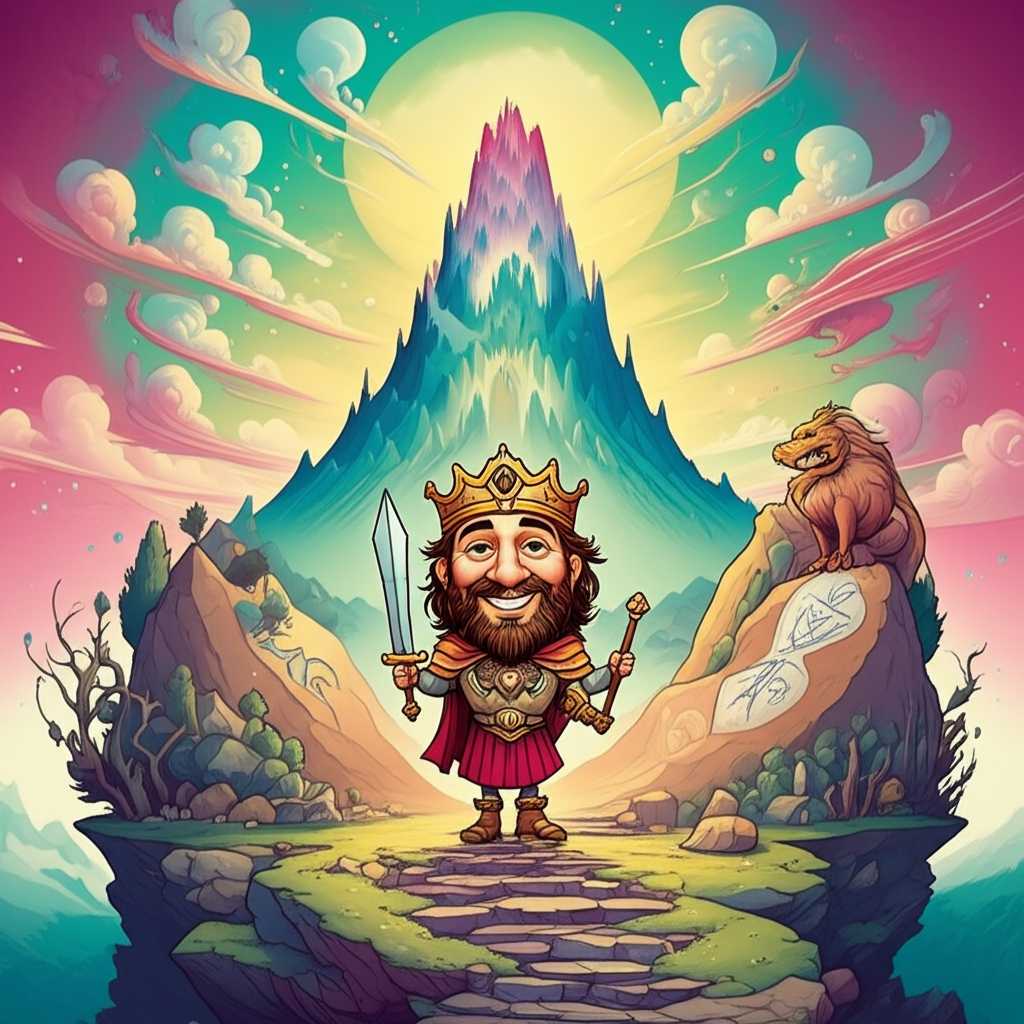
fufufafa
In the mists of antiquity, long before the modern world took shape, the ancient Celtic peoples of Iron Age Europe wove intricate tapestries of tales, legends, and myths to explain the world around them. Among these stories, passed down through generations around crackling hearth fires, is the evocative legend of Cernunnos, the Horned God, and a mysterious sanctuary known only as the Hidden Mountain. It is crucial to understand from the outset that this is a traditional story, a product of the rich oral tradition of ancient peoples, crafted not as historical fact or religious doctrine for today, but as a lens through which they understood their existence.
Origins and Cultural Background
To truly appreciate the tale of Cernunnos, one must journey back to the pre-Roman Iron Age, a time when life in regions spanning from modern-day Britain and Ireland to France, Germany, and beyond, was intrinsically linked to the rhythms of the natural world. These were communities deeply rooted in the land, relying on forests for timber and game, rivers for sustenance and travel, and fertile soils for their crops. Their worldview was animistic, imbued with the belief that spirits resided in every grove, stream, and stone. The boundary between the mundane and the sacred was porous, and the unseen forces of nature were constantly at play, influencing harvests, hunts, and the very health of their communities. For these ancient Celts, the world was a living entity, a vast, interconnected web where deities and spirits were not distant but immanent, shaping their daily lives and requiring respect and understanding.
Character Description: Cernunnos, the Horned Guardian
At the heart of many Celtic narratives stands Cernunnos, often depicted as a powerful, antlered figure. While his name, meaning "The Horned One," speaks directly to his most striking feature, his representation is far richer than a mere animalistic form. He is frequently portrayed in a cross-legged, meditative posture, often flanked by wild animals, particularly stags and serpents. He might hold a torc – a distinctive neck ring worn by ancient Celts – in one hand, and a ram-headed serpent in the other, or a purse overflowing with coins.
It is vital to interpret these attributes symbolically rather than literally. To the ancient Celts, Cernunnos embodied the untamed wildness of nature, its immense fertility and life-giving abundance, as well as its mysterious, even chthonic, aspects. His antlers, shed and regrown annually, symbolized the cyclical nature of life, death, and rebirth, mirroring the seasons and the eternal renewal of the natural world. He was seen as a guardian of animals, a lord of the forest, and a harbinger of prosperity derived from the land. He represented the balance between the human and animal realms, the domesticated and the wild, the visible and the unseen. He was not a figure to be worshipped in the modern sense, but a symbolic representation of profound natural forces and mysteries that commanded respect and contemplation.
The Tale of Cernunnos and the Hidden Mountain
In the heart of the great, ancient forest, where the canopy was so thick that the sun struggled to kiss the mossy earth, lay the village of Eldoria. For generations, the people of Eldoria had lived in harmony with the woods, their lives a delicate dance between the bounty of nature and the harshness of its trials. But a blight had fallen upon the land. The game had grown scarce, the rivers ran thin, and a strange, creeping sickness withered the crops. Despair began to take root in the hearts of the villagers, and their elders spoke of a profound imbalance, a disturbance in the sacred weave of life.
Young Bran, a hunter known for his quiet wisdom and deep respect for the forest, felt the plight of his people most keenly. He had spent countless hours among the ancient trees, learning their whispers and secrets. One frigid morning, after days of fruitless hunting, Bran recalled an old tale, a legend whispered only in the deepest winter nights, of a Hidden Mountain. It was said to be a place untouched by time, shrouded in eternal mist, a sanctuary where the spirit of the wild resided, a place of ultimate balance and profound power. It was a perilous journey, fraught with unseen dangers, but Bran knew he had no other choice.
With a simple staff and a heart full of resolve, Bran ventured deeper than any had dared. The forest grew silent around him, its usual symphony of rustling leaves and birdsong replaced by an eerie stillness. Ancient trees, gnarled and vast, formed tunnels of shadow. Days blurred into nights as Bran followed faint animal trails, guided by the instinct that had always served him well. He passed through groves where the trees seemed to hum with unseen energy and crossed rivers that flowed with an almost unnatural clarity.
Finally, after what felt like an eternity, he saw it. Through a swirling veil of mist, a colossal peak rose, its summit piercing the clouds. It was not a mountain of jagged rock but one covered in primeval forest, its slopes a riot of ancient, untouched flora. A deep, resonant hum vibrated through the air, a sound that seemed to come from the very heart of the earth. This was the Hidden Mountain.
As Bran approached, the mist parted, revealing a narrow, winding path that seemed to invite him inward. He followed it, his senses heightened, until he reached a clearing bathed in an otherworldly light, though no sun was visible. In the center of this clearing, seated upon a throne of living moss and roots, was Cernunnos.
The Horned One was immense, his antlers branching like ancient oaks, crowned with wreaths of ivy. His eyes, deep pools of emerald, held the wisdom of countless seasons. Stags lay peacefully at his feet, and a coiled serpent, ancient and wise, rested upon his arm. He wore torcs of gold around his neck and arms, and from his hands, a gentle energy seemed to emanate. He did not speak with words, but with a presence that resonated deep within Bran’s soul.
Cernunnos gestured towards the withered plants Bran carried, then towards the vibrant life teeming around them. Bran understood. The imbalance in Eldoria was not merely a scarcity of game or a blighted crop; it was a consequence of forgetting the sacred pact with nature, of taking without giving, of losing reverence for the cycle of life and death. The Horned One’s gaze conveyed the simple truth: prosperity was not a gift to be granted, but a harmony to be maintained.
A single, golden acorn dropped from Cernunnos’s hand, landing softly at Bran’s feet. It glowed with a faint, warm light. Bran understood this too. It was not a magical solution, but a seed of understanding, a symbol of renewal, and a reminder that true abundance came from nurturing the earth and respecting its cycles. The Hidden Mountain was not a place of endless miracles, but a sanctuary of profound truth, where the balance of existence was eternally preserved.
With a bow of deep reverence, Bran took the acorn. As he turned to leave, the mist swirled once more, and when he looked back, the clearing, Cernunnos, and the throne of moss were gone, replaced by the silent, ancient trees.
Bran returned to Eldoria, not with a bounty of game, but with a renewed spirit and a profound message. He shared his encounter, not as a miracle, but as a lesson. He taught his people to observe the forest, to listen to its whispers, to offer thanks for what was taken, and to nurture what remained. They planted the golden acorn, not expecting magic, but understanding its symbolism: the promise of renewal through respect and hard work. Slowly, patiently, the balance began to return to Eldoria, the forest healed, and the people thrived once more, remembering the wisdom shared by the Horned Guardian of the Hidden Mountain.
Symbolism and Meaning
The Tale of Cernunnos and the Hidden Mountain, while a work of imaginative storytelling, would have held deep symbolic resonance for ancient Celtic communities. Cernunnos himself symbolized the raw, untamed force of nature – its fertility, its abundance, and its mysterious power. He represented the necessary equilibrium between humanity and the wilderness, a reminder that human prosperity was contingent upon respecting the natural world’s cycles of growth and decay. The Hidden Mountain, in this narrative, stands as a sacred space, an inaccessible realm of ultimate truth and balance, a place where the veil between the mundane and the profound was thinnest. It represented the quest for knowledge, the journey into the unknown to gain wisdom, and the inherent sacredness of certain geographical features. The blight and its resolution highlighted the ancient understanding of cause and effect – that imbalance in human actions would lead to discord in nature, and that restoration required a return to respectful, harmonious living.
Modern Perspective
Today, the figure of Cernunnos and tales like that of the Hidden Mountain are interpreted through a multifaceted lens. In literature and fantasy, Cernunnos appears as a powerful archetype of the wild, often a protector of nature or a mysterious, ancient deity, influencing works ranging from epic fantasy novels to popular role-playing games. In cultural studies and archaeology, these myths offer invaluable insights into the spiritual and ecological concerns of ancient societies. They are studied for their linguistic patterns, their narrative structures, and their reflection of prehistoric worldviews, providing a window into the minds of our ancestors. While some modern neo-pagan traditions may draw inspiration from such figures, the broader academic and cultural appreciation focuses on their significance as cultural heritage and artistic expressions.
Conclusion
The Tale of Cernunnos and the Hidden Mountain remains a compelling narrative, a testament to the vivid imagination and deep connection to nature characteristic of the ancient Celtic peoples. It is a story from a time long past, offered purely for cultural, historical, and educational understanding, reminding us of the rich tapestry of human storytelling. As Muslims, we firmly recognize that only Allah is the true Creator and Sustainer, the One without peer or partner, and that all power and dominion belong solely to Him. We acknowledge that the narratives of Cernunnos and other mythological figures are products of human creativity, reflecting the diverse ways ancient cultures sought to understand their world. These stories, while not to be believed as truth, nonetheless serve as powerful examples of our shared human heritage, showcasing the enduring power of imagination and the timeless tradition of storytelling that binds generations across the vast expanse of history.