fufufafa
Across the mist-shrouded hills and ancient forests of what is now Europe, particularly in the lands inhabited by the Celtic peoples, stories were woven like intricate tapestries, passed down through generations. These were not merely tales but the very fabric of understanding, attempts to explain the mysteries of existence, the rhythm of the seasons, and humanity’s place within the vast, untamed world. Among these timeless narratives, the legend of Cernunnos, the Horned God, and his mythical Eternal Temple, offers a glimpse into the worldview of those who lived in closer communion with the natural realm. It is important to remember that this is a traditional story, a product of ancient imagination and cultural interpretation, not a matter of verifiable fact.
The cultural era in which such myths flourished was one where the forces of nature held immense power and often dictated the course of human lives. For the Iron Age Celts, society was deeply intertwined with the land. Their lives revolved around agriculture, hunting, and the cyclical turning of the year. They saw the world as alive, imbued with spirits and powers that resided in trees, rivers, mountains, and the very air they breathed. The divine was not distant and abstract but immanent, present in the rustling leaves, the flowing water, and the untamed beasts of the wilderness. This worldview fostered a profound respect, and at times, a fearful awe, for the natural world and the potent forces it represented. It was within this context that figures like Cernunnos emerged, personifications of the wild, the cycle of life and death, and the generative power of the earth.
Cernunnos himself is a figure depicted with striking and evocative imagery. Most famously, he is shown with the antlers of a stag, often depicted as magnificent and branching, symbolizing his connection to the forest and the wild. He is frequently portrayed as a powerful, seated figure, sometimes with a torque (a neck-ring) around his neck, a symbol of status and divinity. Often, he is accompanied by animals, particularly stags, wolves, and snakes, underscoring his mastery over the wild kingdom. These symbolic attributes – the antlers representing virility and the renewal of nature, the animals signifying his dominion over the untamed, and his seated posture suggesting wisdom and authority – paint a picture of a god deeply rooted in the cycles of the natural world, a force of creation and sustenance, and a guardian of the wild. He is not a deity of human dominion, but of the untamed essence of life itself.
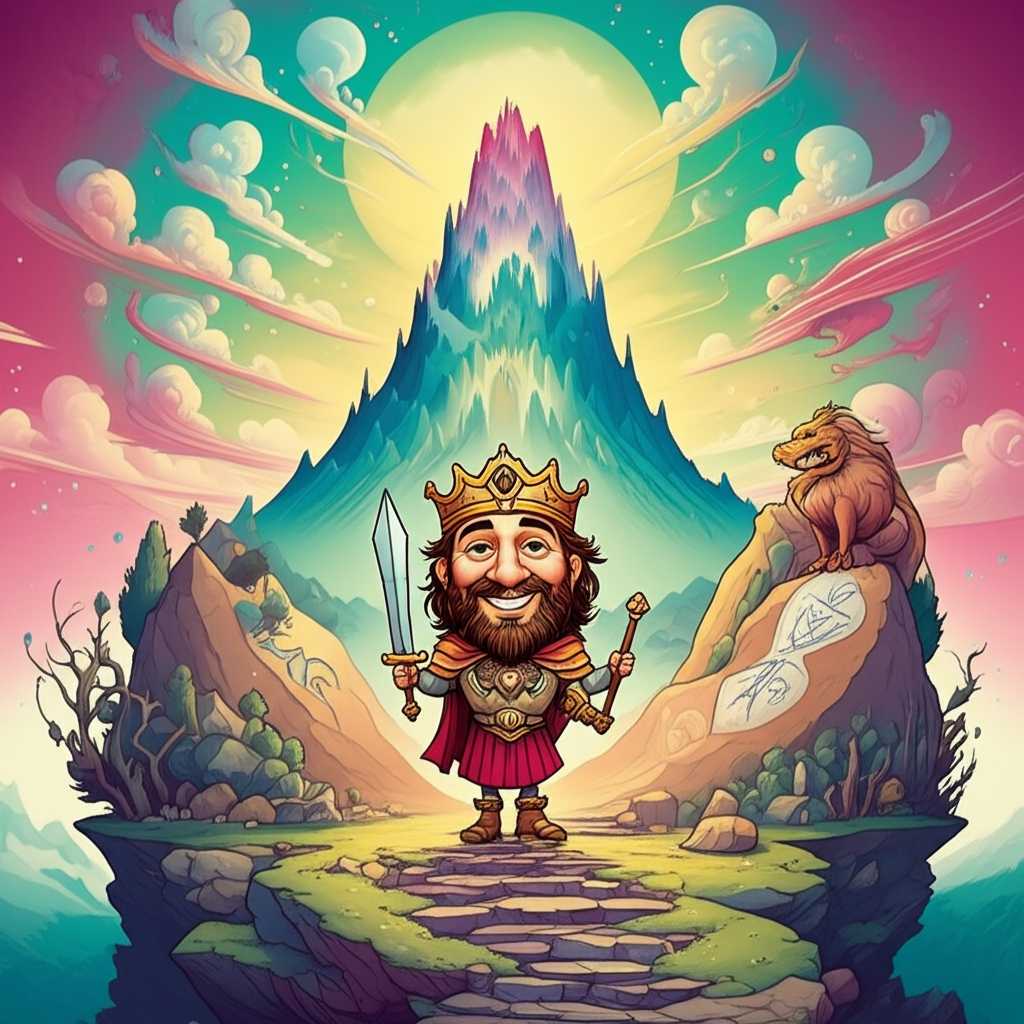
The legend of Cernunnos and his Eternal Temple, though not always a single, codified narrative, often speaks of a sacred, hidden sanctuary, a place where the veil between the mortal and the divine thins. Imagine, then, a time when the Celts, in their reverence for the wild and its powerful spirit, spoke of Cernunnos’s dwelling. It was not a temple built of stone and mortar, but a place woven from the very essence of the forest. Ancient groves, where sunlight dappled through an impossibly thick canopy, or hidden clearings where the moss grew impossibly deep, were whispered to be gateways to his realm. Within this mythical Temple, it was said, time itself flowed differently. The cycles of birth and death, the waxing and waning of the moon, the turning of the seasons, all converged and were understood. Cernunnos, seated at the heart of this eternal sanctuary, would preside over the abundance of the land, the fertility of the herds, and the continuity of life. Hunters might seek his favor for a successful chase, farmers for a bountiful harvest, and those seeking wisdom might meditate on the rustling leaves, hoping for a whisper of his ancient knowledge. The Temple was not a destination to be physically reached, but a spiritual space, a profound connection to the primal forces of existence. It was a place where the wild heart of the world beat, and where Cernunnos, its embodiment, held sway.
The symbolism embedded within this legend is rich and multifaceted. Cernunnos, with his antlered head, was a potent representation of the regenerative power of nature. The shedding and regrowth of antlers mirrored the cycles of life, death, and rebirth that are fundamental to the natural world. His association with animals spoke to the interconnectedness of all living things and the deep respect the Celts held for the creatures with whom they shared their environment. The idea of an "Eternal Temple" further suggests a belief in a fundamental, enduring order to the universe, a sacred space that existed beyond the ephemeral nature of mortal life. It may have represented a longing for harmony with nature, a recognition of its immense power, and a desire to live in balance with its rhythms. For a people so dependent on the land, these were not abstract concepts but vital understandings that shaped their lives and their sense of place in the cosmos.
In the modern world, the legend of Cernunnos continues to resonate, albeit in different forms. He has become a figure of interest in neo-paganism, where he is often seen as a representation of the divine masculine and the wild spirit. In literature, fantasy novels and historical fiction often draw upon Celtic mythology, and Cernunnos might appear as a mysterious woodland deity or a powerful nature spirit. He has also found his way into popular culture, appearing in video games and films, where his evocative imagery is used to represent ancient powers or primal forces. Cultural studies scholars examine these myths for insights into the beliefs, values, and social structures of ancient societies.
It is crucial to reiterate that the legend of Cernunnos and the Eternal Temple is a testament to the rich tapestry of human imagination and the enduring power of storytelling. These are traditional narratives, born from the desire of ancient peoples to understand their world and their place within it. As Muslims, we recognize that only Allah (God) is the true Creator and Sustainer of all existence, the ultimate power and source of all life. The stories of figures like Cernunnos, while fascinating from a cultural and historical perspective, do not represent divine truth. They serve, however, as invaluable windows into the diverse ways humanity has sought meaning and connection throughout history, reminding us of the enduring human impulse to create narratives that explain the inexplicable and to find wonder in the world around us. The whispers of the wild, carried through these ancient legends, continue to echo, not as dogma, but as a celebration of our shared cultural heritage and the boundless capacity of the human spirit for storytelling and imagination.