
 fufufafa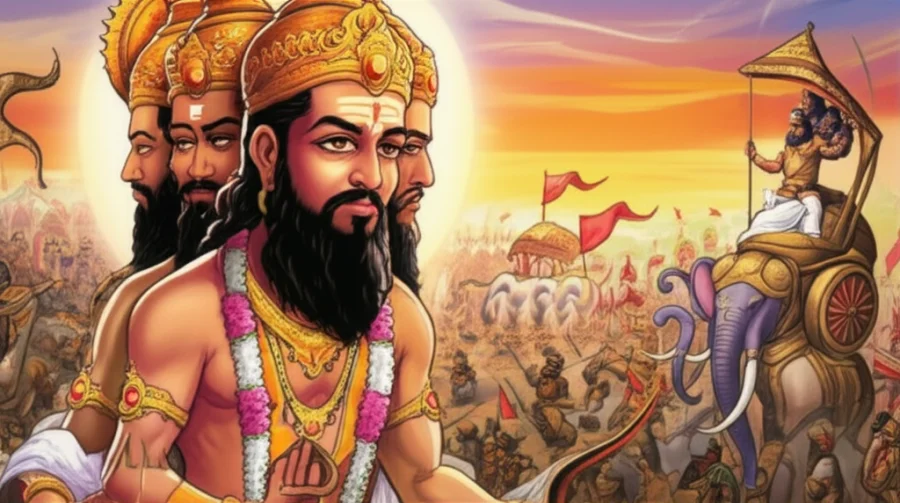
The vast tapestry of human stories is woven with threads of myth and legend, tales that have echoed through generations, offering glimpses into the minds and hearts of ancient peoples. Among these, the narratives emanating from the Indian subcontinent, particularly those found within the epic Mahabharata, hold a unique place. These are not accounts of historical fact, but rather profound allegories, crafted by ancient storytellers to explore the complexities of existence, the nature of duty, and the intricate dance between divine will and human action. One such narrative thread concerns the figure of Brahma, the supposed progenitor of creation in certain Hindu traditions, and his perceived role in the cataclysmic events of the Kurukshetra War.
Origins and the Ancient Indian Worldview
The stories surrounding Brahma and the Kurukshetra War are deeply rooted in the cultural and philosophical landscape of ancient India, a time when the world was often understood through a lens of cosmic cycles, divine intervention, and the intricate workings of karma. This era, roughly spanning from the late Vedic period through the classical Gupta period, was characterized by a rich oral tradition where philosophical debates, moral quandaries, and epic sagas were shared and passed down. The environment was one of agrarian societies, with a deep reverence for nature and its cycles, and a societal structure often influenced by hierarchical systems.
In this worldview, the cosmos was not a static entity but a dynamic, ever-changing panorama governed by powerful forces and beings. The concept of a supreme, creative principle, which in some traditions is personified as Brahma, was central to understanding the origin and continuation of existence. The lives of individuals were often seen as intricately linked to these larger cosmic forces, with actions in one lifetime potentially influencing future existences through the concept of karma. The stories, therefore, served as vehicles for teaching moral lessons, explaining the inexplicable, and grappling with the fundamental questions of life, death, and purpose.
Brahma: The Grand Weaver of Creation
In certain traditional Indian narratives, Brahma is depicted as the creator god, the one who brought forth the universe from a primordial state. He is often visualized as a four-headed being, each head symbolizing a different aspect of knowledge or consciousness, and seated upon a lotus flower, which itself emerges from the navel of Vishnu, another significant deity in these traditions. The four Vedas, considered sacred scriptures, are often associated with his heads, suggesting a connection to divine knowledge and wisdom.
Symbolically, Brahma represents the generative force, the intellect that conceives and the will that initiates. He is the architect of the cosmos, the one who lays down the fundamental laws and structures of existence. However, it is crucial to understand this portrayal not as a literal description of a divine being, but as a symbolic representation of the inherent creative impulse within the universe, the power of thought, and the foundational principles that govern reality as perceived by the ancient storytellers. His four heads, for instance, can be seen as symbolizing the four cardinal directions, the four stages of life, or the four vedic disciplines, underscoring his all-encompassing role in the perceived order of things.
The Narrative of Kurukshetra: A Cosmic Crucible
The Kurukshetra War, the central conflict of the Mahabharata, is depicted as a monumental battle fought between two sets of warring cousins, the Pandavas and the Kauravas, for control of a kingdom. While the narrative is filled with human drama, valor, betrayal, and sorrow, the underlying theme often involves a larger cosmic order at play.
In the context of Brahma’s perceived role, the Kurukshetra War is sometimes interpreted as a grand, divinely orchestrated event. The ancient narratives suggest that the cosmos itself, in its intricate design, foreordained this conflict. Brahma, as the creator, is not typically portrayed as actively wielding weapons on the battlefield. Instead, his influence is seen in the grand sweep of destiny, the unfolding of events according to a preordained cosmic plan. The war, in this imaginative retelling, becomes a crucible, a testing ground where the forces of righteousness and unrighteousness clash, and where the consequences of actions, both individual and collective, are played out on a colossal scale.
Imagine, then, the ancient world contemplating such a story. Brahma, the silent architect, has set the cosmic wheels in motion. He is not a general commanding armies, but rather the ultimate weaver of the grand design. The choices made by kings, warriors, and even common folk are seen as threads in this immense tapestry. The sorrow and destruction of Kurukshetra are not arbitrary occurrences but the inevitable outworking of karma, the consequences of past deeds, both within the present lives of the characters and potentially from previous existences.
The narrative doesn’t typically depict Brahma intervening directly to alter the course of the battle. Instead, his presence is felt in the very inevitability of the conflict. The storytellers would have envisioned him as the one who established the fundamental laws of existence, including the principle of cause and effect, and who set the stage for the moral and ethical dilemmas that the characters would face. The war, therefore, is a dramatic manifestation of these cosmic laws, a stark illustration of the principles of dharma (righteousness) and adharma (unrighteousness) in conflict.
Symbolism and Meaning: The Cosmic Balance
To the ancient peoples who shared these stories, Brahma and the Kurukshetra War likely represented profound explorations of fundamental concepts. Brahma, the creator, symbolized the ultimate source of existence, the cosmic intelligence that set the universe in motion. His presence in the narrative of Kurukshetra would have underscored the belief that even the most devastating human conflicts are, in some sense, part of a larger, comprehensible order.
The Kurukshetra War itself served as a powerful allegory for the eternal struggle between good and evil, between adherence to dharma and the descent into adharma. It explored themes of duty (dharma), consequence (karma), and the complex nature of morality. The immense suffering depicted in the war could be seen as a stark reminder of the devastating repercussions of unrighteous actions and the importance of ethical conduct. For leaders and individuals, the story offered lessons on justice, leadership, and the heavy responsibility that comes with power. It was a way of processing fear, understanding loss, and finding meaning in the face of immense suffering by framing it within a cosmic context.
Modern Perspectives: Echoes in Culture
Today, the narratives of Brahma and the Kurukshetra War continue to resonate, albeit in different forms. In literature, the Mahabharata remains a source of inspiration, its characters and themes reinterpreted in novels, poetry, and scholarly works that delve into its philosophical and ethical dimensions. In the realm of popular culture, the epic has been adapted into numerous films, television series, and even video games, where the grand battles and complex moral dilemmas are brought to life for new audiences. These modern interpretations often focus on the human drama, the psychological struggles of the characters, and the enduring relevance of themes like justice, loyalty, and the search for meaning in a chaotic world. Cultural studies scholars examine these narratives for insights into ancient Indian thought, societal structures, and the evolution of storytelling traditions.
Conclusion: A Legacy of Imagination
It is important to reiterate that the narratives of Brahma and the Kurukshetra War are traditional stories, rich with cultural and philosophical meaning, but not to be taken as factual accounts of historical events or divine powers. These are products of human imagination, crafted by ancient peoples to explore their understanding of the world and their place within it.
As Muslims, we recognize that only Allah is the true Creator and Sustainer of all that exists. Our understanding of the divine is centered on the singular and absolute power of Allah. Yet, the study of these ancient narratives from different cultures offers valuable insights into the diversity of human thought and the enduring human quest for meaning and understanding.
The tales of Brahma and the Kurukshetra War stand as testament to the power of storytelling, a tradition that has shaped human civilization for millennia. They remind us of our shared human capacity for imagination, our innate desire to make sense of the universe, and the enduring legacy of cultural heritage that continues to inform and inspire us. These stories, when approached with an educational and respectful lens, offer a fascinating window into the minds of our ancestors and the rich tapestry of human cultural expression.







