
 fufufafa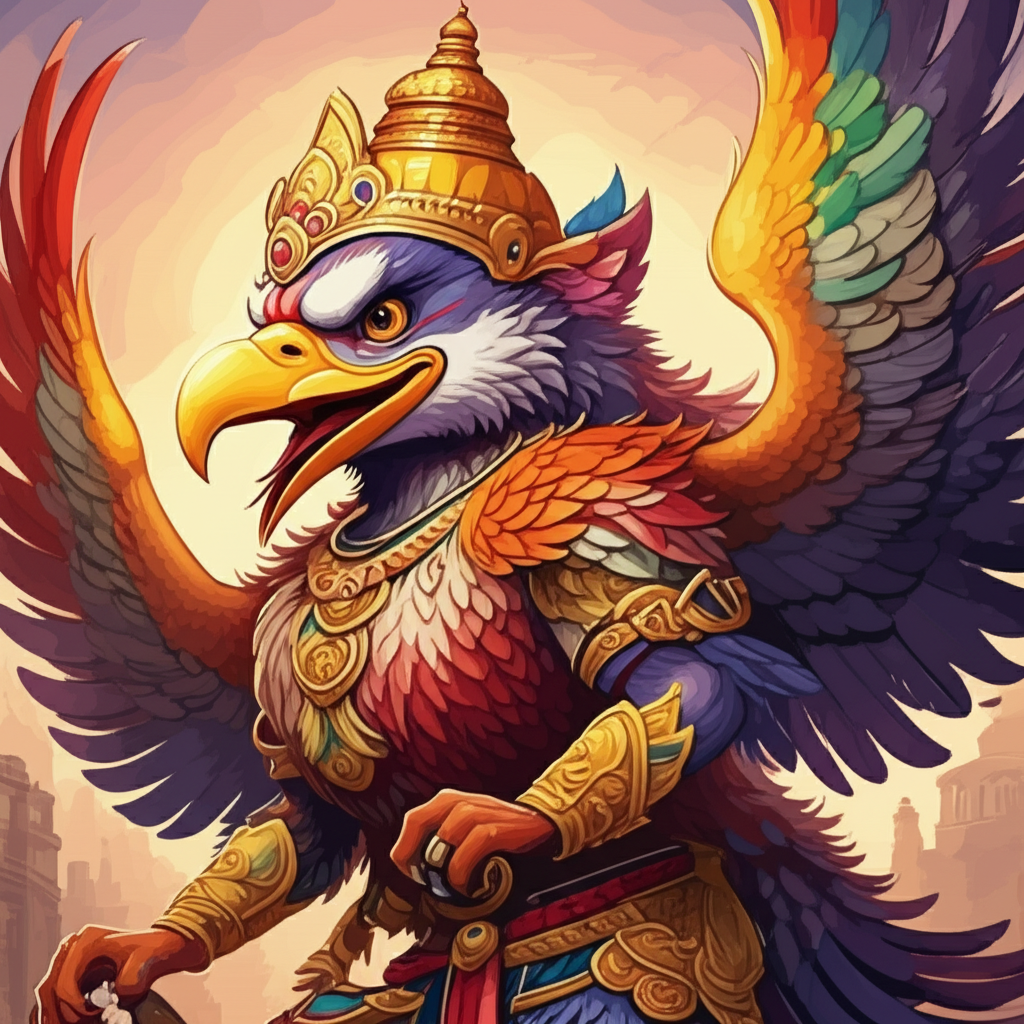
In the tapestry of ancient Indian narratives, where celestial beings and mythical creatures weave through the fabric of belief, lies the tale of Garuda. This story originates from the vibrant cultural landscape of ancient India, a land steeped in rich mythology and a deep connection to the natural world. It is crucial to understand that these are traditional stories, passed down through generations by ancient peoples, offering insights into their worldview and imagination, rather than literal accounts.
The cultural era in which these myths flourished was one where the cosmos was understood through a lens of animism and divine intervention. The world was alive with spirits, and the forces of nature – the sun, the wind, the rivers – were often personified or seen as manifestations of powerful deities. Life was a grand drama, played out between humans, gods, demons, and a host of extraordinary beings. This was a society that sought to explain the unexplainable, to find order in chaos, and to derive moral lessons from the actions of these powerful figures. The environment was often one of lush forests, mighty rivers, and vast plains, providing a fertile ground for tales of immense creatures and epic journeys.
Among these extraordinary beings, Garuda stands out, a figure of immense power and striking imagery. He is often depicted as a colossal bird, a creature of the sky with a regal countenance. His body is described as golden, radiating with the brilliance of the sun. His wings are vast, capable of eclipsing the sun itself, and his eyes are said to burn with an inner fire. He possesses the strength of a lion, the ferocity of an eagle, and the nobility of a king. Garuda is not merely a bird; he embodies the very essence of speed, vigilance, and indomitable spirit. His attributes are symbolic: the golden hue represents purity and divinity, the wings symbolize dominion over the skies and swiftness, and his formidable form speaks of protective strength. He is often adorned with jewels, hinting at his celestial status and the treasures he might guard.
The narrative of Garuda often intertwines with the legendary city of Dvaraka, the opulent seaside capital of Lord Krishna. In some of these ancient tales, Garuda is depicted as a devoted follower and protector of Lord Krishna, and by extension, of Dvaraka. Imagine a scene bathed in the golden light of the setting sun, reflecting off the pearl-white ramparts of Dvaraka. The city, a marvel of architectural brilliance, hums with the activity of its inhabitants. But the skies above are not always peaceful. From the celestial realms, or from hidden mountain abodes, emerges Garuda, his magnificent form blotting out the sun for a fleeting moment. He is not a creature of malice, but a sentinel, his keen eyes scanning the horizon for any sign of danger that might threaten the divine city or its beloved Lord.
In one such imaginative retelling, a formidable demon, driven by envy and a thirst for power, attempts to breach the defenses of Dvaraka. The city’s human guards, though brave, are outmatched by the demon’s supernatural might. As despair begins to creep in, a mighty shriek pierces the air. It is Garuda, summoned by the plight of Dvaraka. With a thunderous beat of his wings, he descends, a golden comet against the darkening sky. His shadow engulfs the battlefield, instilling fear in the demon and hope in the defenders. The ensuing battle is a spectacle of cosmic proportions, a clash between aerial might and earthly malevolence. Garuda, with his sharp talons and fiery gaze, confronts the demon, his movements so swift they are almost a blur. The air crackles with energy as the two titans engage, the fate of Dvaraka hanging in the balance. Ultimately, it is Garuda’s unyielding strength and unwavering loyalty that drive the demon away, ensuring the safety and sanctity of the divine city. He does not conquer for conquest’s sake, but for the protection of what is sacred and beloved.
The symbolism embedded within the story of Garuda and Dvaraka is rich and multifaceted. To the ancient people who shared these narratives, Garuda might have represented the power of nature, particularly the vast and untamed skies. His swiftness could have symbolized the speed of thought or the inevitability of divine justice. His golden hue could have represented the benevolent power of the sun, a life-giving force that also held the power to banish darkness. As a guardian, he embodies the concept of protection, vigilance, and unwavering loyalty, qualities highly valued in any society. The story might have served as a reminder that even in times of great peril, powerful forces are at play, watching over and protecting the righteous.
In the modern era, these ancient myths continue to resonate, albeit through different mediums. Garuda’s image and persona are frequently reimagined in popular culture. He appears in epic Indian literature, as well as in contemporary novels, films, and animated series that draw inspiration from Hindu mythology. In video games, he might be depicted as a powerful character with unique abilities. Academically, scholars study these stories for their insights into ancient Indian history, philosophy, and cultural values. These interpretations highlight the enduring power of storytelling to connect us to our past and to explore universal themes of good versus evil, loyalty, and protection.
It is essential to reiterate that the narrative of Garuda and Dvaraka is a product of ancient storytelling traditions, a testament to the imaginative prowess of bygone eras. As Muslims, we hold the firm belief that only Allah is the true Creator and Sustainer of the universe, and that all power and divinity reside solely with Him. These stories, therefore, are appreciated for their cultural significance, their artistic merit, and the windows they open into the historical imagination of different peoples. They serve as a reminder of the rich tapestry of human culture, the enduring power of stories to shape our understanding, and the beauty of diverse traditions that contribute to our collective heritage. The tale of Garuda, the sun-feathered sentinel, remains a captivating example of how ancient peoples sought to understand and articulate the forces that shaped their world through the power of narrative and imagination.


