fufufafa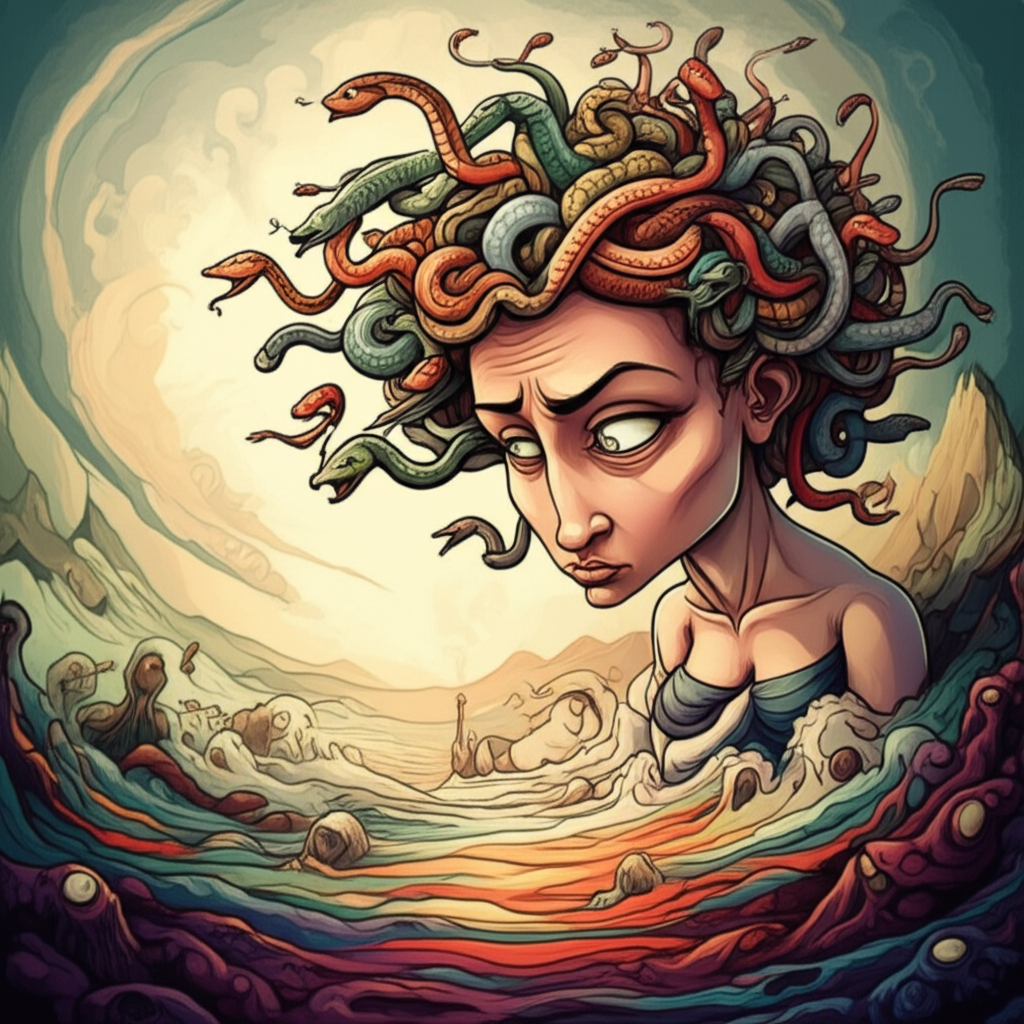
In the twilight of ancient Greece, where the sun-drenched Aegean Sea met rugged mountains and whispering olive groves, stories were woven like intricate tapestries. These were not mere fictions, but rather the collective imagination of a people grappling with the mysteries of existence, the capricious nature of their gods, and the ever-present forces of the natural world. Among these timeless narratives, the tale of Medusa, the serpent-haired Gorgon, and her association with the spectral "River of Souls" stands as a potent testament to their worldview, a reflection of primal fears and the eternal human fascination with mortality and the liminal spaces between life and death.
The era in which these myths flourished was one of burgeoning civilization, where city-states were taking shape, and oral traditions were the primary means of transmitting knowledge, values, and cautionary tales. The ancient Greeks viewed the world as a dynamic interplay of divine will and mortal endeavor, with powerful, often anthropomorphic, deities intervening in human affairs. The natural world itself was imbued with a sense of the sacred and the terrifying. Mountains could be the abodes of gods, the sea a realm of unpredictable power, and the very earth a source of both bounty and destruction. In this context, creatures of monstrous form and formidable power were not necessarily seen as pure evil, but as embodiments of forces beyond human control, or as beings who had transgressed divine order, thus suffering a terrible fate.
At the heart of this particular narrative lies Medusa, a figure of profound and unsettling imagery. She is not depicted as a goddess, but as one of the Gorgons, a trio of monstrous sisters. While her sisters, Stheno and Euryale, were immortal, Medusa alone was mortal, a tragic flaw that set her apart. Her most striking attribute, and the source of her dread, was her hair: not of human tresses, but of writhing, venomous serpents, each hissing with an ancient, primal energy. Her gaze was equally terrifying; it was said that to look directly into her eyes was to be instantly transformed into lifeless stone, a chilling echo of the petrifying power of fear itself. This symbolic attribute of turning onlookers to stone speaks to the paralyzing effect of overwhelming terror or the irreversible consequences of certain encounters. Her monstrous form, often depicted with tusks, scales, and wings, further emphasized her otherness, her departure from the human realm.
The legend of Medusa and the River of Souls often intertwines with her tragic story. Once, it is said, Medusa was a beautiful maiden, a priestess of Athena. However, through an act of desecration or divine wrath – accounts vary, often attributing her curse to Poseidon or Athena herself – she was transformed into the monstrous Gorgon. Her mortal life became a curse, a solitary existence in a remote, often subterranean, location. It is here that the concept of the River of Souls enters the narrative. This is not a physical river of water, but a spectral, ethereal current, a pathway that souls take in their transition from the mortal coil to the underworld, the realm of Hades. Some ancient beliefs suggested that Medusa, in her cursed state, was somehow connected to this transition. Perhaps her gaze, which could halt life, was seen as a macabre guardian of the boundary between worlds, or perhaps the very essence of her being, touched by divine punishment, resonated with the profound stillness of death.
The narrative often unfolds with a heroic quest. Perseus, a demigod, is tasked with slaying Medusa. Armed with divine aid – a mirrored shield from Athena to avoid her direct gaze, winged sandals from Hermes, and a special bag (the kibisis) from the nymphs to contain her severed head – Perseus embarks on his perilous journey. He finds Medusa in her lair, often described as a desolate place filled with the stone statues of her past victims. With cunning and divine protection, Perseus manages to surprise the sleeping Gorgon. He uses the mirrored shield to see her reflection, carefully guiding his sword to sever her head. From her mortal wound, it is said, sprang forth two extraordinary beings: Pegasus, the winged horse, and Chrysaor, a giant with a golden sword. Medusa’s head, though lifeless, retained its terrifying power, and Perseus uses it as a weapon, turning his enemies to stone with its stony gaze.
The symbolism embedded within the Medusa myth is rich and multifaceted. The serpents in her hair can represent chaos, primal instincts, or the destructive forces of nature. Her petrifying gaze embodies the ultimate fear of annihilation, the irreversible cessation of life. The River of Souls, as a concept, speaks to the universal human preoccupation with death and the afterlife, the mysterious journey from existence to non-existence. Medusa’s transformation itself serves as a potent allegory for the consequences of hubris, the dangers of divine displeasure, or the cruel twists of fate. She can be seen as a cautionary figure, a reminder of the fragility of beauty and the potential for even the most divine-seeming of creatures to fall from grace. Her story, in essence, may have been a way for ancient Greeks to process their anxieties about mortality, the unknown, and the power of forces beyond their comprehension.
In the modern world, the figure of Medusa continues to captivate and inspire. Her image has been reinterpreted across various mediums, often shedding her purely monstrous aspect to become a symbol of female empowerment and resilience. In literature, she is sometimes portrayed as a victim of patriarchal oppression, her monstrousness a consequence of abuse or betrayal. In films, art, and video games, she remains a formidable antagonist, her iconic serpentine hair and petrifying gaze instantly recognizable. Cultural studies scholars analyze her enduring appeal as a representation of the "feminine monstrous," exploring how societal fears and perceptions of femininity have been projected onto her image throughout history. The River of Souls, though less frequently depicted, continues to resonate as a metaphor for the spiritual journey and the mysteries of the afterlife.
It is crucial to reiterate that these are traditional stories, rich with cultural significance and imaginative power, but not factual accounts. As Muslims, we understand that only Allah (God) is the true Creator, Sustainer, and Possessor of all power. The concept of Allah as the singular, all-powerful deity is the foundation of our faith, and we do not ascribe divine attributes or worship to figures from ancient mythology.
The myth of Medusa and the River of Souls, therefore, serves as a fascinating window into the minds of ancient peoples, their understanding of the world, their fears, and their creative expressions. It is a testament to the enduring power of storytelling, the human capacity for imagination, and the cultural heritage that shapes our understanding of history and belief systems. These ancient narratives, when approached with respect for their origins and a clear understanding of their context, offer valuable insights into the human condition and the diverse ways in which cultures have sought to explain the inexplicable and grapple with the profound mysteries of life and death.