fufufafa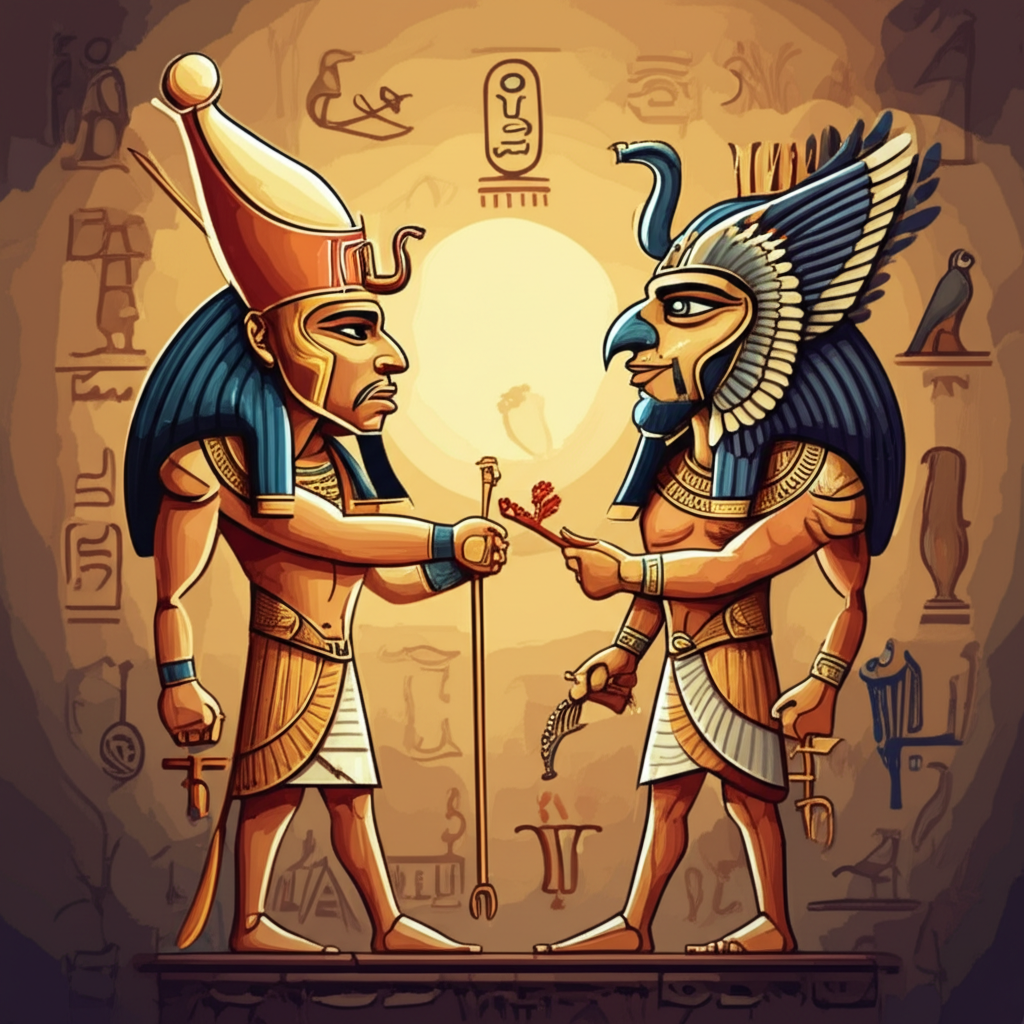
From the sun-baked sands and fertile banks of the Nile River, a civilization bloomed that looked to the heavens and the earth for understanding. Ancient Egypt, a land of pharaohs and pyramids, of intricate hieroglyphs and profound spiritual beliefs, wove a rich tapestry of myths and legends to explain the mysteries of existence. Among these narratives, the story of Set and the War of Contendings of Horus stands as a dramatic exploration of kingship, chaos, and the enduring struggle for cosmic balance. This is not a chronicle of historical events, nor a call to worship, but a traditional story, a testament to the imagination and worldview of a people long past.
The genesis of these tales lies deep within the ancient Egyptian cultural milieu, a society deeply intertwined with the rhythms of nature and the cyclical passage of time. Their world was one of stark contrasts: the life-giving inundation of the Nile against the unforgiving barrenness of the desert, the benevolent sun god Ra against the encroaching darkness of night. This dualistic perception of reality, where opposing forces were constantly in play, formed the bedrock of their mythological landscape. The gods and goddesses, the pharaohs who were seen as divine intermediaries, and the very fabric of their society were understood through this lens of perpetual flux and reconciliation. The myths served as a framework for understanding not only the natural world but also the complex dynamics of human society, particularly the precarious nature of order and the ever-present threat of chaos.
At the heart of this particular narrative lies the figure of Set. He is often depicted as a powerful, imposing deity, frequently represented by a creature that defies easy identification – a stylized animal with a long snout, pointed ears, and a forked tail, sometimes called the "Set animal" or "sha." This enigmatic form itself suggests a creature of the wild, of the untamed desert, a stark contrast to the more familiar forms of other deities. Set’s symbolic attributes are rooted in this association with the desert, with storms, with foreign lands, and with violence. He embodies the disruptive, the unpredictable, the forces that threaten the established order. He is the embodiment of chaos, the agent of destruction, a potent force that, while feared, was also understood as a necessary, albeit dangerous, component of the cosmic cycle. His strength and ferocity were undeniable, making him a formidable adversary.
The narrative of the War of Contendings unfolds as a protracted and often brutal struggle for the throne of Egypt, following the death of Osiris, the benevolent god of the afterlife and fertility. Osiris’s murder and dismemberment by his envious brother, Set, plunges the land into turmoil. Isis, Osiris’s devoted wife and sister, painstakingly reassembles her husband’s body and conceives their son, Horus, the falcon-headed god, who is destined to avenge his father and reclaim the kingship.
The story is not a swift victory but a prolonged conflict, a series of trials, battles, and legal disputes that span generations. Horus, the rightful heir, represents order, justice, and the legitimate succession of kingship. Set, however, refuses to relinquish his claim, and the ensuing "contendings" are a visceral clash of these opposing principles. They engage in epic battles, sometimes in physical form, sometimes through cunning and trickery. Set, in his monstrous power, often employs brute force and intimidation, seeking to overwhelm Horus. He might transform into a formidable beast, unleashing his fury upon his nephew. Horus, guided by his divine heritage and the support of other gods, fights with the grace and precision of a falcon, his keen eyesight and swift attacks symbolizing his unwavering pursuit of justice.
The conflict is not solely fought on the battlefield. The gods of the Egyptian pantheon are called upon to arbiticate, to judge the legitimacy of their claims. These divine tribunals are often filled with drama and intrigue, with Set employing his cunning and manipulative nature to sway the proceedings. He might present false evidence or attempt to bribe influential deities. Horus, in contrast, relies on the purity of his cause and the support of those who uphold the established order. The tales recount instances where Set, in a fit of rage, attempts to physically harm Horus or even sexually assault him, showcasing his primal and destructive urges. These episodes, though disturbing, underscore the extreme nature of the chaos he represents and the lengths to which he will go to disrupt the natural order.
The symbolism embedded within this myth is multifaceted and deeply resonant with the ancient Egyptian understanding of the world. The core of the story revolves around the concept of Ma’at, the principle of truth, justice, balance, and cosmic order. Set’s actions represent a direct assault on Ma’at, a descent into chaos that threatens to unravel the very fabric of existence. Horus, on the other hand, is the champion of Ma’at, the force that restores balance and ensures the continuation of life and prosperity. The struggle between them is a microcosm of the eternal battle between order and chaos, light and darkness, creation and destruction, that was central to their worldview.
The falcon imagery associated with Horus is also significant. Falcons were revered for their keen eyesight, their ability to soar to great heights, and their predatory prowess. They were seen as messengers of the sun god Ra, connecting the earthly realm with the divine. Horus, as a falcon-headed god, embodies these qualities, symbolizing divine oversight, swift justice, and the power of the heavens. Set, in contrast, represents the unpredictable, the wild, the forces that lie beyond the controlled environment of human society and the ordered landscape of the Nile Valley.
In modern times, the myth of Set and Horus continues to capture the imagination, albeit through different lenses. It has been reinterpreted in literature, serving as inspiration for tales of conflict, betrayal, and the quest for rightful inheritance. In popular culture, the dramatic struggle between these archetypal forces can be seen in films, video games, and other forms of media, where the themes of good versus evil, order versus chaos, and the battle for power are explored. Academically, these stories are invaluable for cultural studies, offering insights into ancient Egyptian religious beliefs, social structures, and their philosophical understanding of the universe. They are studied for their narrative richness, their psychological depth, and their enduring influence on storytelling traditions.
As we reflect on these ancient narratives, it is crucial to reiterate that the story of Set and Horus is a cultural legacy, a product of human storytelling and imagination from a bygone era. It is a testament to the power of myth to explain the world and to explore fundamental human concerns. For Muslims, the understanding of creation and sustenance rests solely with Allah, the One true Creator and Sustainer. While we acknowledge the cultural significance and imaginative power of these ancient tales, they do not hold divine truth. The enduring appeal of these myths lies in their ability to tap into universal themes that continue to resonate with us today, reminding us of the enduring human need to understand our place in the world and the perpetual dance between order and the forces that threaten to disrupt it. The echoes of the serpent and the falcon, of chaos and order, continue to reverberate, not as divine pronouncements, but as fascinating chapters in the grand narrative of human culture and storytelling.