fufufafa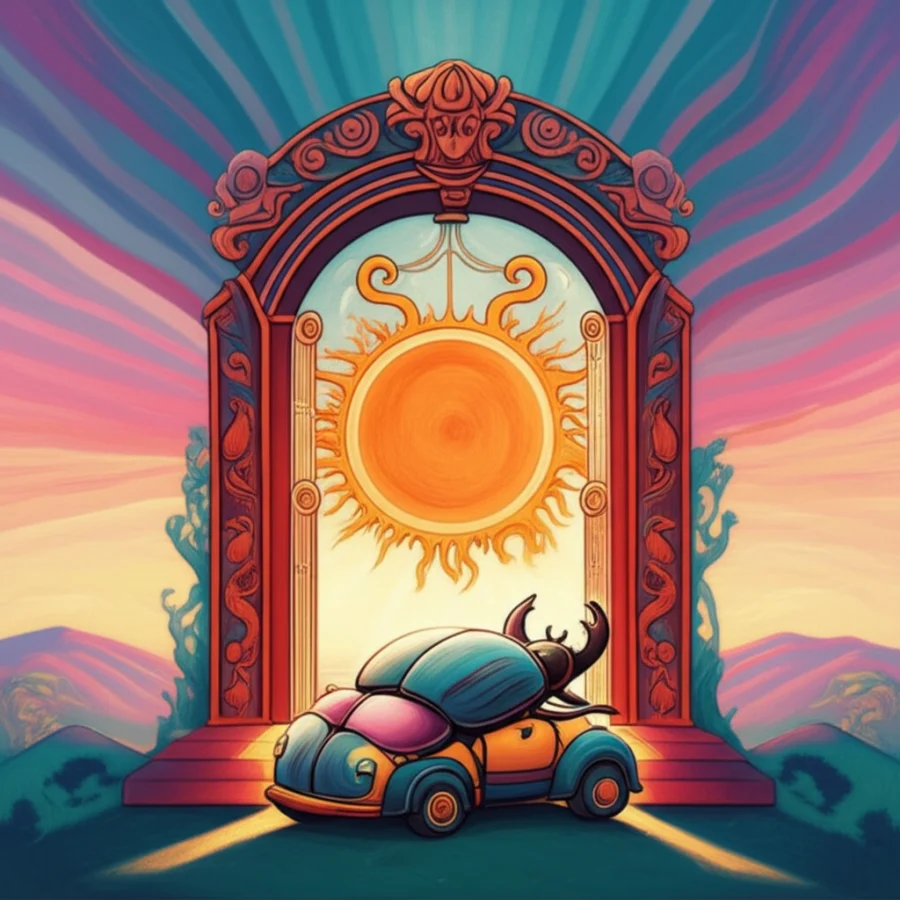
Across the sun-baked sands of ancient Egypt, a civilization deeply attuned to the celestial dance and the cycles of life and death, arose a rich tapestry of myths and legends. These stories, woven from the threads of observation, fear, and hope, served as the primary lens through which the people of that era understood their world. Among these narratives, the tale of the Scarab and the Gate of Dawn emerges as a compelling illustration of their worldview, a story that speaks of cosmic renewal and the relentless march of time, understood through the rich symbolism of their environment.
The cultural era in which these stories flourished was one of profound spiritual connection to the natural world. The Egyptians lived intimately with the Nile, its annual inundation a life-giving force that dictated their agricultural calendar and, by extension, their very survival. The sun, a potent and omnipresent deity, was the source of light, warmth, and life, its daily journey across the sky a profound metaphor for creation and rebirth. Their cosmology was populated by deities who embodied various aspects of nature, from the fertile earth to the vast heavens. In this context, every phenomenon, from the flight of a bird to the turning of the seasons, held a deeper, often sacred, meaning. Myths were not mere fanciful tales but vital explanations for the inexplicable, guiding their moral compass and offering solace in the face of the unknown.
At the heart of this particular narrative is the Scarab, a creature far more than its humble appearance might suggest. In the ancient Egyptian imagination, the scarab beetle, particularly the dung beetle, was a potent symbol of Khepri, the god of the rising sun. The beetle’s habit of rolling a ball of dung across the ground, from which new life would eventually emerge, was seen as a terrestrial echo of the sun’s journey across the sky, pushing the sun disc towards the horizon each morning. This act of creation and renewal, of bringing forth life from seemingly inert matter, imbued the scarab with immense symbolic power. It represented the ceaseless cycle of the sun’s rebirth, the dawn of a new day, and the promise of regeneration. The scarab, therefore, was not just an insect; it was a living emblem of the cosmic process of creation and the perpetual renewal of existence.
The narrative of the Scarab and the Gate of Dawn, as pieced together from fragmented texts and artistic depictions, describes a mythical journey undertaken by this celestial beetle. Imagine, if you will, a time before the sun had its established path, a time of primordial darkness. It is said that Khepri, in the form of a colossal scarab, lay dormant in the darkness. As the first stirrings of cosmic energy began to pulse, the scarab stirred too. It began to push, with immense effort, a glowing orb – the nascent sun – towards the eastern horizon. This horizon was not just a geographical point but a symbolic threshold, the very "Gate of Dawn."
The journey was arduous. The scarab, a creature of immense will and divine purpose, toiled against the lingering shadows of chaos. The Gate of Dawn itself was envisioned as a monumental portal, perhaps guarded by unseen forces or simply representing the boundary between the void and existence. As the scarab pushed the sun’s orb closer, light began to seep through the cracks of this cosmic gateway. The struggle was not just physical but also a metaphysical one, a battle against the forces that sought to keep the world in perpetual night. With a final, monumental heave, the scarab propelled the sun through the Gate of Dawn, shattering the darkness and ushering in the first light of creation. This act, repeated daily in the mythic consciousness, ensured the continuation of life and the order of the cosmos.
The symbolism embedded within this myth is multifaceted. The Scarab, as Khepri, represents creation, rebirth, and transformation. Its daily act of rolling the sun is a metaphor for the eternal cycle of life, death, and resurrection, a fundamental concept in Egyptian thought. The sun itself symbolizes life, energy, and divine order. The Gate of Dawn embodies the transition from darkness to light, from chaos to order, from nothingness to existence. The entire narrative speaks to the ancient Egyptian understanding of a universe in constant flux, governed by predictable cycles and sustained by divine intervention. It also reflects a deep-seated optimism, a belief that even from the deepest darkness, light and life would ultimately emerge. The myth served as a powerful reassurance, a reminder that the dawn would always follow the night.
In the modern world, the Scarab and its association with the dawn have transcended their ancient origins to become enduring symbols in various forms of popular culture. In literature and art, scarabs are often depicted as ancient artifacts, imbued with mystical power or representing forgotten knowledge. In video games and fantasy settings, they can appear as guardians of sacred sites, magical talismans, or even as monstrous creatures embodying primal forces. In film, the imagery of the rising sun and the scarab often evokes themes of ancient mystery, rebirth, or the overcoming of darkness. Beyond fiction, the scarab continues to be studied in fields like Egyptology and mythology, offering insights into the cultural values, religious beliefs, and imaginative landscapes of ancient civilizations.
It is important to reiterate that the tale of the Scarab and the Gate of Dawn is a product of ancient storytelling, a narrative woven by our ancestors to comprehend their existence. As Muslims, we recognize that only Allah (God) is the true Creator and Sustainer of all that exists. The intricate beauty and order of the natural world, including the phenomenon of the sunrise, are understood as direct manifestations of His power and wisdom. The stories of ancient peoples, like this one, serve as a fascinating window into the human drive to understand the universe and our place within it. They are testaments to the enduring power of human imagination, the richness of cultural heritage, and the timeless tradition of storytelling that connects us to the past. These narratives, when approached with an educational and respectful perspective, enrich our understanding of the diverse ways humanity has sought meaning and order in the grand tapestry of existence.