fufufafa
The vast tapestry of human history is interwoven with threads of imagination, belief, and storytelling. Across continents and through millennia, ancient peoples sought to understand their world, their origins, and the forces that shaped their existence. From the rich cultural heritage of China emerges a particularly captivating collection of myths and legends, passed down through generations. Among these, the figure of Nuwa, the mother goddess, stands paramount, often associated with the creation of humanity and the mending of the heavens. Within her narratives, a mysterious artifact occasionally appears, an object of profound significance and enigmatic power: the Ruyi. This article delves into the captivating story of Nuwa and the Ruyi, presenting it as a traditional narrative told by ancient people, a product of their rich cultural imagination rather than a claim of truth or divine power.
Origins and Cultural Background
To truly appreciate the myth of Nuwa and the Ruyi, one must journey back to the mists of ancient China, to a time long before recorded history, or during its earliest foundational dynasties. This was a period when human civilization was deeply intertwined with the rhythms of nature. Early Chinese society was predominantly agrarian, with communities living in close harmony, and often at the mercy of, the natural world. Rivers could bring life-giving water or devastating floods; mountains could offer shelter or present insurmountable barriers; the sky brought both sun and storms.
In such an environment, people looked to the cosmos for explanations and meaning. Their worldview was often animistic and polytheistic, populated by a pantheon of deities, spirits, and mythical creatures who personified natural forces and cosmic principles. The line between the human and the divine was fluid, with gods and goddesses often possessing human-like emotions and interacting directly with the mortal realm. They believed the world was a dynamic, often chaotic place, requiring order and balance, and that these celestial beings played crucial roles in maintaining or disrupting that equilibrium. Myths of creation, destruction, and restoration provided comfort, explanation, and a moral compass for their communities, shaping their understanding of their place in a grand, interconnected universe.
Nuwa: The Serpentine Mother and Her Mystical Scepter
At the heart of many foundational Chinese myths is Nuwa, a being of extraordinary power and compassion, revered as the creator of humanity and the savior of the world. She is often depicted with the upper body of a woman and the lower body of a serpent or dragon, a form that speaks to her ancient origins and her connection to both the earth and the celestial realms. This unique appearance symbolizes her mastery over both the earthly and divine, her profound wisdom, and her innate connection to the primal forces of creation.
Nuwa is traditionally seen as a maternal figure, embodying creativity, nurturing, and boundless empathy. Her most famous deeds include fashioning the first humans from yellow clay, breathing life into them, and later, heroically mending the fractured sky. Her symbolic attributes extend beyond mere creation; she represents resilience in the face of catastrophe, the restoration of order from chaos, and the benevolent force that sustains life.
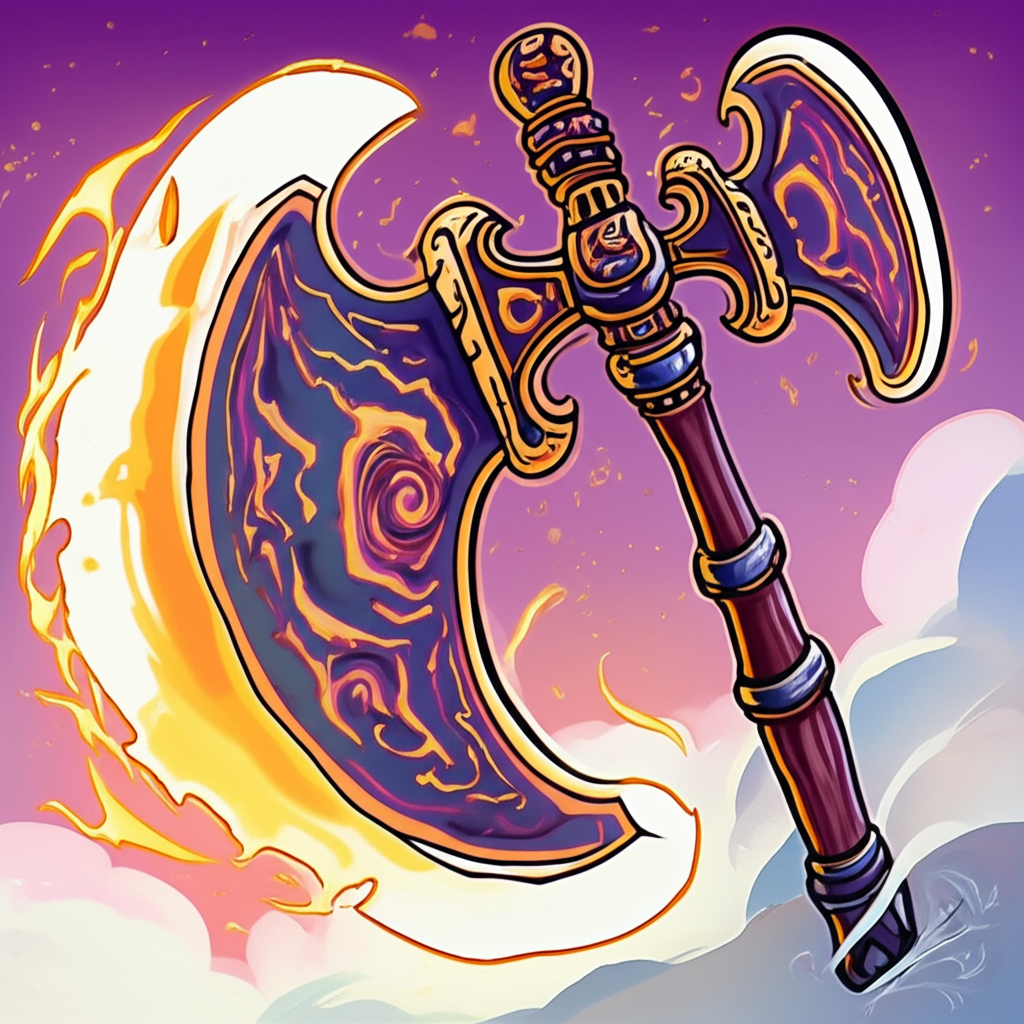
Alongside Nuwa, the Ruyi (如意), meaning "as you wish" or "as you desire," is an object of profound symbolic weight in Chinese culture, often associated with power, authority, and good fortune. In its most common form, the Ruyi is a ceremonial scepter, typically made from jade, gold, or other precious materials, characterized by its distinct cloud-shaped head. While the Ruyi evolved into a popular decorative and ceremonial item, in the context of ancient myths like Nuwa’s, it transcends mere ornament. It becomes a magical artifact, an instrument through which a deity’s will can be channeled, or a symbol of their inherent ability to shape reality. For Nuwa, the Ruyi is not just a scepter; it is an extension of her creative and restorative essence, an embodiment of the cosmic order she strives to maintain.
The Main Story: The Ruyi and the Mending of the Sky
Our story begins in an age when the world, though freshly populated by Nuwa’s hand-molded creations, still bore the marks of primordial chaos. Nuwa, with her serene human face and majestic serpent tail, watched over the nascent human race with a loving gaze. From the banks of the Yellow River, where she had shaped them from clay, she observed their simple lives, their joys, and their nascent struggles. She cherished them, her children, and wished for them a world of stability and peace.
It was during this era that the heavens, once a shimmering dome, were plunged into cataclysm. Legend tells of a fierce battle between the water god Gonggong and the fire god Zhurong, a clash of elemental titans that shook the very foundations of the cosmos. In a fit of rage and defeat, Gonggong, in his despair, crashed his head against Mount Buzhou, one of the four pillars supporting the sky. The impact was cataclysmic. The pillar shattered, tearing a gaping hole in the firmament. The heavens cracked, fire rained down from the cosmic void, and the earth groaned, cracking open to unleash floods and monstrous beasts. Humanity, Nuwa’s precious creations, faced utter annihilation.
Nuwa, witnessing the devastation, felt a profound sorrow and an unwavering determination. Her children screamed in terror, the world spiraled into chaos, and the very fabric of existence threatened to unravel. She knew she had to act, but how could one mend the heavens themselves? It was then that her gaze fell upon her Ruyi. It was not merely an ornate scepter; it was a relic of creation, a conduit for her deepest will, gifted to her by the cosmos itself, its true potential yet to be fully realized. Its cloud-shaped head seemed to shimmer with an inner light, humming with a subtle energy that resonated with her desperate resolve.
As Nuwa pondered, holding the Ruyi, she felt a surge of ancient wisdom flow through her. The Ruyi seemed to guide her thoughts, revealing a path forward. Its smooth, polished surface, traditionally made of the finest jade, began to glow with a soft, ethereal light. It was as if the Ruyi itself was whispering the secret of restoration. She understood then: she needed the Five-Colored Stones, gems imbued with the purest essence of the five elements, scattered across the highest, most perilous peaks of the world.
With the Ruyi clutched firmly in her hand, Nuwa embarked on her arduous quest. The Ruyi did not merely accompany her; it became her instrument. As she traversed the shattered landscape, battling infernal fires and surging waters, the Ruyi pulsed with power, illuminating hidden paths, shielding her from dangers, and even, at times, calming the elements just enough for her to pass. It was a beacon of hope and a testament to her unyielding will.
Upon gathering the five magnificent stones—red, yellow, blue, black, and white—each radiating with its unique elemental energy, Nuwa sought the highest point on Earth. There, under the shattered sky, she built a massive furnace. Placing the Ruyi within the heart of the flames, she invoked the primal forces of the universe. The Ruyi, now glowing with an intense, multi-hued light, began to channel the cosmic energies, melting the disparate stones into a single, molten, kaleidoscopic paste.
With the Ruyi still channeling the celestial forge’s heat, Nuwa gathered the molten essence. Then, with a mighty, graceful sweep of her serpent tail, and guided by the Ruyi, she began to patch the gaping wound in the sky. Each application of the radiant paste solidified, hardening into a shimmering, resilient patch that mirrored the hues of a rainbow. The Ruyi, now cool and steady in her hand, seemed to hum with satisfaction, its task fulfilled. It had been the conduit, the focus, the silent, powerful partner in her miraculous endeavor.
Finally, the sky was whole again, though forever marked by the beautiful, iridescent patches of Nuwa’s repair. With the heavens mended, she then slew a mighty turtle, using its four legs as new pillars to support the sky, stabilizing the earth. The floods receded, the fires died down, and the world slowly began to heal. Nuwa, exhausted but triumphant, looked upon her restored creation, the Ruyi now a symbol of her unparalleled achievement, a silent testament to the mystery of its power and the depths of her resolve.
Symbolism and Meaning
To the ancient Chinese, the myth of Nuwa and the Ruyi was far more than an entertaining tale; it was a profound narrative imbued with deep symbolism and moral lessons. Nuwa herself represents the ultimate maternal figure, the benevolent creator and protector. Her half-human, half-serpent form speaks to the unity of opposing forces – humanity and nature, earth and heaven – and the wisdom born from such integration. She embodies compassion, sacrifice, and the unwavering spirit of resilience required to overcome even the most catastrophic challenges.
The Ruyi, in this context, transcends its ceremonial function. It symbolizes divine authority, cosmic order, and the power of intention. Its name, "as you wish," points to the ability to manifest desire, not through selfish whim, but through benevolent will and profound understanding. It is an instrument of transformation, a conduit for creative energy, and a symbol of good fortune derived from harmonious action. In Nuwa’s hands, the Ruyi becomes the embodiment of wise leadership, a tool used not for conquest, but for restoration and the welfare of all. The mending of the sky itself symbolizes the cyclical nature of destruction and creation, humanity’s dependence on the stability of the cosmos, and the belief that even in utter chaos, order can be restored through heroic effort and divine intervention. It also subtly teaches responsibility – that even divine actions can have immense consequences, and that mending what is broken is a sacred duty.
Modern Perspective
Today, the myth of Nuwa and the Ruyi continues to resonate, though its interpretation has shifted from literal belief to cultural appreciation. In modern literature, Nuwa often appears as an archetype of the powerful, compassionate female leader, inspiring countless fantasy novels, poetry, and graphic narratives. The Ruyi, too, frequently features in popular culture; it is depicted in movies, animated series, and video games as a magical artifact, granting wishes, bestowing power, or serving as a symbol of authority and wisdom. Its distinctive cloud-head shape is instantly recognizable, making it a popular motif in traditional and contemporary art, jewelry, and decorative crafts.
Academically, these myths are studied within cultural anthropology, comparative mythology, and sinology, offering invaluable insights into the worldview, societal values, and philosophical underpinnings of ancient Chinese civilization. They provide a window into how ancient peoples grappled with existential questions of creation, chaos, and order, and how they envisioned the interplay between humanity and the divine.
Conclusion
The story of Nuwa and the Ruyi, like countless myths from cultures across the globe, stands as a testament to the enduring power of human imagination and the rich tapestry of cultural heritage. It is a traditional story, told by ancient people to explain their world and impart timeless values, not a claim of truth or divine power. As Muslims, we recognize and affirm that only Allah, the Most High, is the true Creator and Sustainer of the heavens and the earth, the sole source of all power and wisdom.
Yet, these narratives, though products of human invention, offer profound insights into the minds and hearts of those who first told them. They allow us to connect with the aspirations, fears, and understandings of our ancestors. The myth of Nuwa and the Ruyi reminds us of the universal human quest for meaning, the desire for order in a chaotic world, and the timeless tradition of storytelling that binds generations together. It endures not as a belief, but as a cherished cultural artifact, a beautiful reflection of a civilization’s deepest thoughts and its most imaginative dreams.