fufufafa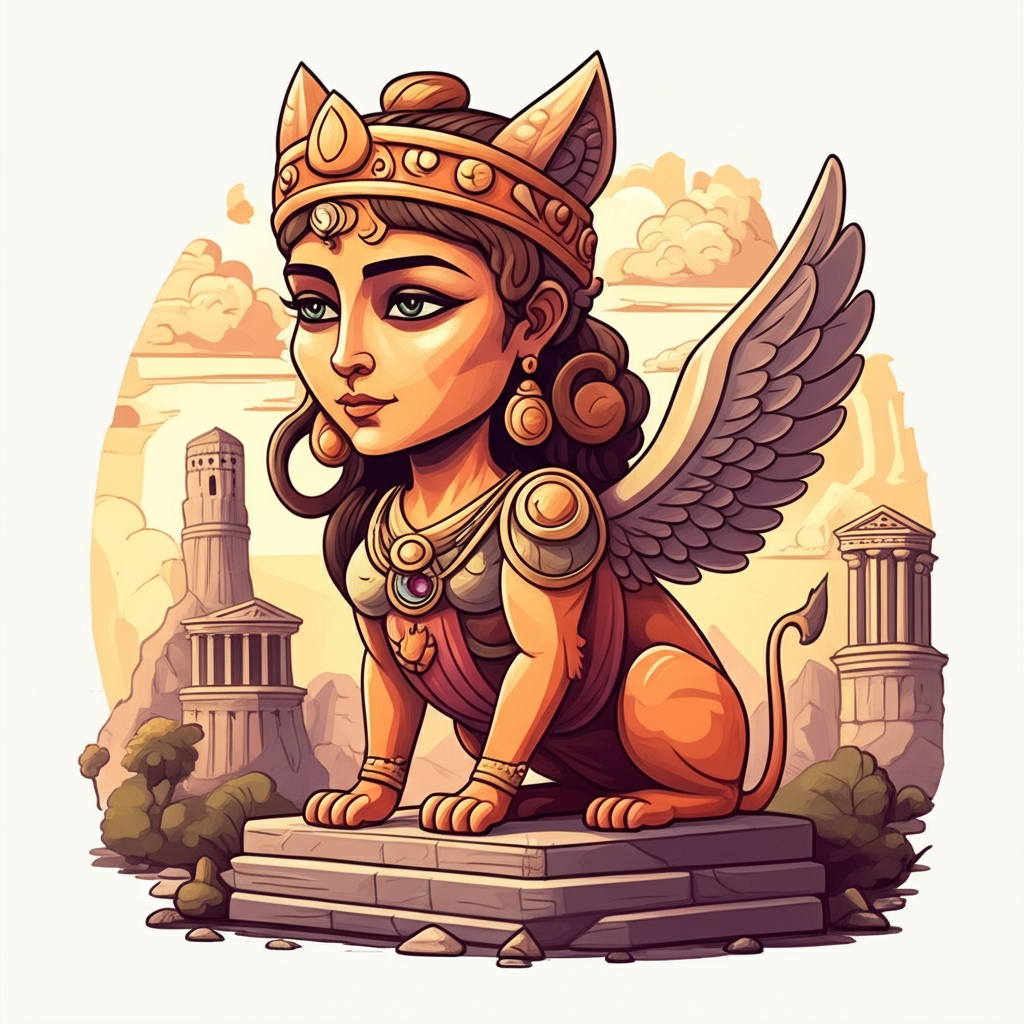
The ancient world, a tapestry woven with threads of awe, fear, and profound curiosity, birthed countless narratives to explain the mysteries of existence. Among these, the myth of the Sphinx of Delphi stands as a chilling testament to the power of riddles, the terror of the unknown, and the enduring human drive to overcome formidable challenges. This is not a tale of divine decree, but a story passed down through generations of ancient Greeks, a vivid product of their imagination and their quest for understanding the world around them.
Our journey into this myth begins in the cradle of Western civilization, in the sun-drenched landscapes of ancient Greece. This was an era where the cosmos was often seen as a stage for the whims of powerful, anthropomorphic deities, and where natural phenomena were imbued with divine intent. People looked to the stars for guidance, to the earth for sustenance, and to their gods for explanation and protection. In this context, myths served a vital purpose: they provided frameworks for understanding morality, the forces of nature, and the very essence of humanity’s place in the universe. The Sphinx, in its terrifying form, emerged from this rich cultural soil, a creature born of ancient fears and a symbol of the intellectual and existential challenges faced by individuals and communities alike.
The figure of the Sphinx, as depicted in this myth, is a creature of striking and unsettling hybridity. Imagine a being with the powerful body of a lion, symbolizing brute strength and ferocity. Upon this powerful frame rests the head and torso of a woman, often rendered with a stern, unyielding expression, hinting at intelligence and perhaps a cruel cunning. To this already formidable combination, wings are added, suggesting an otherworldly nature and the ability to traverse vast distances, to descend upon unsuspecting victims from the heavens. These symbolic attributes – strength, intelligence, and an avian power – coalesce to create a figure that embodies both physical threat and intellectual peril. The Sphinx was not merely a beast to be fought; it was a puzzle to be solved, a guardian that demanded wit rather than just might.
The narrative of the Sphinx of Delphi unfolds on the rugged slopes leading to the sacred site of Delphi, a place renowned for its oracle, the Pythia, who dispensed prophecies from the god Apollo. It was here, on this perilous path, that the Sphinx had established its terrifying dominion. This creature, according to the tale, was sent by the gods (or perhaps as a punishment from the gods) to plague the city of Thebes. Its modus operandi was simple, yet devastating. As travelers approached Delphi, seeking wisdom or solace, they were confronted by the Sphinx. The creature would then pose a single, enigmatic riddle, a question designed to ensnare the unwary mind.
The riddle, famously, was: "What walks on four legs in the morning, two legs at noon, and three legs in the evening?" Those who failed to answer correctly, whose minds faltered under the Sphinx’s gaze and the pressure of impending doom, were met with a swift and brutal end. The Sphinx would snatch them up and devour them, adding their remains to the grim tableau of its reign. The path to Delphi, a place of spiritual pilgrimage, became a gauntlet of death, its allure overshadowed by the terrifying presence of this enigmatic guardian. Fear gripped Thebes, and the land suffered under the Sphinx’s oppressive shadow.
It was in this atmosphere of despair that a hero emerged, a figure destined to confront the monster. His name was Oedipus, a prince of Thebes who, unbeknownst to him, was entangled in a complex destiny. Upon returning to his homeland, Oedipus, unaware of his true parentage, encountered the Sphinx on the road to Delphi. The creature, confident in its usual victory, posed its riddle. Oedipus, however, possessed a sharp intellect and a mind honed by hardship. He pondered the question, his thoughts racing through the cycles of life, of growth and decay.
He understood that the riddle was not about a literal animal, but a metaphor for the human condition. In the "morning" of life, a baby crawls on all fours. In the "noon" of adulthood, a person walks upright on two legs. And in the "evening" of old age, they rely on a cane, a third leg, for support. Oedipus, with a confident voice, declared his answer: "Man."
The Sphinx, having its riddle solved for the first time in its reign, was defeated. The ancient tales often describe its reaction as one of utter despair and fury. In its shame and utter defeat, it threw itself from its rocky perch, meeting its demise in the abyss below. With the Sphinx vanquicthed, the path to Delphi was finally freed, and Oedipus was hailed as a hero, his wisdom having saved the city from its terror.
The symbolism embedded within the myth of the Sphinx is multifaceted and rich. At its most primal level, the Sphinx represents the terrifying unknown, the challenges that life throws at us, whether they are external threats or internal struggles. Its riddle speaks to the human journey, the inevitable passage of time, and the changes that life brings. It also highlights the importance of wisdom and intellect over brute force. Oedipus’s victory was not achieved through physical combat, but through his ability to decipher the riddle, to understand the deeper meaning behind the words. This suggests that sometimes, the greatest battles are fought and won in the mind. Furthermore, the Sphinx’s placement near Delphi, a site of prophecy and divine communication, could imply that understanding oneself and the nature of life is a prerequisite for true spiritual enlightenment.
In the modern world, the myth of the Sphinx continues to resonate, albeit in different forms. It has been reinterpreted in literature, serving as a powerful metaphor for enigma and intellectual challenge. In popular culture, the Sphinx often appears in fantasy novels, video games, and films, frequently depicted as a formidable guardian or a source of ancient riddles. Its image is instantly recognizable as a symbol of mystery and intellectual combat. Beyond entertainment, the myth is a subject of study in classical literature and mythology courses, offering insights into the ancient Greek worldview, their anxieties, and their understanding of human nature.
It is crucial to reiterate that the myth of the Sphinx of Delphi is a traditional story, a product of ancient imagination, and not a reflection of verifiable reality. As Muslims, we firmly believe that only Allah is the true Creator and Sustainer of all existence. These ancient narratives, while fascinating and culturally significant, are not to be believed or worshipped. They offer us a window into the past, a glimpse of how our ancestors grappled with the world, and a testament to the enduring power of storytelling. The myth of the Sphinx reminds us that even in the face of seemingly insurmountable challenges, human ingenuity and the pursuit of knowledge can ultimately prevail. It is a narrative that continues to captivate, inviting us to ponder the mysteries of life, the power of our minds, and the rich tapestry of our shared cultural heritage.