fufufafa
The mists of antiquity often veil the origins of the tales that shaped human understanding, yet their echoes resonate through time. Among the most evocative of these narratives is "The Legend of Nuada and the Eternal Mountain," a powerful story born from the rich tapestry of Celtic mythology, primarily associated with the ancient peoples of Ireland. This is a traditional story, a narrative woven by the imaginative minds of ancient communities, passed down through generations, and intended not as literal truth, but as a vessel for cultural values, historical memory, and profound symbolic meaning.
Origins in a World of Wonder
To understand the world that gave birth to such a legend, one must journey back to a time long before the advent of modern science, to the Iron Age and early medieval periods in regions like Ireland. This was an era where human existence was intimately bound to the rhythms of nature. The ancient Celts lived in a society deeply connected to the land – its forests, rivers, mountains, and the ever-changing sky. Their world was alive with spirits and potent forces, where the boundaries between the mundane and the magical were often blurred. Oral tradition was paramount; stories were the primary means of education, entertainment, and the preservation of identity.
In this cultural landscape, the people viewed the world through a lens of profound respect and occasional fear for the natural environment. Gods and goddesses were not distant, abstract entities but manifestations of natural phenomena, tribal ancestors, or divine patrons. Their worldview was often cyclical, reflecting the seasons, birth, death, and rebirth. Magic was an inherent part of the cosmos, heroes performed incredible feats, and the Otherworld – a parallel realm of gods, spirits, and ancestors – was always just beyond a thin veil, accessible through sacred sites, ancient mounds, or indeed, towering, mystical mountains.
Nuada: The King with a Silver Hand
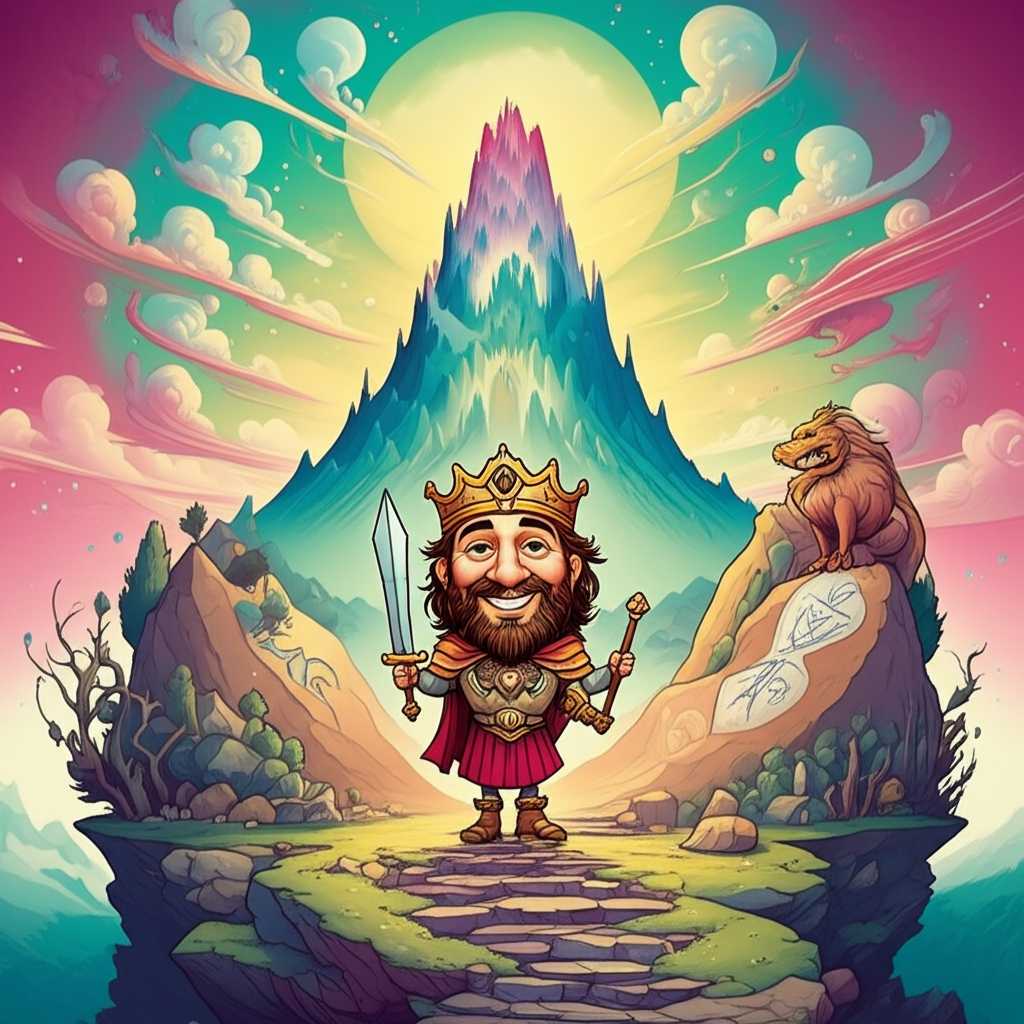
Central to many tales of the Tuatha Dé Danann, the divine race of ancient Ireland, is Nuada. In "The Legend of Nuada and the Eternal Mountain," he is presented as a paramount figure: the first king of the Tuatha Dé Danann, a leader whose wisdom, courage, and sense of justice were unmatched. He was a warrior, a strategist, and a figure of regal authority. His most defining attribute, however, and one that carries immense symbolic weight, is his hand. In the traditional myths, Nuada famously lost his hand in the First Battle of Mag Tuired (Moytura) against the Fir Bolg. Because a king had to be physically perfect, he was temporarily deposed. However, a master physician, Dian Cécht, crafted for him a magnificent, fully functional silver hand (or arm), earning him the epithet "Nuada Airgetlám," meaning "Nuada of the Silver Hand." This silver appendage became a symbol of his resilience, the ingenuity of his people, and the concept that true leadership could overcome physical imperfection through wisdom and artifice.
The "Eternal Mountain" in this legend is not a specific, named peak in Irish geography, but rather a profound, symbolic entity. It is imagined as a colossal, ancient edifice, its summit perpetually shrouded in swirling mists and clouds, its base rooted in the very fabric of the earth. This mountain is a repository of primordial power, an anchor point for the Otherworld, and a dwelling place of forgotten wisdom. It represents the enduring, unyielding forces of nature, the source of ancient magic, and a place where the gods themselves might commune or from which their power emanates. It is a place of ultimate challenge and ultimate enlightenment, a sacred threshold between worlds.
The Quest for the Heart of Éire
In the vibrant annals of the Tuatha Dé Danann, a looming shadow began to stretch across the fertile lands of Éire. The Fomorians, monstrous beings of chaos and destruction, stirred from their abyssal depths, their numbers swelling, their intent clear: to subjugate the luminous Tuatha Dé Danann and claim Éire for their own dark dominion. Nuada, the esteemed king, felt the weight of his people’s fate upon his shoulders. He gathered his wisest druids and most valiant warriors, but their combined knowledge and might seemed insufficient against the encroaching tide of primal darkness.
During a night of troubled visions, the ancient seeress, Adair, spoke of a prophecy long forgotten: "When the heart of Éire trembles, only the king who seeks the eternal flame within the mountain’s core shall find the strength to mend it." The "Eternal Mountain," a place whispered about in hushed tones, a sentinel of forgotten ages, was the key. Its peak, perpetually veiled in swirling clouds, was said to guard the "Heart of Éire" – not a literal organ, but the very essence of the land’s spiritual power and resilience.
Nuada, despite the recent loss of his natural hand in an earlier skirmish with Fomorian scouts (a precursor to the great war), and now bearing the gleaming, artfully crafted silver hand, knew he had to undertake this perilous journey. He entrusted his kingship temporarily to Bres, a seemingly charismatic but ultimately treacherous figure (a detail from traditional lore, adapted here). With a small, loyal retinue, Nuada set forth.
The journey to the Eternal Mountain was arduous. The path was fraught with illusions woven by ancient spirits, treacherous bogs that sought to swallow the unwary, and the chilling whispers of the wilderness itself. Nuada’s silver hand, a marvel of craft, proved invaluable, not merely as a replacement for his lost limb but as a symbol of his unwavering resolve. It shimmered with a faint, inner light, guiding them through the darkest passes.
Finally, after weeks of relentless travel, they stood at the foot of the colossal peak. Its sheer face rose into the heavens, seeming to touch the stars. The air grew heavy with ancient magic. To ascend, they had to pass through trials: riddles posed by ancient guardians of stone, tests of courage against phantom beasts, and moments requiring profound self-reflection and sacrifice. At one point, Nuada had to offer a drop of his own blood, drawn by the silver hand itself, to awaken an ancient pathway carved into the rock.
Deep within the mountain’s heart, in a cavern pulsating with a gentle, golden light, Nuada found not a flame, but a vast, shimmering crystal – the true "Heart of Éire." It pulsed with the life force of the land, ancient wisdom, and the collective memory of all who had ever lived upon it. As Nuada reached out his silver hand, a surge of energy flowed into him. He saw visions of Éire’s past, present, and future: the verdant plains, the rushing rivers, the struggles and triumphs of his people. He understood that the true strength lay not in overwhelming force, but in unity, resilience, and the deep, abiding connection to the land itself. The silver hand, now glowing brightly, absorbed a fragment of the crystal’s essence, becoming imbued with a new, subtle power – the ability to inspire hope and unwavering courage in his people.
Returning to his people, Nuada carried not a weapon, but a renewed spirit and the wisdom of the mountain. He rallied the Tuatha Dé Danann, his silver hand now a beacon of their shared destiny. With the mountain’s essence within him, he led them in the climactic battle against the Fomorians, inspiring such bravery and unity that they pushed back the encroaching darkness, securing Éire’s future.
Symbolism and Enduring Meaning
The Legend of Nuada and the Eternal Mountain, though an imaginative construct built upon existing mythological foundations, is rich with symbolism. Nuada himself embodies ideal leadership: wise, courageous, capable of sacrifice, and resilient in the face of adversity. His silver hand is a potent symbol of overcoming physical limitation through ingenuity and spirit, representing the triumph of skill and artifice over raw power. It also signifies the concept of a just and rightful king, whose authority is not diminished by imperfection but strengthened by his character and the collective efforts of his people.
The Eternal Mountain represents the enduring power and mystery of the natural world, a source of ancient wisdom and spiritual strength. It symbolizes the sacredness of the land, a place where the divine and the mortal realms converge, and where profound truths can be uncovered. The quest to the mountain signifies the inner journey that leaders, and indeed all individuals, must undertake to find true understanding and strength. The "Heart of Éire" within the mountain speaks to the vital essence of a culture or nation – its spirit, its history, and its potential for renewal. This tale, therefore, would have represented to ancient people the importance of strong, just leadership, the resilience of their community, the sacred bond with their land, and the eternal struggle between order and chaos, light and darkness.
Modern Echoes of Ancient Tales
Today, the enchanting tales of Celtic mythology, including figures like Nuada, continue to captivate and inspire. While not interpreted as literal historical accounts, these myths are invaluable for their cultural, historical, and literary significance. Nuada, with his distinctive silver hand and his role as a king, has been reimagined in various modern works. He appears as a character in fantasy literature, often as a noble warrior-king or a figure representing ancient power. In popular culture, a notable interpretation is Prince Nuada in Guillermo del Toro’s film Hellboy II: The Golden Army, though this portrayal significantly diverges from the traditional myth, borrowing the name and some attributes to create a new, compelling character. Video games and role-playing games frequently draw upon Celtic mythology for their world-building, characters, and magical elements, where figures akin to Nuada or concepts like sacred mountains and ancient artifacts play pivotal roles.
Academically, these myths are studied for their insights into ancient belief systems, societal structures, and the psychology of storytelling. They are seen as foundational texts for understanding European folklore, literature, and the enduring power of archetypes that resonate across cultures and time.
A Legacy of Imagination
In conclusion, "The Legend of Nuada and the Eternal Mountain" stands as a testament to the profound imagination and rich cultural heritage of the ancient Celtic peoples. It is a story, a narrative crafted to entertain, educate, and impart values, not a historical account or a divine revelation. As Muslims, we recognize and affirm that only Allah (God) is the true Creator and Sustainer of all existence, and only He is worthy of worship. We understand that these ancient narratives, while captivating and culturally significant, belong to the realm of human creativity and folklore.
Yet, even through a modern lens, we can appreciate the beauty and wisdom embedded in such tales. They remind us of the universal human quest for meaning, the power of leadership, the resilience of the human spirit, and the deep connection people have always felt to the natural world. These myths are not to be believed, but to be understood and cherished as part of the vast, intricate tapestry of human storytelling, offering windows into the hearts and minds of those who came before us.