fufufafa
In the misty annals of ancient Ireland, where the rolling green hills met the wild, untamed Atlantic, a rich tapestry of stories was woven by the hands of its early inhabitants. Among these tales, passed down through generations by bards and storytellers, is the captivating legend of Dagda, the "Good God," and his profound connection to the mysterious and powerful entity known as the Eternal Sea. This is not a historical account of events, nor a divine revelation, but a traditional story told by ancient people, reflecting their worldview and their understanding of the forces that shaped their lives.
Origins and Cultural Background
The myth of Dagda and the Eternal Sea hails from the vibrant and complex cultural landscape of pre-Christian Celtic Ireland. This was a society deeply intertwined with nature, where the rhythm of life was dictated by the turning of the seasons, the fertility of the land, and the immense power of the surrounding waters. For these ancient Celts, the world was alive, imbued with spirits and powerful forces that manifested in every tree, river, and mountain. They perceived the cosmos as a layered existence, with the earthly realm interacting with otherworlds – realms of the gods, spirits, and the ancestors.
Their worldview was not one of a single, omnipotent deity in the Abrahamic sense, but rather a pantheon of gods and goddesses, each embodying different aspects of nature, human experience, and societal functions. Spiritual leaders, often called Druids, played a crucial role in interpreting these forces, conducting rituals, and preserving the vast oral tradition of their people. The sea, in particular, was a constant, formidable presence – a source of sustenance, a pathway to other lands, and an unpredictable force capable of both immense generosity and terrifying destruction. It was a boundary and a gateway, a mirror to the infinite, and thus, a fitting stage for a tale of their most powerful deity.
Dagda: The All-Father of the Tuatha Dé Danann
At the heart of many Irish myths stands Dagda, a towering figure among the Tuatha Dé Danann, the mythological race of divine beings who were said to have ruled Ireland before the arrival of humanity. Dagda, whose name means "the Good God" or "the Great God," was often depicted as a benevolent, fatherly leader, possessing immense strength, wisdom, and a generous spirit. His attributes, while impressive within the context of the myth, are symbolic representations of leadership, natural forces, and societal virtues, rather than actual divine powers.
Dagda was famously associated with three potent magical artifacts, each carrying deep symbolic weight:
- The Cauldron of Plenty (Coire Ansic): This wondrous cauldron was said to be inexhaustible, always providing enough food for everyone, no matter how many gathered. It symbolized hospitality, sustenance, generosity, and the life-giving abundance of nature.
- Uaithne (The Harp): Dagda’s magnificent harp was not merely an instrument; it was capable of controlling the seasons, commanding the emotions of listeners (provoking laughter, tears, or sleep), and maintaining cosmic order. It represented harmony, artistic power, the rhythmic cycles of nature, and the influence of wisdom over chaos.
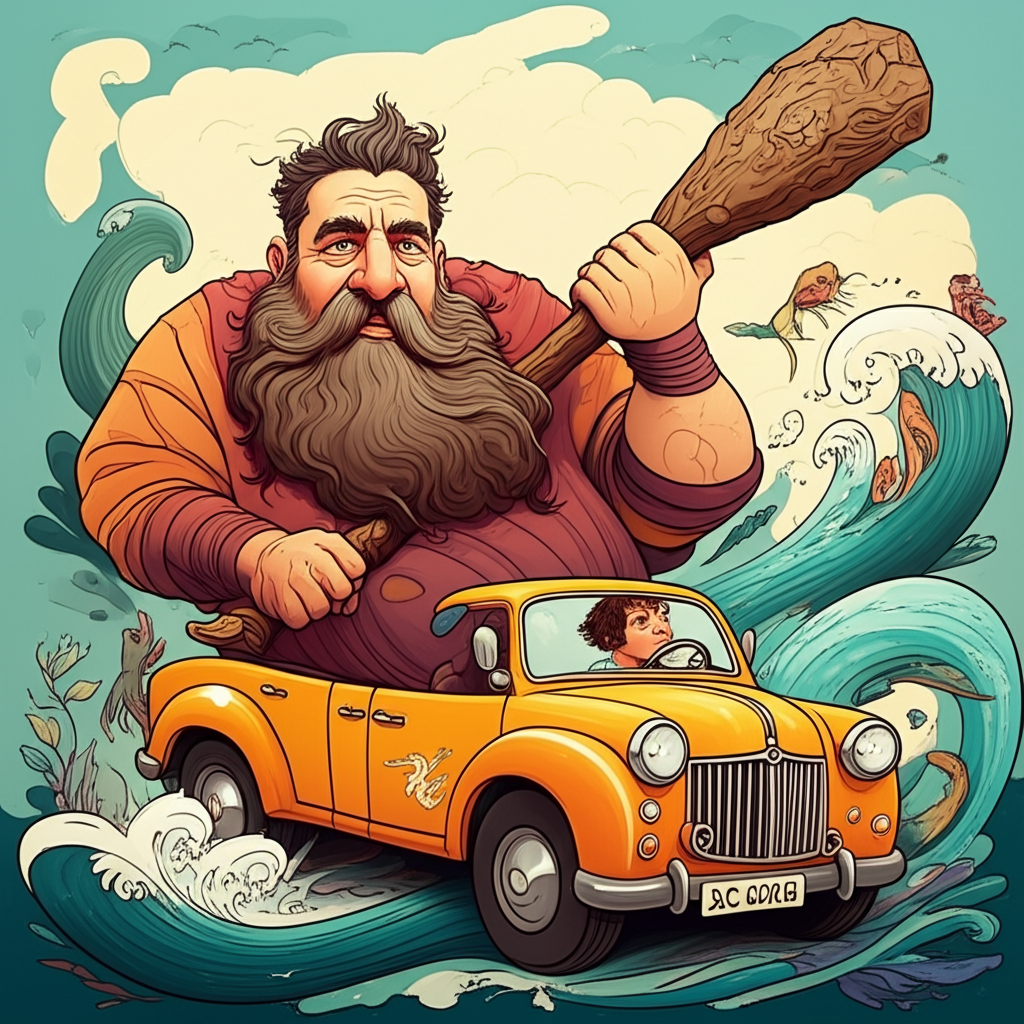
- The Lorg Mór (The Great Club): This massive club was so powerful that one end could kill nine men, while the other end could restore them to life. It was a potent symbol of power, justice, authority, and the cyclical nature of life, death, and rebirth.
Together, these attributes painted a picture of Dagda as a comprehensive deity: a provider, an enforcer of order, and a master of life and death – a figure central to the well-being and stability of his people.
The Main Story: Dagda and the Eternal Sea
In a time long past, when the veils between worlds were thin and the voices of the ancient gods still resonated across the land, a profound challenge befell the Tuatha Dé Danann. The very essence of their world, the delicate balance of life and death, creation and dissolution, seemed to falter. The land grew weary, the harvests dwindled, and a pervasive sense of unease settled upon the hearts of all. It was said that the primordial forces themselves were out of alignment, and only a journey to the source of all beginnings and endings, the vast and unfathomable Eternal Sea, could restore equilibrium.
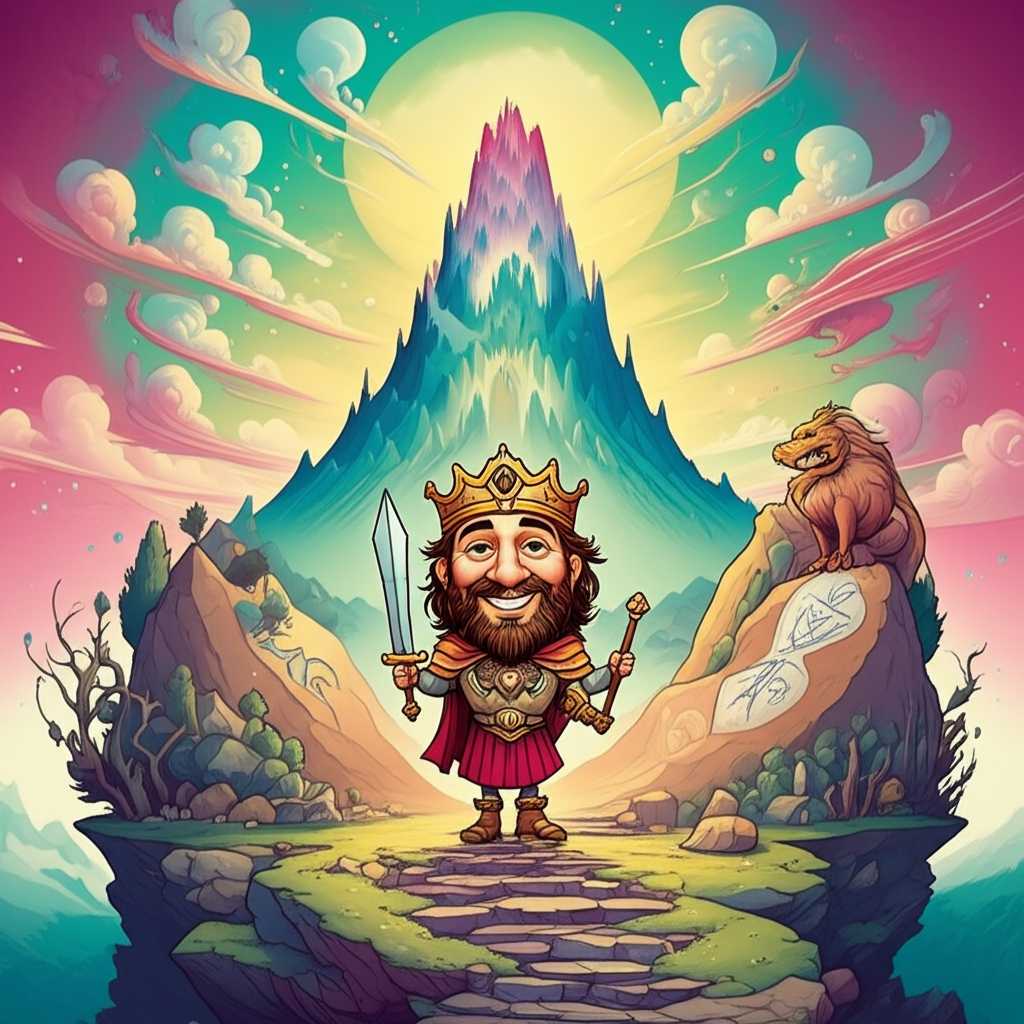
Dagda, ever the wise and responsible leader, knew that this quest fell to him. With his three mighty treasures – the ever-full Cauldron, the melodious Harp, and the formidable Club – he embarked upon his epic voyage. His path led him through ancient forests where gnarled trees whispered secrets of ages past, over towering mountains that scraped the clouds, and across barren plains where the wind howled like a mournful spirit. He faced trials of endurance, navigated treacherous landscapes, and outwitted cunning creatures, all the while guided by an inner knowing that drew him ever closer to the boundless horizon.
Finally, after what felt like an eternity, he stood upon the precipice of the world, where the land gave way to an ocean unlike any other. This was not merely water; it was the Eternal Sea, a shimmering expanse that stretched beyond all sight, beyond all time. Its surface was a kaleidoscope of every hue imaginable, yet its depths held an impenetrable darkness. It breathed with the rhythm of creation itself, a silent hum that vibrated through the very bones of the earth. Here, all things began, and to here, all things would return. It was the source of life, the keeper of wisdom, and the ultimate arbiter of fate.
Dagda, with his immense presence, approached the shore. He did not seek to conquer this primal force, for he understood its ancient majesty. Instead, he sought communion. He first brought forth his Cauldron of Plenty, offering its boundless sustenance not to consume, but as a symbolic gesture of reciprocity – a recognition that all life springs from the deep well of existence. The sea seemed to ripple in acknowledgment, its vastness reflecting the cauldron’s eternal generosity.
Then, he took up Uaithne, his wondrous Harp. With powerful, knowing hands, he struck its strings. The melody that flowed forth was not merely music; it was the song of creation, a symphony that echoed the pulse of the universe. It sang of the first dawn, the crash of primordial waves, the slow dance of the planets. The Harp’s notes resonated with the Eternal Sea, harmonizing with its ceaseless ebb and flow, calming its tumultuous currents, and inviting it to share its ancient wisdom. The sea responded with a gentle, rhythmic swell, as if listening intently, revealing glimpses of its profound depths through shimmering light.
Finally, Dagda raised his Lorg Mór, the Great Club. He did not wield it in aggression, but as a staff of authority and balance. He plunged its life-giving end into the shallows, and a vibrant energy surged through the water, invigorating the very essence of life within it. Then, he touched its death-dealing end to the surface, not to destroy, but to acknowledge the inevitable cycle of decay and renewal that the Eternal Sea oversaw. Through this act, Dagda affirmed the necessary balance of all things, demonstrating his understanding that life and death are but two sides of the same eternal coin, held in the vast embrace of the primordial waters.
Through this profound interaction, Dagda did not tame the Eternal Sea, nor did he gain dominion over it. Instead, he achieved a deep understanding, a cosmic harmony that resonated throughout the world. He returned to his people, not with a trophy, but with renewed wisdom and the reassurance that the balance of their world was restored, for he had communed with the very source of all existence.
Symbolism and Meaning
To the ancient Celts, the legend of Dagda and the Eternal Sea was far more than a fantastical tale. It was a profound reflection of their understanding of the cosmos, leadership, and the forces of nature. Dagda, with his benevolent strength and magical artifacts, symbolized the ideal leader – a provider, a protector, and a wise mediator between his people and the powerful, often mysterious, forces of the universe. He represented divine providence, the father figure who ensures the well-being of his community.
The Eternal Sea, in this context, was the ultimate metaphor for the unknown, the primordial source, and the cycle of all things. It embodied both the terrifying chaos and the serene order of existence, the boundless depths of the subconscious, and the thin boundary between the mortal and spiritual realms. It was the wellspring of life, the ultimate mystery, and the final destination of all. Dagda’s interaction with it, not through conquest but through respectful communion using his symbolic tools, conveyed the message that true power lies in understanding, balance, and harmony with the natural world, rather than dominance over it. The myth taught them about responsibility, the interconnectedness of life and death, and the enduring cycles that govern existence.
Modern Perspective
Today, the legend of Dagda and the Eternal Sea, like many Celtic myths, continues to captivate and inspire. It is interpreted not as a literal truth, but as a rich source of cultural heritage, psychological archetypes, and narrative frameworks. In literature, figures like Dagda often appear as archetypal wise kings or powerful mages in fantasy novels, influencing authors from J.R.R. Tolkien to Neil Gaiman. His artifacts – the cauldron, the harp, the club – have become recognizable symbols of power and destiny in popular culture, from video games to television series that draw upon mythological themes.
Academically, these myths are studied for their insights into ancient belief systems, societal structures, and the human psyche. They are celebrated for their poetic beauty and their ability to convey complex ideas through imaginative storytelling. In Ireland, these legends form a vital part of the national identity, inspiring art, music, and a thriving heritage tourism industry, allowing modern audiences to connect with the imaginative spirit of their ancestors.
Conclusion
The legend of Dagda and the Eternal Sea stands as a testament to the enduring power of human imagination and the universal tradition of storytelling. It is a vibrant cultural story, a window into the spiritual and philosophical world of ancient Celtic people, and not a belief to be worshipped or practiced. As Muslims, we recognize that there is only one true Creator and Sustainer of the universe, Allah (SWT), who is beyond all description and comparison, the Lord of all existence.
Yet, we can appreciate these cultural narratives for their historical significance, their educational value, and the profound ways they allowed ancient communities to make sense of their world, express their fears, celebrate their hopes, and transmit wisdom across generations. Such stories remind us of humanity’s innate desire to understand the mysteries of life and the cosmos, a quest that ultimately points to the ultimate reality of our Creator.