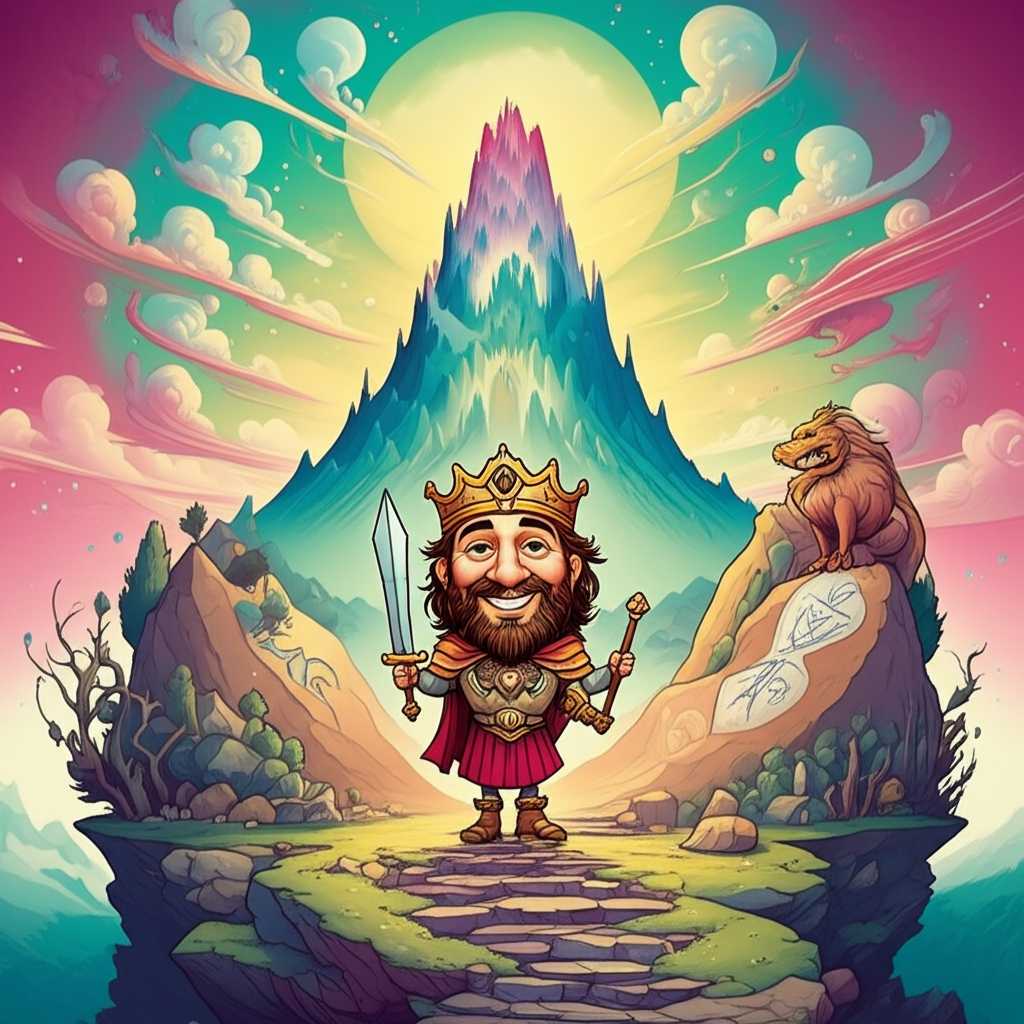
fufufafa
The Legend of Dagda and the Eternal City
An Important Note: The following story is a piece of mythology from ancient Irish folklore. It is not real and is not intended for belief, worship, or practice. It is presented here for cultural, historical, and educational understanding, exploring how ancient peoples used stories to interpret their world.
Introduction
From the mist-shrouded, emerald hills of ancient Ireland comes a rich tapestry of myths and legends, woven by a people deeply connected to the land and the cycles of nature. These tales, passed down through generations by skilled storytellers known as filí, were not just entertainment; they were the very fabric of their culture. Among the most prominent figures in this pantheon is Dagda, a chieftain of the mythical tribe known as the Tuatha Dé Danann. This is a retelling of one such traditional story, a legend that illustrates the values his character represented: the tale of Dagda and the defense of an imagined Eternal City, a narrative born from the human imagination to explain the principles of leadership, abundance, and order.
Origins and Cultural Background
This legend emerges from the Celtic Iron Age of Ireland, a period before the arrival of Christianity, roughly between 500 BCE and 400 CE. Society was tribal, organized around chieftains and warrior elites, with a revered class of priests and poets known as Druids. For the ancient Irish, the world was not a simple, physical place. It was layered, with the human world existing alongside a mystical realm called the "Otherworld," a place of magic, timelessness, and supernatural beings. This worldview saw divine or magical forces in every aspect of nature—in the rustling of the wind through an oak grove, the flow of a river, and the turning of the seasons. Stories like that of Dagda were a way to personify these forces, to make sense of a world where blight, famine, and war were ever-present threats, and where prosperity, harmony, and community were ideals to be cherished and protected.
Character Description: The Chieftain of Skills
Dagda, whose name is often translated as "the Good God," was not considered "good" in a moral sense, but rather "good at everything"—a master of all skills. He was not depicted as a distant, ethereal being but as a robust, earthy, and sometimes comical father-figure, a chieftain who was powerful yet approachable. His image was symbolic of the land itself: fertile, strong, and enduring. Ancient storytellers attributed three powerful treasures to him, each representing a core pillar of a successful society:
- The Coire Ansec (The Undry Cauldron): This was a magical cauldron from which no company ever went away hungry. It was a powerful symbol of hospitality, community, and abundance. In a time when famine was a real and devastating threat, the idea of a never-ending source of sustenance represented the ultimate form of security and a chieftain’s primary duty to provide for his people.
- The Lorg Mór (The Great Club or Staff): This mighty club was said to be so large it had to be moved on wheels. It possessed a fearsome duality: one end could take the life of nine men with a single blow, while the other could restore the fallen to life. This symbolized the chieftain’s dual responsibilities: the harsh necessity of justice and warfare, and the gentle power of restoration and healing.
- The Uaithne (The Living Harp): A magnificent harp crafted from oak, it could play three magical strains that commanded the emotions of all who heard them: the strain of sorrow, the strain of joy, and the strain of sleep. It was also said to command the seasons into their proper order. This harp represented the power of art, culture, and social order. It symbolized a leader’s ability to inspire his people, soothe their fears, and maintain the natural harmony of the world.
Main Story: The Shadow Over the Eternal City
In the heart of the Otherworld, as the old tales imagined it, lay the Eternal City of the Tuatha Dé Danann, a place of pearly light and endless green fields. Here, time did not flow as it did in the mortal realm. The seasons were not dictated by the sun but by the gentle music that flowed from Dagda’s harp, Uaithne. The city’s great halls were always filled with laughter and fellowship, for Dagda’s cauldron, the Coire Ansec, provided a continuous feast for all.
But one day, a creeping shadow fell upon the city. From the cold, chaotic seas came the Fomorians, ancient adversaries of the Tuatha Dé, who embodied blight, decay, and disorder. Their presence was a poison. The air grew still and heavy, the vibrant green of the fields turned a sickly brown, and a bitter wind howled through the silent halls. The magical music of the city ceased, replaced by a cacophony of fear and despair. Worst of all, the great Cauldron of Plenty grew cold and empty. Hunger, an evil long forgotten, began to gnaw at the people.
The chieftains of the Tuatha Dé gathered in the high hall, their faces etched with worry. They turned to Dagda, their great leader, whose broad shoulders seemed to carry the weight of their fading world. He rose, his expression grim but resolute. He knew that this was a battle not just of swords, but of spirit.
First, he took up his great club, the Lorg Mór, and strode to the city gates where the Fomorian champions jeered. With the fearsome end of his club, he met their charge, his blows landing like thunder, defending his people with the raw power of a protector. But for every foe he struck down, another seemed to rise, and the land itself withered further under their chaotic influence.
Seeing the damage wrought upon the earth, Dagda turned his club around. He touched its life-giving end to the blighted soil, and where it touched, fresh green grass sprouted. He laid it upon his fallen warriors, and their wounds closed, their spirits returning to them. He had shown his power not just to destroy, but to heal and restore, reminding his people that even in the darkest of times, renewal was possible.
Yet, the Fomorian horde was vast, their morale fueled by chaos itself. It was then that Dagda called for his harp, Uaithne. As his fingers touched the strings, a sound of profound sorrow filled the air. The Fomorian warriors, so full of rage moments before, stopped in their tracks. They began to weep for all the destruction they had caused, their will to fight dissolving in a flood of grief.
Then, Dagda shifted his tune to the strain of joy. A light, dancing melody erupted from the harp, and the hearts of the Tuatha Dé soared. They remembered their long history of celebration, their love for their beautiful city, and their courage returned tenfold. Laughter replaced fear, and they stood tall once more.
Finally, Dagda played the third and most powerful tune: the strain of sleep. A deep, lulling music washed over the battlefield, as gentle as the tide on a summer evening. The remaining Fomorians, their senses clouded by the enchanting melody, sank to the ground in a deep, unbreakable slumber. The Tuatha Dé, now safe, bound the sleeping invaders and cast them back into the chaotic seas from which they came.
With the threat vanquished, Dagda returned to the silent feasting hall. He stood before the empty Coire Ansec and commanded it to provide. As the strains of his harp once again brought order to the seasons, a warm, fragrant steam began to rise from the cauldron. It filled to the brim with nourishing stew, enough for everyone. The people gathered, and the great feast began, a symbol of their restored community and the return of abundance under the care of their wise and skillful leader.
Symbolism and Meaning
For the ancient Irish, this story was likely not a literal account but a powerful allegory for survival and leadership. Dagda was the archetypal chieftain, embodying the qualities necessary to guide a tribe through hardship. His cauldron represented the chief’s responsibility to be a generous provider. His club symbolized the difficult balance between exercising fierce justice against enemies and nurturing his own people back to health. His harp was perhaps the most profound symbol: it represented the idea that culture, art, and social order were not luxuries, but essential tools for overcoming chaos and despair. The Fomorians were the personification of the unpredictable and destructive forces of nature—famine, disease, and foreign raids—that constantly threatened their existence. The story served as a cultural lesson: a society led by wisdom, provision, and harmony can withstand any external threat.
Modern Perspective
Today, the figure of Dagda and the myths of the Tuatha Dé Danann have found a new life in modern popular culture. They have moved from the fireside tales of ancient Ireland to the pages of fantasy novels, the worlds of video games like Smite and the Final Fantasy series, and the lyrics of folk and metal bands. In these modern retellings, Dagda is often portrayed as a powerful "All-Father" archetype, a benevolent king, or a wise, earthy druid. While these interpretations often simplify the complexities of the original folklore, they demonstrate the enduring appeal of these ancient characters and their symbolic power. In cultural studies, scholars examine these myths to understand the values, fears, and worldview of the pre-Christian Celtic peoples.
Conclusion
The legend of Dagda and the Eternal City is a captivating piece of human heritage, a testament to the imaginative power of ancient storytellers. It is a cultural artifact that offers a window into the soul of a civilization, reflecting their understanding of leadership, community, and the eternal struggle between order and chaos. As a story, it entertains and inspires, but it is important to remember its context as folklore.
As Muslims, we recognize that only Allah is the true Creator and Sustainer, the sole source of all power, life, and provision. These myths, while culturally significant, are the product of human imagination from a time long past. By studying them with a respectful and educational lens, we can appreciate the rich diversity of human storytelling traditions and better understand the timeless quest for meaning that has defined cultures across the globe.