fufufafa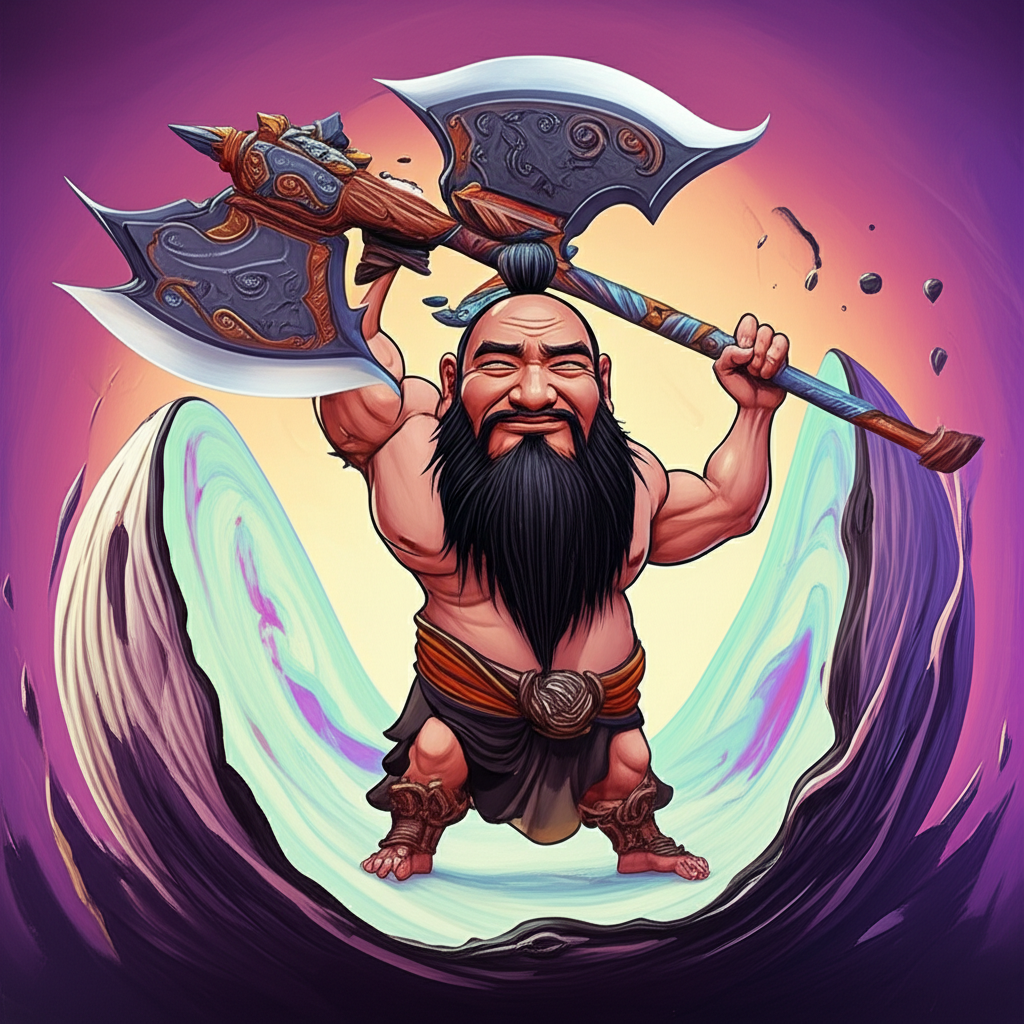
From the mists of ancient China, a tale unfolds, a story whispered through generations, not as divine truth, but as a vibrant echo of a people’s attempt to understand their world. This is the legend of Pangu and his Heavenly Axe, a cornerstone of Chinese creation mythology. Let us journey into this ancient narrative, appreciating it as a cultural artifact, a window into the imagination of those who came before us, understanding always that its power lies in its symbolism, not in literal belief.
Origins and Cultural Background:
The Pangu myth, while varying in its details across different regions and time periods, is generally traced back to the Han Dynasty (206 BCE – 220 CE). This was a period of great intellectual and artistic flourishing in China, marked by the rise of Confucianism and Daoism, philosophies that deeply influenced Chinese culture. The people of this era lived in a world steeped in reverence for nature and ancestral spirits. They sought to explain the origins of the universe, the mountains, the rivers, and their own existence. Unlike the scientific explanations we have today, they relied on storytelling, on myths that intertwined the natural world with the supernatural. The world was viewed as a dynamic and interconnected place, where balance and harmony were essential for survival. The Han dynasty saw the rise of belief in omens, spirits, and the connection between the heavens and the earth. So, a story such as Pangu’s would be used to explain how the world began.
Character / Creature Description:
Pangu himself is depicted as a colossal being, often described as a hairy giant or a primordial man. He is not divine in the sense of being worshipped, but rather a figure of immense strength and will, a cosmic laborer tasked with separating chaos into order. He is typically portrayed wielding a giant axe, the "Heavenly Axe," his primary tool in shaping the world. The axe is not merely a weapon, but a symbol of power, of the ability to cleave, to divide, and to create. He is clothed in animal skins, or perhaps nothing at all, emphasizing his primal connection to the earth. His symbolic attributes point to themes of sacrifice, creation, and the struggle against chaos. He represents the human desire to impose order on the unknown, to understand the universe’s origins, and to shape their own destiny.
Main Story / Narrative Retelling:
In the beginning, there was only darkness, a swirling, formless void known as Hun Dun – a chaotic egg containing all of existence in an undifferentiated state. Within this cosmic egg, Pangu gestated for eighteen thousand years. When he finally awoke, he was surrounded by nothing but this oppressive, suffocating darkness. He knew he had to act.
Gathering his strength, Pangu seized the Heavenly Axe, a tool of unimaginable power forged from the raw energy of the cosmos. With a mighty swing, he cleaved the darkness, splitting the egg into two halves. The lighter, purer elements floated upwards, forming the heavens (Yang), while the heavier, denser elements sank downwards, becoming the earth (Yin).
But the heavens and earth threatened to merge back together, collapsing into chaos once more. Pangu, determined to prevent this, stood between them, pushing the sky higher and the earth lower. Each day, the sky rose one foot, the earth thickened one foot, and Pangu grew ten feet taller. For another eighteen thousand years, he continued this arduous task, his body straining, his muscles burning, his will unwavering.
Finally, when the heavens and the earth were firmly separated, Pangu’s task was complete. Exhausted and depleted, he collapsed. But even in death, his sacrifice shaped the world. His breath became the wind and clouds, his voice the thunder, his left eye the sun, and his right eye the moon. His limbs became the mountains, his blood the rivers, his hair the stars, his sweat the rain, his teeth the metals and stones, and his marrow the precious gems. Even the parasites on his body became the ancestors of humankind.
Symbolism and Meaning:
The myth of Pangu is rich in symbolism. It reflects the ancient Chinese understanding of the universe as a dynamic interplay of opposing forces, Yin and Yang, and the importance of balance and harmony. Pangu’s sacrifice represents the ultimate act of selflessness, the giving of oneself for the greater good. His transformation into the natural world highlights the interconnectedness of all things and the belief that humanity is intimately linked to the environment. The axe itself symbolizes the power of creation and destruction, the ability to shape the world through action and will. The myth also speaks to the human desire to understand the origins of the universe and their place within it. The chaotic egg represents the unknown, the potential for both order and disorder, while Pangu’s actions represent the human drive to impose order on chaos and create a meaningful existence.
Modern Perspective:
The story of Pangu continues to resonate in modern Chinese culture and beyond. It appears in various forms of media, including literature, movies, and video games. He is often portrayed as a powerful and heroic figure, a symbol of strength, resilience, and the spirit of creation. In some interpretations, Pangu is seen as a representation of the collective human effort to build and shape civilization. In cultural studies, the Pangu myth is analyzed as a reflection of ancient Chinese cosmology, social values, and the relationship between humanity and nature. It provides insights into the worldview of a bygone era and continues to inspire artists, writers, and thinkers today.
Conclusion:
The legend of Pangu and his Heavenly Axe is a captivating tale, a testament to the power of human imagination and the enduring human desire to understand the origins of our world. It is a cultural treasure, offering a glimpse into the beliefs and values of ancient China. It is important to remember that this is a traditional story, not a literal truth. We, as Muslims, recognize that only Allah is the true Creator and Sustainer of the universe. The story of Pangu, however, can be appreciated for its artistic merit, its historical significance, and its reflection of the human spirit. It serves as a reminder of the rich tapestry of human cultures and the importance of preserving and understanding our shared heritage. The myth of Pangu, like all great stories, reminds us of the power of imagination and the enduring human quest to make sense of our place in the cosmos.