fufufafa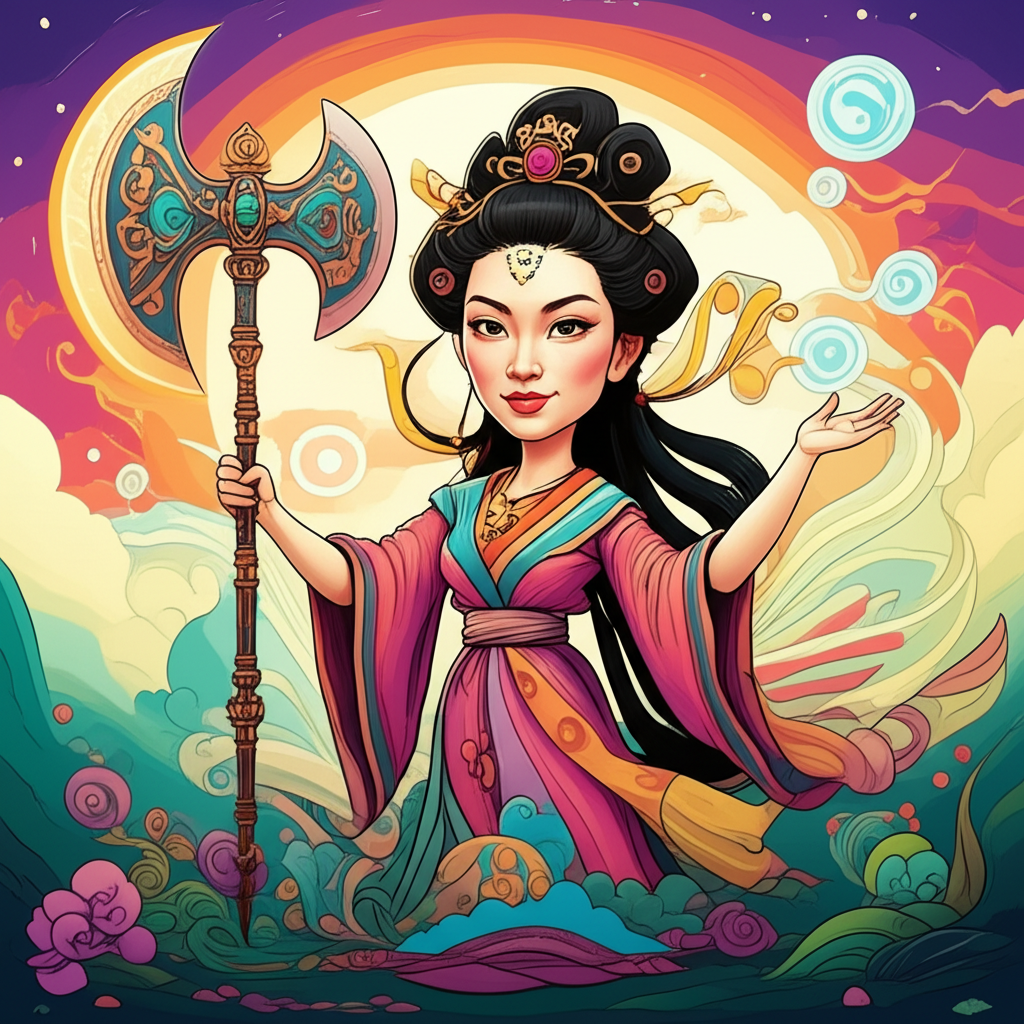
The tapestry of human civilization is richly woven with tales of creation, destruction, and restoration, passed down through generations. Among these profound narratives are the ancient myths of China, which offer a window into the cosmological understandings and moral frameworks of its earliest inhabitants. One such captivating legend, deeply rooted in the heart of Chinese mythology, speaks of the revered figure of Nuwa and, in some interpretations, the symbolic "Heavenly Axe"—an embodiment of her immense power to shape and repair the nascent world. It is crucial to understand that this is a traditional story, a product of human imagination and ancient wisdom, not a factual account or a basis for belief.
Origins and Cultural Background: A World Shaped by Myth
This legend emerges from a period of profound antiquity in China, long before recorded history, when early communities lived in close communion with nature. In this era, societies were predominantly agrarian, their lives intricately tied to the rhythms of the seasons, the fertility of the land, and the unpredictable forces of floods, droughts, and earthquakes. For these ancient people, the world was not a realm governed by scientific principles as we understand them today, but a living entity, animated by powerful, often capricious, spirits and deities.
Their worldview was characterized by a search for order amidst chaos, a desire to explain the inexplicable, and to find meaning in the grandeur and terror of the natural world. The heavens, the earth, and all living things were believed to be interconnected, their existence often attributed to the actions of divine or semi-divine beings. Myths served not only as entertainment but also as explanations for the origins of the cosmos, the human race, and the moral principles that guided daily life, offering comfort, guidance, and a sense of belonging in a vast and often bewildering universe.
Nuwa: The Serpentine Mother of Humanity
At the heart of many foundational Chinese myths stands Nuwa, a revered figure often depicted with the upper body of a human and the lower body of a serpent or dragon. She is not presented as an object of worship in the modern sense, but rather as a symbolic representation of primal creative force, nurturing motherhood, and cosmic order. Her serpentine form often symbolized her connection to both the earth (as a creature of the ground) and the divine (as a powerful, ancient being), bridging the mortal and immortal realms.
Nuwa is traditionally known as the creator of humanity, who, feeling lonely in a pristine but empty world, fashioned people from yellow clay. She is also celebrated as the ultimate restorer, the one who repaired the broken cosmos after a cataclysmic event. Her attributes include compassion, ingenuity, and an unwavering determination to protect her creations. The "Heavenly Axe," in this context, is not always a literal physical tool she wielded but can be understood as a powerful conceptual extension of her divine will and capability—a metaphorical instrument of cosmic magnitude, representing her power to cleave chaos, sculpt reality, and re-establish equilibrium. It embodies the sheer force and precision required to mend the very fabric of existence.
The Great Cataclysm and the Power of the Heavenly Axe
The narrative of Nuwa’s greatest trial begins after she had lovingly populated the earth with humans. For a time, peace reigned, and her creations flourished. However, this tranquility was shattered by a devastating cosmic battle between two powerful deities, Gonggong, the god of water, and Zhuanxu, the god of fire. In their furious struggle, Gonggong, defeated and enraged, smashed his head against Buzhou Mountain, one of the four pillars holding up the sky.
The impact was catastrophic. The pillar crumbled, tearing a gaping hole in the heavens. The firmament itself ripped open, exposing the world to a torrent of celestial fire and water. The earth cracked and fractured, unleashing floods that drowned vast lands and fires that scorched what remained. Ferocious beasts and monstrous creatures emerged from the chaos, preying upon the terrified humans. The world tilted, the sun, moon, and stars veering off course, plunging everything into unprecedented turmoil.
Nuwa, witnessing the suffering of her beloved creations, was filled with profound sorrow and resolve. She knew that the world, as it was, could not endure. To repair such a monumental cosmic rupture, she needed a tool that could command the very elements, a force capable of cleaving chaos and shaping creation anew. It was in this moment of dire necessity, when the world hung by a thread, that the concept of the Heavenly Axe, representing the apex of her divine power, came into being. This was not merely an axe of metal or stone, but an embodiment of cosmic will, a tool forged from the essence of creation itself, capable of cutting through the veil of disaster and re-establishing order.
With the metaphorical power of this "Heavenly Axe," Nuwa embarked on her monumental task. First, she traversed the lands, gathering various colored stones—yellow, blue, red, white, and black—each imbued with the essence of the five elements. She then melted these stones in a great furnace, their molten hues blending into a brilliant, malleable substance. With the guiding precision of her "Heavenly Axe," she then patched the gaping hole in the sky, sealing the celestial breach and stopping the deluge of fire and water. The sky, though forever slightly tilted, was whole once more.
Next, the earth needed stabilization. The "Heavenly Axe" was again conceptually wielded, not for destruction, but for repurposing. Nuwa found a giant turtle, Ao, whose legs were immense and sturdy. She cut off Ao’s four legs, using them as new pillars to support the four corners of the sky, firmly anchoring the heavens and preventing the earth from tilting further. Finally, with the same conceptual power, she quelled the rampaging floods, bound the raging fires, and drove away the monstrous beasts, restoring a semblance of balance to the devastated world.
Symbolism and Meaning: A Blueprint for Humanity
To the ancient Chinese, the myth of Nuwa and her world-repairing power, represented by the "Heavenly Axe," was rich with profound symbolism. It first and foremost established Nuwa as a benevolent mother figure, the protector and sustainer of humanity, emphasizing themes of creation, care, and sacrifice. Her actions symbolized the triumph of order over chaos, a fundamental philosophical concept in ancient Chinese thought, underscoring the importance of balance and harmony in the cosmos and within human society.
The "Heavenly Axe" itself, as a concept, symbolized the ultimate power to shape and restore. It represented the divine authority to impose form on formlessness, to mend the broken, and to establish new foundations. It spoke of ingenuity and resilience, demonstrating that even in the face of utter devastation, repair and renewal are possible through determined effort and extraordinary power. The story also served as an explanation for natural phenomena, such as the slightly tilted sky (which explains why Chinese rivers often flow eastward) and the presence of mountains and valleys, attributing them to the grand, transformative acts of a deity. Morally, it might have instilled a sense of humanity’s vulnerability and dependence on higher forces, while also celebrating the spirit of perseverance.
Modern Perspectives: Echoes in Contemporary Culture
In contemporary times, the myth of Nuwa continues to resonate, not as a religious doctrine, but as a rich vein of cultural heritage. Her story, along with the symbolic power of the "Heavenly Axe" or similar tools of creation and repair, finds new life in various forms of modern media. She appears as a powerful character in fantasy literature, inspiring narratives of cosmic battles and heroic restoration. In video games, Nuwa is often depicted as a deity with immense magical abilities, capable of shaping landscapes and wielding elemental powers, embodying the creative and destructive forces of nature. Movies and animated series occasionally draw inspiration from her tale, using her as a symbol of resilience, environmental protection, or the enduring maternal spirit.
Academically, cultural studies and folklore scholars analyze the Nuwa myth for its insights into ancient Chinese cosmology, societal values, and the role of female deities in early pantheons. It is examined for its reflections on humanity’s relationship with the natural world, concepts of gender, and the universal human quest for meaning and order in a chaotic universe.
Conclusion: A Cultural Narrative, Not a Creed
The legend of Nuwa and the conceptual power of the "Heavenly Axe" remains a potent cultural narrative, a testament to the vivid imagination and deep philosophical insights of ancient Chinese civilization. It is a story to be appreciated for its historical significance, its artistic beauty, and its profound symbolic meaning, offering valuable lessons about resilience, creation, and the eternal human quest for order.
As Muslims, we recognize that Allah (SWT) alone is the true Creator and Sustainer of all existence, the One who fashioned the heavens and the earth with perfect wisdom and power, and to whom all praise and glory belong. This understanding underpins our belief in the singularity of divine authority. The "Heavenly Axe" of Nuwa, therefore, stands as a cultural artifact of human storytelling—a magnificent creation of the human mind, reflecting humanity’s ancient attempts to comprehend the world around them through narrative. It reminds us of the enduring power of myth to shape cultural identity, spark imagination, and transmit values across countless generations, connecting us to the rich tapestry of human history and creativity.