fufufafa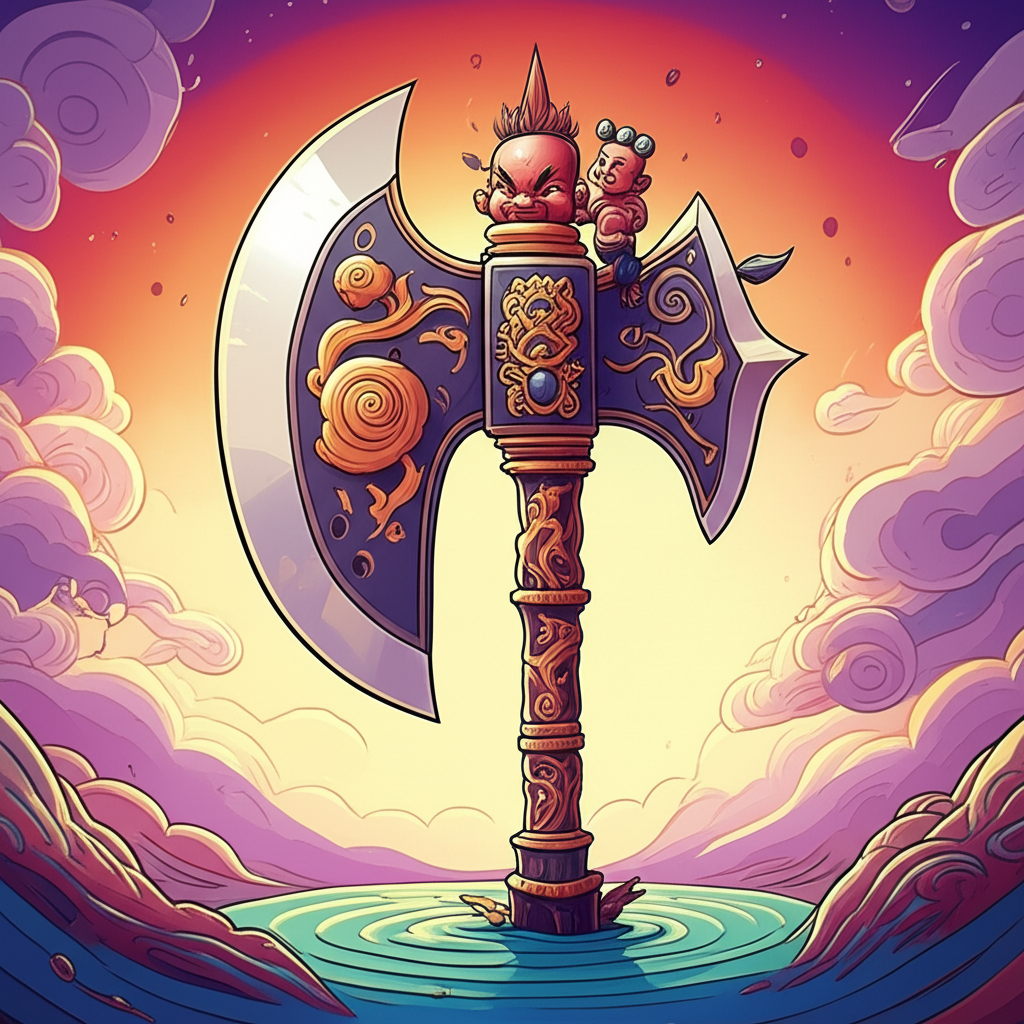
Origins and Cultural Background
The myth of Fuxi and his Heavenly Axe emerges from a period in ancient China often referred to as the era of the Three Sovereigns and Five Emperors, a legendary age preceding the establishment of verifiable dynasties. This was a time when humanity was thought to be nascent, struggling against the raw, untamed forces of nature. The environment was harsh and unpredictable; devastating floods routinely reshaped the landscape, mountains stood as insurmountable barriers, and wild beasts roamed freely. Life was a constant battle for survival, marked by the need for shelter, sustenance, and protection from the elements.
In this primal world, the people viewed their surroundings with a blend of awe and fear. They believed that natural phenomena – the sun, moon, rivers, and mountains – possessed spirits or were manifestations of divine will. There was a deep-seated desire for order, for a way to tame the chaos and bring structure to their lives. It was within this context of struggle, yearning for knowledge, and the belief in cosmic forces that figures like Fuxi rose in myth, embodying humanity’s innate drive to overcome adversity and shape their destiny. These stories served not only to explain the origins of their world but also to impart wisdom, moral guidance, and a sense of shared heritage.
Character Description: Fuxi and the Heavenly Axe
At the heart of this particular myth stands Fuxi, a revered figure in Chinese mythology, often considered one of the Three Sovereigns. He is depicted as a culture hero, a benevolent sage-king who bestowed upon humanity the foundational elements of civilization. Legend describes Fuxi with a human head and the body of a serpent or dragon, symbolizing his profound connection to both the earthly realm and the celestial heavens, embodying wisdom, power, and a primordial link to the cosmos. He is credited with inventing fishing, hunting tools, animal husbandry, writing (specifically the eight trigrams, or Bagua, a system of divination), music, and marriage rites. His attributes are symbolic of human ingenuity and the dawn of organized society, rather than being literal divine powers. He represents the transition from a primitive, chaotic existence to an ordered, civilized way of life.
Central to his legend, and indeed to the "Curse of Fuxi," is the Heavenly Axe. This artifact is not a sentient being, but a mythical tool of unimaginable power, forged from the very essence of creation, or perhaps gifted by celestial beings. It is described as glowing with an inner light, its edge capable of cleaving through the hardest rock and its mass able to command the flow of waters. Symbolically, the Axe represents the pinnacle of transformative power, the means by which Fuxi was able to literally reshape the world, bringing form to the formless and order to the chaotic. It is an emblem of human ambition and the potent, yet sometimes perilous, consequences of wielding immense influence over nature.
Main Story: The Burden of the Heavenly Axe
In the nascent days of the world, before the rivers ran in their settled courses and the mountains stood as grand monuments, chaos reigned supreme. The land was a tempestuous expanse, perpetually reshaped by raging floods and jagged, untamed peaks. Humanity, few in number, huddled in fear, their lives dictated by the capricious whims of nature. Crops were routinely swept away, settlements submerged, and the very ground beneath their feet seemed to rebel against any attempt at permanence.
It was during these dire times that Fuxi, the wise and compassionate sage, looked upon his suffering people with a heavy heart. He understood that for humanity to truly flourish, the world itself needed to be ordered, its wild energies harnessed. Guided by an innate wisdom and a profound sense of purpose, Fuxi embarked on a quest for a tool that could bring balance to the tumultuous world.
The legends whisper of how Fuxi ascended to the highest celestial peaks, or perhaps delved into the deepest caverns where the world’s raw elements converged. There, through immense effort and guided by celestial inspiration, he either forged or discovered the Heavenly Axe. It was a tool unlike any other, its blade shimmering with the condensed light of stars, its haft resonating with the primal hum of the earth. With the Heavenly Axe in his grasp, Fuxi descended, ready to embark on his grand task.
With each swing of the Heavenly Axe, the world began to transform. He struck at the soaring, chaotic mountains, cleaving them apart to form valleys and plains where people could dwell and cultivate the land. He redirected the rampaging rivers, carving deep channels for them to flow peacefully towards the sea, thus taming the destructive floods that had plagued humanity for so long. He leveled uneven terrain, creating pathways and stable ground for communities to thrive. The Heavenly Axe was an instrument of immense creation, reshaping the very geography of the world, bringing forth a semblance of order and habitability.
However, the legends also speak of a profound consequence, a lingering burden that became known as the "Curse of Fuxi." It was not a malevolent spell, nor a divine punishment in the traditional sense, but rather an inherent cost of wielding such transformative power. As Fuxi reshaped the world, imposing his will upon its wildness, he inadvertently fragmented its primal unity. Each mountain carved, each river channeled, each forest cleared, while bringing order, also created divisions, boundaries, and a subtle separation between humanity and the pristine, untamed essence of nature.
The "curse" manifested as an eternal vigilance, a ceaseless responsibility. By establishing order, Fuxi had not eradicated chaos but merely organized it, pushing it to the fringes. The Axe’s power, once unleashed, seemed to demand continuous intervention. Fuxi, and by extension, his successors and all of humanity, were now burdened with the endless task of maintaining this delicate balance. The world, once shaped, required constant tending, protection, and correction. The "curse" was the realization that the work of creation was never truly finished, that the act of imposing order forever bound the creator to its upkeep, a perpetual struggle against entropy and the resurgence of chaos. It was the weight of progress, the unintended consequence of transforming a wild world into a civilized one – a ceaseless cycle of construction, decay, and reconstruction, mirroring the ongoing challenges of leadership and governance.
Symbolism and Meaning
To the ancient Chinese, the myth of Fuxi and the Heavenly Axe was rich with profound symbolism. Fuxi himself embodied the ideals of wise leadership, human ingenuity, and the aspiration to bring order from chaos. He represented the pivotal transition of humanity from a primitive state of survival to one of civilization and cultural development. The Heavenly Axe symbolized immense power, not just physical strength but also the power of innovation, of tools, and of human will to overcome natural obstacles. It reflected the belief that humans, with the right knowledge and instruments, could profoundly impact their environment.
The "Curse of Fuxi" offered a deeper philosophical insight. It wasn’t about divine retribution but about the inherent consequences of wielding great power and fundamentally altering the natural world. It represented the "double-edged sword" of progress: while civilization brought comfort and security, it also brought new challenges and an ongoing responsibility. To the ancient people, this part of the story likely served as a cautionary tale about the burden of leadership, the endless nature of stewardship, and the subtle, often unforeseen, prices paid for transforming their world. It underscored the idea that even the most benevolent acts of creation could lead to perpetual vigilance and an enduring struggle against the forces that seek to undo order, a reflection of their own daily battles against nature and the challenges of governance.
Modern Perspective
Today, the myth of Fuxi and the Heavenly Axe continues to resonate, though its interpretation has shifted from a literal explanation of the world to a valuable cultural and literary artifact. In modern literature, fantasy novels, and video games, the Heavenly Axe might appear as a powerful, world-shaping artifact, often imbued with both immense power and a challenging cost or burden for its wielder, mirroring the original "curse." Fuxi, as an archetype, inspires characters who are culture-bringers, wise leaders, or figures who struggle with the responsibilities of their transformative abilities.
Culturally, these myths provide crucial insights into the worldview of ancient Chinese civilization, their relationship with nature, their understanding of leadership, and their foundational philosophical concepts. They are studied in cultural and historical contexts to understand the evolution of human thought, storytelling traditions, and the enduring themes that shape human experience, such as the desire for order, the impact of technology, and the responsibilities that come with power.
Conclusion
The tale of "The Heavenly Axe: Curse of Fuxi" stands as a powerful testament to the human imagination and the enduring tradition of storytelling. It is a cultural narrative from ancient China, woven from the aspirations, fears, and wisdom of a people striving to understand their world and their place within it. It is important to remember that this is a myth, a legend, and not a factual account or a basis for belief.
As Muslims, we recognize that the true Creator and Sustainer of the heavens and the earth, and all that is in between, is Allah alone. He is the One who fashioned the world with perfect order and wisdom, and to Him belongs all power and dominion. While these mythological narratives are products of human creativity and cultural heritage, they ultimately point to the innate human desire to comprehend creation and existence, a desire that finds its ultimate fulfillment in the recognition of the One True God. This story, therefore, serves as a valuable window into the cultural heritage of humanity, reminding us of the profound impact of imagination and the timeless power of narratives to shape understanding and preserve the legacies of ancient civilizations.