
 fufufafa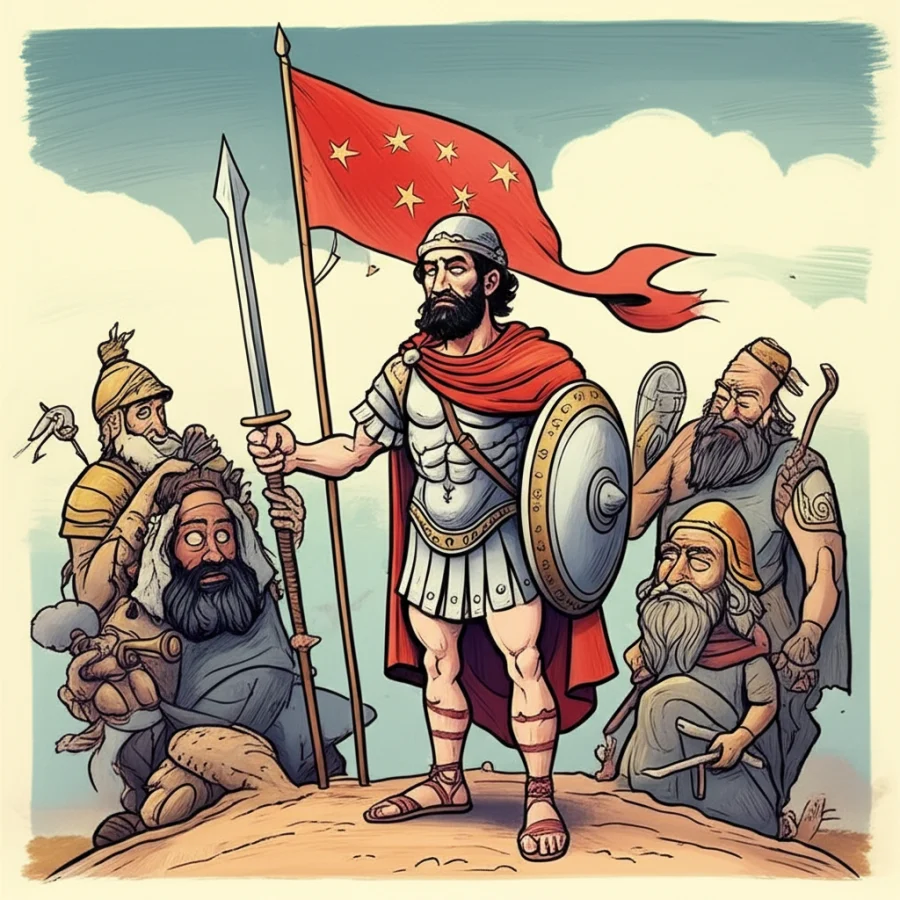
The winds that whisper through the ancient ruins of Rome carry echoes of stories, tales spun by generations of people who sought to understand their origins, their gods, and their place in the cosmos. Among these, the legend of Aeneas and his fabled trial on Palatine Hill stands as a potent narrative from the rich tapestry of Greco-Roman mythology. This is not a chronicle of historical fact, but a vibrant myth, a creation of ancient imaginations that sought to forge a grand destiny for the Roman people.
The story of Aeneas originates from the oral traditions and later written epics of ancient Greece and Rome. It gained prominence with Virgil’s Aeneid, a monumental work commissioned by Emperor Augustus to legitimize his rule and connect his lineage to the heroic past. This myth was deeply embedded in a world where the divine was understood to actively participate in human affairs, where omens were read in the flight of birds, and where the fates of mortals were inextricably linked to the whims of powerful, anthropomorphic deities. In the cultural milieu of the late Roman Republic and early Empire, a time of vast expansion and political upheaval, myths like Aeneas’s served as powerful tools for shaping identity, reinforcing civic virtue, and providing a sense of divine sanction for Rome’s burgeoning power. The world was seen as a stage where gods and heroes played out dramas that had profound consequences for humankind, and the Romans, in their ambitious pursuit of empire, found a potent ancestor in the Trojan hero who was destined to found their city.
Central to this narrative is Aeneas himself, a figure who, in the context of the myth, embodies a complex blend of divine heritage and human vulnerability. He is the son of the goddess Venus and the mortal Anchises, a prince of Troy. This dual parentage imbues him with a certain gravitas, suggesting a destiny woven by both the celestial and the terrestrial realms. Symbolically, Aeneas represents piety (pietas), a deep sense of duty towards the gods, his family, and his people. He is also a wanderer, a refugee carrying the embers of a fallen civilization, tasked with a monumental mission of founding a new home. His journeys are fraught with peril, testing his resolve and his faith in the divine pronouncements that guide him. He is not a god himself, but a hero chosen to undertake a task of immense significance, a mortal imbued with divine favor and burdened by an extraordinary destiny.
The "Trial of Palatine Hill," as it is envisioned within the broader epic of Aeneas’s journey, is not a singular, distinct event in the way a court trial might be. Instead, it represents a culmination of trials and tribulations that ultimately lead to Aeneas establishing his settlement in Latium, the region that would become the heartland of Rome. After the devastating fall of Troy, Aeneas is divinely commanded to flee his burning city and sail westward to Italy, where his descendants will one day establish a great empire. His journey is a harrowing odyssey, filled with storms, encounters with mythical creatures, and the constant threat of losing his way or his purpose.
Upon reaching the shores of Latium, Aeneas faces a new set of challenges. He must contend with local kings, notably Turnus, the prince of the Rutuli, who views the arrival of the Trojans as an invasion and a threat to his own established power and his betrothal to the princess Lavinia. The land itself, teeming with both beauty and danger, can be seen as a metaphorical "Palatine Hill," a place of immense potential but also of fierce competition and inherent risks.
The trials Aeneas endures on this new land are not about legal pronouncements but about proving his worthiness, his leadership, and his divinely ordained right to settle. He must forge alliances with indigenous tribes, navigate complex political landscapes, and engage in fierce battles to defend his claim. The "trial" is the very act of establishing a foothold, of overcoming the obstacles placed before him by both human adversaries and the natural world. It is a test of his pietas, his unwavering devotion to his divine mission and his people, and his ability to translate the promises of the gods into tangible reality. Imagine the scene: Aeneas, weary from his sea voyage, stands on the unfamiliar shores, the weight of Troy’s memory and the hope of a new future pressing upon him. The land is fertile, promising, but also guarded by fierce inhabitants. His trial is the constant struggle to build, to defend, to persuade, and to ultimately lay the foundations for a civilization that will one day dominate the Mediterranean. It is a trial of perseverance, of diplomacy, and of martial prowess, all undertaken under the watchful eyes of the gods who have set him on this path.
The symbolism within this myth is multifaceted. The journey itself represents the arduous path of nation-building, the immense effort and sacrifice required to establish a new civilization. The trials on the land symbolize the inherent challenges of settling new territories, the need for strength, wisdom, and the ability to integrate with existing populations. Palatine Hill, the eventual site of Rome’s founding, becomes a potent symbol of destiny and divine favor. It represents a sacred space, chosen by the gods for the establishment of a great power. Aeneas’s struggles and eventual success embody the Roman ideal of overcoming adversity through virtue and divine guidance. The myth also speaks to the concept of fate and destiny, suggesting that Rome’s eventual dominance was not a mere accident but a preordained outcome.
In the modern world, the story of Aeneas continues to resonate. Virgil’s Aeneid remains a cornerstone of classical literature, studied for its poetic grandeur and its profound exploration of themes like duty, exile, and the founding of nations. The myth has inspired countless works of art, literature, and even video games, offering fertile ground for imaginative storytelling. Scholars of cultural studies analyze it to understand Roman identity formation, the power of propaganda, and the ways in which ancient societies constructed their past. The archetypes of the exiled hero, the divine mission, and the founding of a new civilization remain potent narrative devices.
In conclusion, the legend of Aeneas and his trials on the land that would become Palatine Hill is a profound piece of ancient storytelling. It is a testament to the enduring human impulse to understand origins, to grapple with destiny, and to weave narratives of grand purpose. As Muslims, we recognize that only Allah is the true Creator and Sustainer, and that all narratives, however compelling, are ultimately human creations. Yet, these stories hold immense value in understanding the cultural heritage of humanity, the evolution of imagination, and the powerful tradition of storytelling that has shaped civilizations for millennia. The whispers of Aeneas’s journey, carried on the winds of time, remind us of the rich tapestry of human thought and the enduring power of a well-told tale.







