
 fufufafa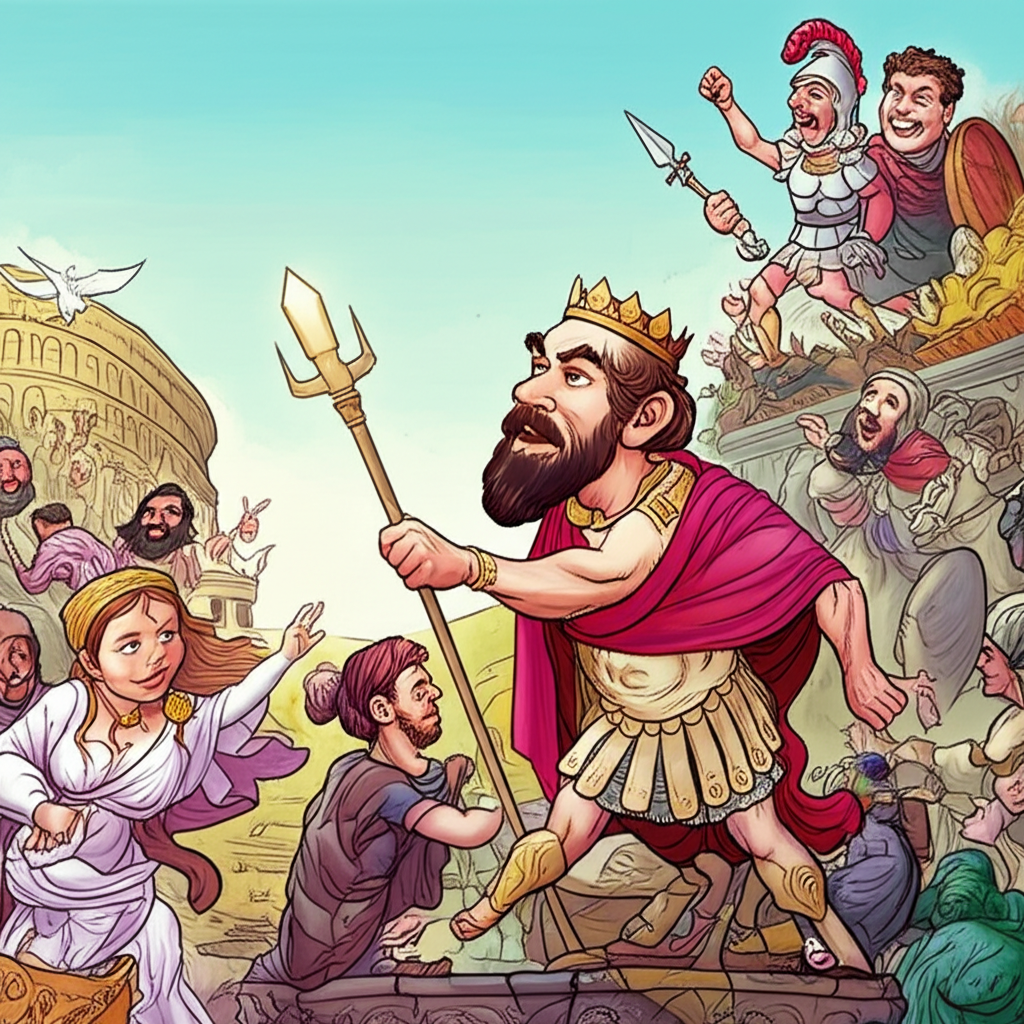
Introduction:
The legend of the founding of Rome is one of the most enduring narratives from ancient Roman mythology. Rooted in the traditions of the Italic peoples who inhabited the Italian peninsula centuries before the rise of the Roman Empire, this story, passed down through generations via oral tradition and eventually written down by historians and poets like Livy and Virgil, tells of gods, heroes, and the fateful events that led to the establishment of the city that would one day dominate the Mediterranean world. This is a traditional story, meant to be understood as a cultural artifact reflecting the values and beliefs of the ancient Romans, not as a statement of historical fact or divine truth.
Origins and Cultural Background:
The Roman foundation myth emerged in a society deeply influenced by agriculture, warfare, and a complex system of religious beliefs. The era, spanning from the early Iron Age (around 1000 BCE) to the rise of the Roman Republic (around 500 BCE), was characterized by the constant struggle for land and resources amongst various tribes and settlements in the Latium region. The Romans, like other ancient peoples, viewed the world as populated by powerful deities who intervened in human affairs. They believed in a pantheon of gods and goddesses, each with their own domains and personalities, who could bring fortune or disaster depending on their favor. Their understanding of causality was intertwined with divine agency; natural phenomena, military victories, and even personal successes were often attributed to the intervention of the gods. Fate, fatum, was a powerful concept, believed to govern the lives of individuals and the destinies of nations. The myth of Romulus and Remus, therefore, provided a divine mandate for Rome’s existence and explained its rise to power as the fulfillment of a predetermined destiny.
Character Description: Avernus
While not a character in the traditional sense, Avernus plays a crucial, if indirect, role in the events that led to the founding of Rome. Avernus (Latin: Avernus lacus) was a volcanic crater lake located near Cumae, in the Campania region of Italy. It was believed by the Romans to be an entrance to the Underworld. The name "Avernus" likely derives from the Greek aornos, meaning "birdless," a testament to the lake’s noxious fumes, which were said to be so poisonous that they killed any bird that flew over it.
In Roman mythology, Avernus was more than just a geographical location; it was a symbolic representation of death, the unknown, and the boundary between the mortal and the divine. The dark, brooding waters and the sulphurous smells evoked a sense of dread and mystery. It was a place of pilgrimage for those seeking to communicate with the dead, a gateway to the realm ruled by Pluto, god of the Underworld. While Romulus and Remus themselves did not directly encounter Avernus, the broader context of Roman beliefs about the Underworld and its influence on the world of the living shaped their story. The presence of Avernus underscored the Roman preoccupation with mortality and the cyclical nature of life and death, themes that are interwoven into the very fabric of the foundation myth.
Main Story / Narrative Retelling:
Centuries before the rise of Rome, in the ancient city of Alba Longa, ruled a king named Numitor. His ambitious and ruthless brother, Amulius, seized the throne, banishing Numitor and forcing his daughter, Rhea Silvia, to become a Vestal Virgin, a priestess sworn to chastity, thus preventing her from bearing any potential heirs to the throne.
However, the god Mars, captivated by Rhea Silvia’s beauty, visited her in secret. From their union were born twin boys, Romulus and Remus. Enraged, Amulius ordered the infants to be drowned in the Tiber River. The servants, however, took pity on the children and placed them in a basket, hoping they would find salvation downstream.
The Tiber, swollen by the winter rains, carried the basket far. By chance, it landed near the foot of the Palatine Hill, where a she-wolf, Lupa, had recently lost her cubs. Moved by the cries of the infants, the she-wolf suckled them and protected them from the elements. A woodpecker, sacred to Mars, also brought them food.
Eventually, a shepherd named Faustulus discovered the twins and, with his wife Acca Larentia, raised them as his own. Romulus and Remus grew into strong and courageous young men, skilled in hunting and leadership. They learned of their true lineage and, burning with righteous anger, they rallied their followers and overthrew Amulius, restoring Numitor to his rightful place on the throne of Alba Longa.
However, the twins were not content to remain in Alba Longa. They yearned to found their own city. They chose a location near the place where they had been rescued, but disagreement arose over which of the seven hills the new city should be built upon. Romulus favored the Palatine Hill, while Remus preferred the Aventine. To settle the dispute, they decided to consult the gods through augury – observing the flight of birds.
Remus claimed to have seen six vultures first, but Romulus later saw twelve. Each claimed victory, arguing that their interpretation was the correct one. The disagreement escalated into a violent quarrel. In a fit of rage, Romulus killed his brother Remus.
Overcome with grief and remorse, Romulus buried Remus on the Aventine Hill. Then, with heavy heart, he began the construction of his city on the Palatine. He plowed a furrow around the hill, marking the sacred boundary, the pomerium. Rome was founded. Romulus became its first king, and the city was named after him.
Symbolism and Meaning:
The myth of Romulus and Remus is rich in symbolism. The she-wolf symbolizes the wild, untamed forces of nature, but also maternal care and protection. The woodpecker, sacred to Mars, represents divine intervention and the connection between the gods and the mortal world. The fratricide, the killing of Remus by Romulus, is often interpreted as a representation of the inherent violence and conflict involved in the founding of any nation. It also highlights the importance of strong leadership and the need for decisive action, even if it requires sacrifice. The act of plowing the pomerium symbolizes the creation of order out of chaos and the establishment of a defined territory and a set of laws. Ultimately, the myth served to legitimize Rome’s power and expansion, portraying it as a city destined for greatness, founded by the son of a god and blessed by the divine.
Modern Perspective:
The myth of Romulus and Remus continues to resonate in modern culture. The image of the she-wolf suckling the twins remains a powerful symbol of Rome, appearing on coins, statues, and other emblems. The story has been retold in countless books, films, and television shows. It serves as a source of inspiration for artists, writers, and filmmakers who are drawn to its themes of ambition, destiny, and the struggle for power. In cultural studies, the myth is analyzed as a reflection of Roman values, social structures, and political ideologies. It is also examined in the context of comparative mythology, alongside other foundation myths from around the world.
Conclusion:
The legend of Romulus and Remus is a captivating tale that offers a glimpse into the minds of the ancient Romans. It is a story about origins, destiny, and the enduring power of myth. It is important to remember that this is a cultural story, a product of the human imagination, and not a statement of religious belief. As Muslims, we recognize that only Allah is the true Creator and Sustainer of the universe, and we do not ascribe divine attributes to any other being. We can, however, appreciate the richness and complexity of this cultural heritage and recognize its importance in understanding the history and values of the Roman civilization. By studying these stories, we gain a deeper understanding of the human condition and the enduring power of storytelling. They remind us of the creative capacity of the human mind and the importance of preserving and celebrating our diverse cultural traditions.


