fufufafa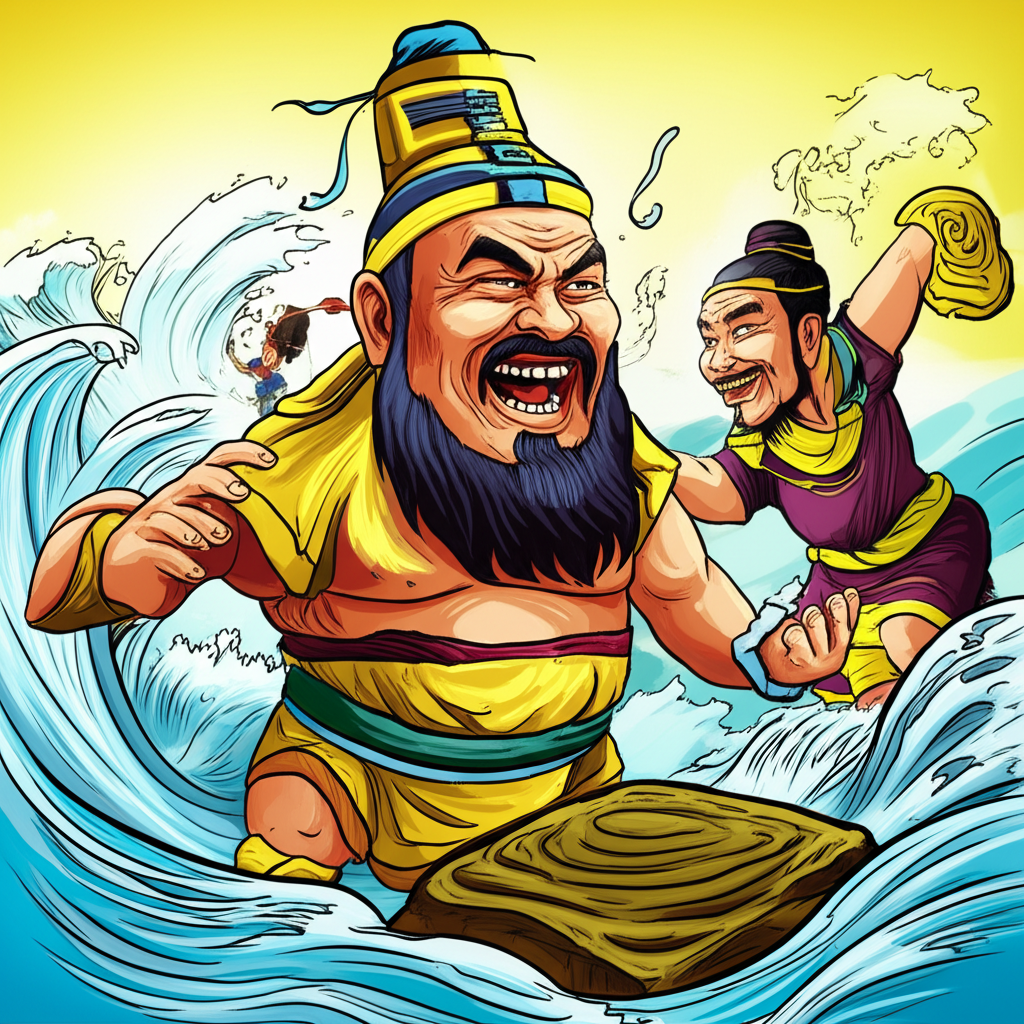
In the vast tapestry of ancient Chinese mythology, where mountains breathed and rivers held sentient spirits, stories of creation and cosmic order are woven with vivid imagination. Among these, the legend of the Flood of Gun and Yu stands as a powerful, albeit fantastical, narrative explaining the genesis of the world as the ancient Chinese understood it, particularly the formation of the "Four Seas" – a concept that encompassed not just the oceans but the entirety of the known world. This is a traditional story, a product of human ingenuity and an attempt to make sense of a chaotic and awe-inspiring natural world through the lens of allegory and myth.
The era in which these tales likely took root was one of profound societal transformation and a deep connection with the rhythms of nature. Imagine a time when agriculture was paramount, where the capricious generosity and destructive fury of rivers dictated the very survival of communities. The ancient Chinese, living in fertile river valleys like the Yellow River and the Yangtze, would have witnessed firsthand the devastating power of floods, the constant threat of inundation, and the arduous task of reclaiming land for cultivation. Their worldview was deeply animistic and pantheistic; spirits were believed to inhabit natural phenomena, and deities, often anthropomorphic, were thought to govern the elements. The world was not a sterile, mechanical entity, but a vibrant, living system where human actions could appease or anger powerful forces. In this context, a monumental flood would not be a mere meteorological event, but a cosmic upheaval, a test of divine will, and a call for extraordinary human endeavor.
Central to this saga are two figures, Gun and his son Yu, who are depicted as legendary heroes tasked with managing the Great Flood. Gun, often portrayed as a wise but ultimately flawed figure, is described as possessing immense knowledge of earth and water. He is said to have had a connection to the celestial realm, sometimes depicted as having scales on his body or a dragon-like form, symbolizing his mastery over the watery elements. His ambition was immense, his methods, however, proved to be ultimately insufficient. Yu, his son, inherits his father’s burden but embodies a different kind of leadership. He is characterized by his perseverance, his relentless dedication, and his deep empathy for the suffering of the people. His symbolic attributes are those of tireless labor, strategic planning, and unwavering resolve. He is the archetypal diligent ruler, the one who toils for the common good, often depicted with the tools of his trade – a shovel, a pickaxe, and a measuring rod – signifying his practical approach to problem-solving.
The narrative begins with a cataclysmic flood that engulfs the land. The waters rise relentlessly, swallowing mountains, drowning villages, and bringing despair to the people. The heavens weep, the earth trembles, and humanity faces annihilation. It is in this dire hour that Gun is tasked with the monumental undertaking of controlling the deluge. He employs his knowledge, attempting to build dams and dikes to stem the relentless tide. However, his efforts are ultimately in vain. The sheer power of the flood overwhelms his defenses. The myth suggests that Gun’s methods were akin to trying to contain the uncontainable, perhaps symbolizing an overreliance on brute force or an incomplete understanding of the forces at play. After years of struggle, Gun is said to have failed, and in some versions, is punished by being exiled or even transformed into a beast, a stark reminder of the consequences of ambition without ultimate success.
It is then that Yu, Gun’s son, steps into the breach. Unlike his father, Yu’s approach is one of channeling and guiding the waters rather than simply damming them. He embarks on an epic journey, traversing the flooded lands, meticulously digging channels and canals to direct the raging rivers towards the sea. For thirteen long years, Yu toils without rest, his body hardened by labor, his spirit unwavering. He works alongside his people, sharing their hardships, and demonstrating a profound commitment to their welfare. He is said to have visited every corner of the land, charting the course of the waters, and establishing the intricate network of waterways that would shape the landscape. Through his immense effort and ingenious engineering, Yu successfully manages to drain the floodwaters, carving out the rivers and establishing the boundaries of the land. The "Four Seas" – the mythical oceans that encircled the known world – are understood to have been formed and defined by this monumental act of flood control, becoming the ultimate destination for the waters Yu so diligently channeled. This act of taming the wild forces of nature and establishing order signifies the birth of civilization and the establishment of a stable, habitable world.
The symbolism within the Flood of Gun and Yu is rich and multifaceted. The Great Flood itself can be interpreted as representing primal chaos, the untamed power of nature, and the existential threats that ancient societies faced. Gun’s struggle and eventual failure might symbolize the limitations of human power when confronting overwhelming natural forces, or perhaps a cautionary tale about pride and an incomplete understanding of complex systems. Yu’s triumph, on the other hand, represents the triumph of human perseverance, ingenuity, wisdom, and selfless leadership. His dedication to his people and his meticulous, methodical approach embody the ideals of good governance and the establishment of order. The act of digging canals and defining the boundaries of the land can be seen as a metaphor for the formation of civilization itself – the structuring of society, the establishment of territories, and the creation of a predictable and manageable world. The "Four Seas" represent not just geographical expanses but the entirety of the cosmos as understood by these ancient peoples, a world brought into being through the heroic efforts of Yu.
In the modern world, the myth of Gun and Yu continues to resonate, albeit through a different lens. It is a cornerstone of Chinese folklore and mythology, studied in literature, history, and cultural studies programs. The narrative has been retold in countless books, poems, and dramatic performances, each interpretation offering new insights into its enduring themes. In popular culture, elements of the myth can be found in video games and animated series, where the figures of Gun and Yu might be reimagined as powerful demigods or heroic figures battling natural disasters. These modern interpretations often focus on the epic scale of the struggle, the ingenuity of the solutions, and the unwavering determination of the protagonists, reflecting a continued fascination with tales of overcoming immense adversity.
It is crucial to reiterate that the Flood of Gun and Yu is a traditional story, a product of ancient imagination and a way for people to understand their world. It is not a factual account, nor is it intended for belief or worship. As Muslims, we recognize that the true Creator and Sustainer of all existence is Allah (God) alone. He is the ultimate power behind the universe and all its phenomena. This ancient Chinese legend, therefore, serves as a fascinating window into the cultural heritage, the storytelling traditions, and the deep-seated human desire to explain the inexplicable through narrative. It speaks to our collective need to find meaning in the face of chaos, to celebrate the power of human resilience, and to acknowledge the enduring impact of imagination on shaping our understanding of the world and our place within it. The tales of Gun and Yu, like countless other myths from across the globe, remind us of the richness of human cultural expression and the timeless power of a well-told story.